


Features of triple-negative breast cancer: Analysis of 38,813 cases from the national cancer database
- PMID: 27583878
- PMCID: PMC5008562
- DOI: 10.1097/MD.0000000000004614
Features of triple-negative breast cancer: Analysis of 38,813 cases from the national cancer database
Abstract
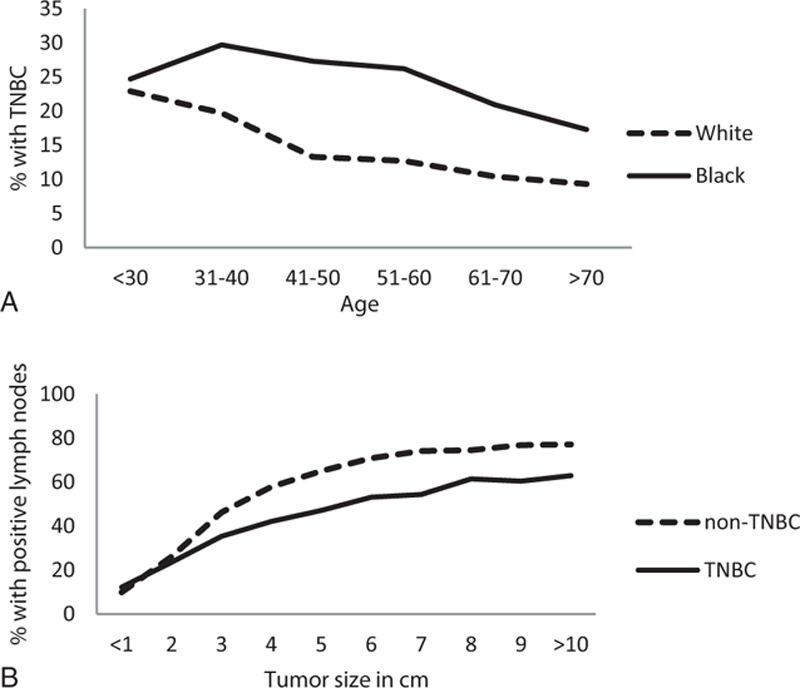
The aim of this study was to determine the features of triple-negative breast cancer (TNBC) using a large national database. TNBC is known to be an aggressive subtype, but national epidemiologic data are sparse. All patients with invasive breast cancer and known molecular subtype diagnosed in 2010 to 2011 were identified from the National Cancer Data Base (NCDB). Patients with and without TNBC were compared with respect to their sociodemographic and clinicopathologic features. TNBC was present in 38,628 of 295,801 (13%) female patients compared to 185 of 3136 (6%) male patients (P < 0.001). The incidence of TNBC varied by region from 10.8% in New England to 15.8% in the east south central US (P < 0.001), as well as by race with the highest rates in African-Americans (23.7%), and lowest in Filipino patients (8.9%). The incidence of TNBC also varied by histology, accounting for 76% of metaplastic cancers, but only 2% of infiltrating lobular carcinomas. TNBCs were significantly larger than non-TNBC (mean 2.8 cm vs 2.1 cm, P < 0.001), and more TNBC were poorly differentiated compared to other subtypes (79.7% vs 25.8%, P < 0.001). On univariate analysis, TNBC was no more likely than non-TNBC to have node-positive disease (32.0% vs 31.7%, respectively, P = 0.218) but in a multivariable analysis controlling for tumor size and grade, TNBC was associated with significantly less node-positivity (OR = 0.59; 95% confidence interval [CI]: 0.57-0.60). TNBC has distinct features regarding age, gender, geographic, and racial distribution. Compared to non-TNBC, TNBC is larger and higher grade, but less likely to have lymph node metastases.
Conflict of interest statement
The authors have no conflicts of interest to declare.
Figures
References
-
- Newman LA, Reis-Filho JS, Morrow M, et al. The 2014 society of surgical oncology susan g. Komen for the cure symposium: triple-negative breast cancer. Ann Surg Oncol 2015; 22:874–882. - PubMed
-
- Cancello G, Maisonneuve P, Rotmensz N, et al. Prognosis in women with small (T1mic,T1a,T1b) node-negative operable breast cancer by immunohistochemically selected subtypes. Breast Cancer Res Treat 2011; 127:713–720. - PubMed
-
- Duffy MJ, McGowan PM, Crown J. Targeted therapy for triple-negative breast cancer: where are we? Int J Cancer 2012; 131:2471–2477. - PubMed
MeSH terms
Grants and funding
LinkOut - more resources
Full Text Sources
Other Literature Sources
Medical
