Methods for assessing the quality of mammalian embryos: How far we are from the gold standard?
- PMID: 27584609
- PMCID: PMC5264381
- DOI: 10.5935/1518-0557.20160033
Methods for assessing the quality of mammalian embryos: How far we are from the gold standard?
Abstract
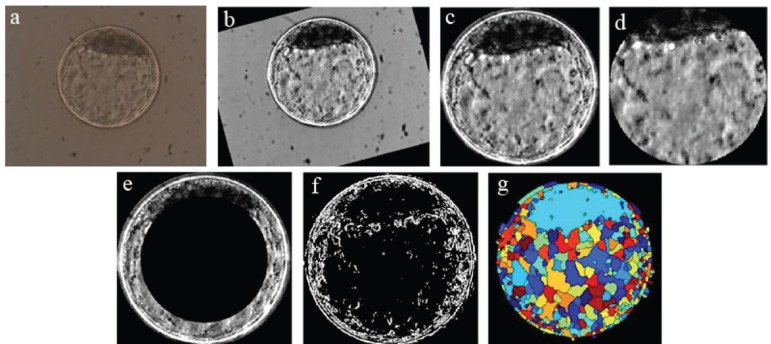
Morphological embryo classification is of great importance for many laboratory techniques, from basic research to the ones applied to assisted reproductive technology. However, the standard classification method for both human and cattle embryos, is based on quality parameters that reflect the overall morphological quality of the embryo in cattle, or the quality of the individual embryonic structures, more relevant in human embryo classification. This assessment method is biased by the subjectivity of the evaluator and even though several guidelines exist to standardize the classification, it is not a method capable of giving reliable and trustworthy results. Latest approaches for the improvement of quality assessment include the use of data from cellular metabolism, a new morphological grading system, development kinetics and cleavage symmetry, embryo cell biopsy followed by pre-implantation genetic diagnosis, zona pellucida birefringence, ion release by the embryo cells and so forth. Nowadays there exists a great need for evaluation methods that are practical and non-invasive while being accurate and objective. A method along these lines would be of great importance to embryo evaluation by embryologists, clinicians and other professionals who work with assisted reproductive technology. Several techniques shows promising results in this sense, one being the use of digital images of the embryo as basis for features extraction and classification by means of artificial intelligence techniques (as genetic algorithms and artificial neural networks). This process has the potential to become an accurate and objective standard for embryo quality assessment.
Keywords: Embryo quality assessment; artificial intelligence; mammalian embryo; morphological evaluation.
Conflict of interest statement
CONFLICT OF INTERESTS No conflict of interest have been declared.
Figures
References
-
- Arce JC, Ziebe S, Lundin K, Janssens R, Helmgaard L, Sørensen P. Interobserver agreement and intraobserver reproducibility of embryo quality assessments. Hum Reprod. 2006;21:2141–2148. - PubMed
-
- Atherton TJ, Kerbyson DJ. Size invariant circle detection. Image Vision Comput. 1999;17:795–803.
-
- Balaban B, Urman B, Sertac A, Alatas C, Aksoy S, Mercan R. Blastocyst quality affects the success of blastocyst-stage embryo transfer. Fertil Steril. 2000;74:282–287. - PubMed
-
- Balaban B, Yakin K, Urman B. Randomized comparison of two different blastocyst grading systems. Fertil Steril. 2006;85:559–563. - PubMed
-
- Bényei B, Komlósi I, Pécsi A, Pollot G, Marcos CH, Campos AO, Lemes MP. The effect of internal and external factors on bovine embryo transfer results in a tropical environment. Anim Reprod Sci. 2006;93:268–279. - PubMed
Publication types
MeSH terms
LinkOut - more resources
Full Text Sources
Other Literature Sources
Medical