


Microcircuits in respiratory rhythm generation: commonalities with other rhythm generating networks and evolutionary perspectives
- PMID: 27589601
- PMCID: PMC5495096
- DOI: 10.1016/j.conb.2016.08.003
Microcircuits in respiratory rhythm generation: commonalities with other rhythm generating networks and evolutionary perspectives
Abstract
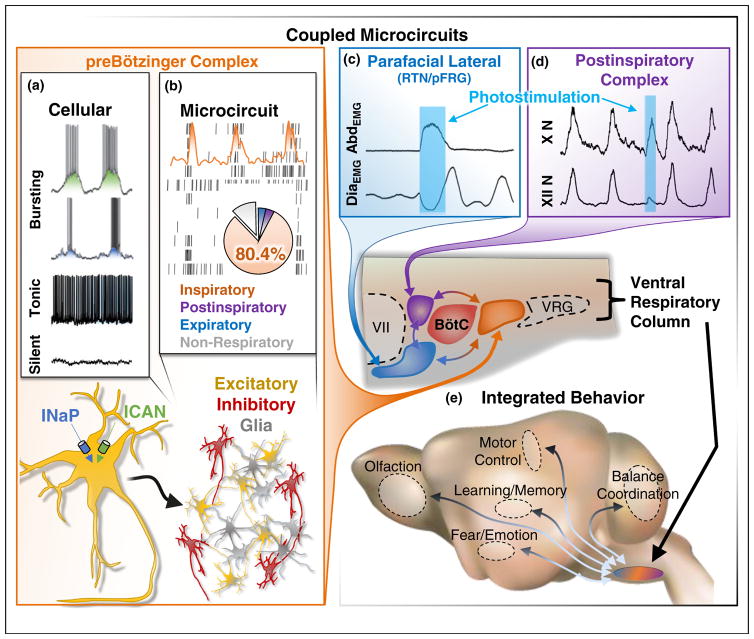
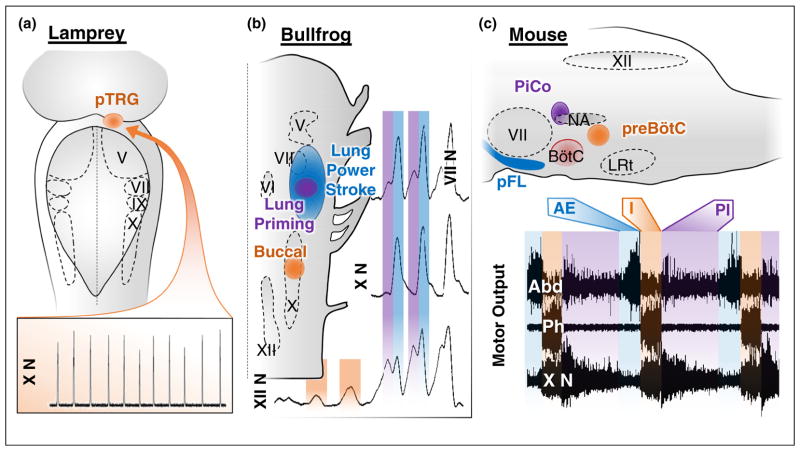
Rhythmicity is critical for the generation of rhythmic behaviors and higher brain functions. This review discusses common mechanisms of rhythm generation, including the role of synaptic inhibition and excitation, with a focus on the mammalian respiratory network. This network generates three phases of breathing and is highly integrated with brain regions associated with numerous non-ventilatory behaviors. We hypothesize that during evolution multiple rhythmogenic microcircuits were recruited to accommodate the generation of each breathing phase. While these microcircuits relied primarily on excitatory mechanisms, synaptic inhibition became increasingly important to coordinate the different microcircuits and to integrate breathing into a rich behavioral repertoire that links breathing to sensory processing, arousal, and emotions as well as learning and memory.
Copyright © 2016. Published by Elsevier Ltd.
Conflict of interest statement
The authors do not have any conflict of interest.
Figures
References
-
- Ramirez JM, Tryba AK, Pena F. Pacemaker neurons and neuronal networks: an integrative view. Curr Opin Neurobiol. 2004;14:665–674. - PubMed
-
- Butler JL, Paulsen O. Hippocampal network oscillations –recent insights from in vitro experiments. Curr Opin Neurobiol. 2015;31:40–44. - PubMed
-
- Wagenaar DA. A classic model animal in the 21st century: recent lessons from the leech nervous system. J Exp Biol. 2015;218:3353–3359. - PubMed
Publication types
MeSH terms
Grants and funding
LinkOut - more resources
Full Text Sources
Other Literature Sources
