


Distribution of High-Sensitivity C-Reactive Protein and Its Relationship with Other Cardiovascular Risk Factors in the Middle-Aged Chinese Population
- PMID: 27589783
- PMCID: PMC5036705
- DOI: 10.3390/ijerph13090872
Distribution of High-Sensitivity C-Reactive Protein and Its Relationship with Other Cardiovascular Risk Factors in the Middle-Aged Chinese Population
Abstract
Background: An increased concentration of high-sensitivity C-reactive protein (hs-CRP) indicates risk for cardiovascular disease (CVD). Because the available data is limited, a cross-sectional survey was conducted in 2009-2010 to describe hs-CRP distribution and its relationship with established CVD risk factors.
Methods: A population-based sample of adults aged 35 to 64 years (n = 14,046) was taken from 12 research populations across China. Demographic and clinical characteristics were recorded, and hs-CRP measured. Pearson's and Kendall's tau-b correlation coefficient, and multiple regression analyses were used to test the relationship between hs-CRP and other CVD risk factors.
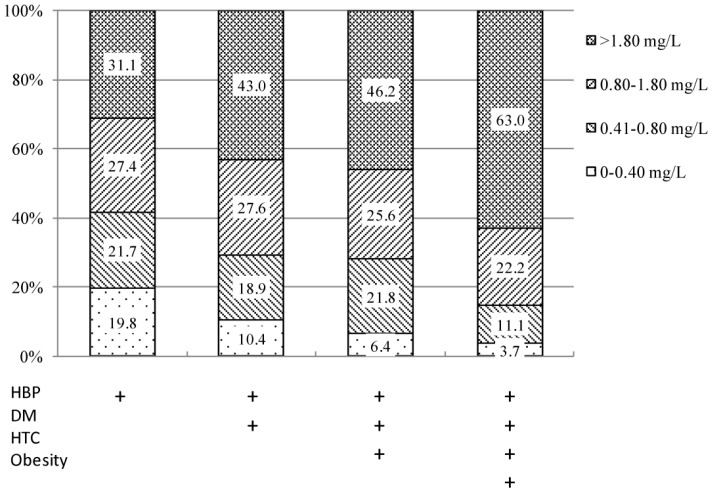
Results: For 8389 (4412 females) eligible participants, hs-CRP was 1.89 ± 4.37 mg/L (median (25th, 75th): 0.80 (0.40, 1.80)), and increased with age, BP, glucose, and BMI (p < 0.05), males had significantly higher hs-CRP than females (2.07 (4.89) vs. 1.73 (3.83), p < 0.001). About 24.3% had the hs-CRP concentrations more than the top quartile (25.8% in males, 22.9% in females), 12.3% (13.3% in males, 11.5% in females) >3 mg/L. There was a significant positive correlation of quartiles of hs-CRP concentrations with age, SBP, DBP, glucose level, BMI, LDL-C/HDL-C ratio, and LDL-C/total cholesterol ratio (p < 0.001). The elevated hs-CRP (>1.80 mg/L) related positively with age, LDL-C, BP, glucose, BMI, and living north and negatively with HDL-C/TC, LDL-C/TC, TC independently (p < 0.05). For subjects with coexisting hypertension, diabetes, high cholesterol, and obesity, about 63.0% were in the top quartile of hs-CRP concentrations.
Conclusions: Hs-CRP was associated with most of the known CVD risk factors. Measurement of hs-CRP may provide a more comprehensive view of the patient's overall risk profile in the Chinese population.
Keywords: blood pressure; cardiovascular disease; high-sensitivity C-reactive protein; risk factor.
Conflict of interest statement
The authors declare no conflict of interest.
Figures
References
-
- Hu S.S., Kong L.Z., Gao R.L., Zhu M.L., Wang W., Wang Y.J., Wu Z.S., Chen W.W., Liu M.B. Outline of the report on cardiovascular disease in China, 2010. Biomed. Environ. Sci. 2012;25:251–256. - PubMed
-
- Tunstall-Pedoe H., Vanuzzo D., Hobbs M., Mahonen M., Cepaitis Z., Kuulasmaa K., Keil U. Estimation of contribution of changes in coronary care to improving survival, event rates, and coronary heart disease mortality across the WHO MONICA Project populations. Lancet. 2000;355:688–700. doi: 10.1016/S0140-6736(99)11181-4. - DOI - PubMed
-
- Greenland P., Alpert J.S., Beller G.A., Benjamin E.J., Budoff M.J., Fayad Z.A., Foster E., Hlatky M.A., Hodgson J.M., Kushner F.G., et al. 2010 ACCF/AHA guideline for assessment of cardiovascular risk in asymptomatic adults: A report of the American College of Cardiology Foundation/American Heart Association Task Force on practice guidelines. J. Am. Coll. Cardiol. 2010;56:e50–e103. doi: 10.1016/j.jacc.2010.09.001. - DOI - PubMed
MeSH terms
Substances
LinkOut - more resources
Full Text Sources
Other Literature Sources
Medical
Research Materials
Miscellaneous
