


Diastolic Blood Pressure, Subclinical Myocardial Damage, and Cardiac Events: Implications for Blood Pressure Control
- PMID: 27590090
- PMCID: PMC5089057
- DOI: 10.1016/j.jacc.2016.07.754
Diastolic Blood Pressure, Subclinical Myocardial Damage, and Cardiac Events: Implications for Blood Pressure Control
Abstract
Background: The optimal systolic blood pressure (SBP) treatment goal is in question, with SPRINT (Systolic Blood Pressure Intervention Trial) suggesting benefit for 120 mm Hg. However, achieving an SBP this low may reduce diastolic blood pressure (DBP) to levels that could compromise myocardial perfusion.
Objectives: This study sought to examine the independent association of DBP with myocardial damage (using high-sensitivity cardiac troponin-T [hs-cTnT]) and with coronary heart disease (CHD), stroke, or death over 21 years.
Methods: The authors studied 11,565 adults from the ARIC (Atherosclerosis Risk In Communities) cohort, analyzing DBP and hs-cTnT associations as well as prospective associations between DBP and events.
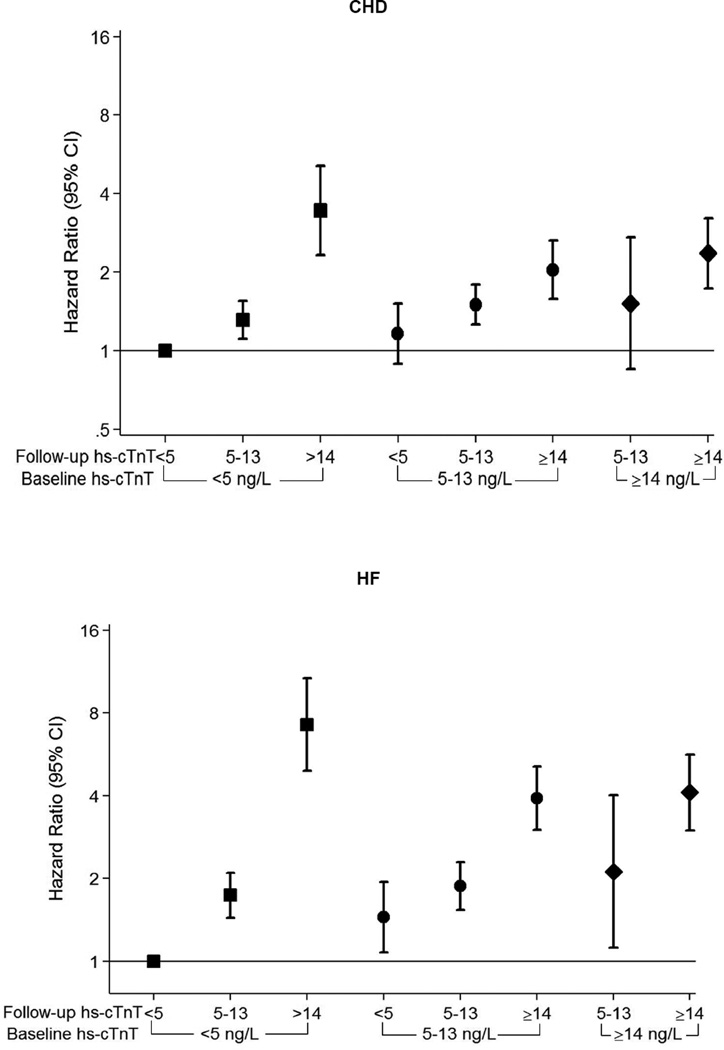
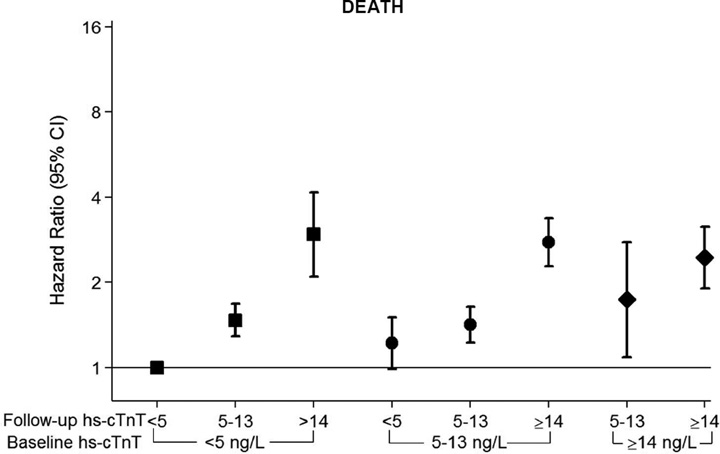
Results: Mean baseline age was 57 years, 57% of patients were female, and 25% were black. Compared with persons who had DBP between 80 to 89 mm Hg at baseline (ARIC visit 2), the adjusted odds ratio of having hs-cTnT ≥14 ng/l at that visit was 2.2 and 1.5 in those with DBP <60 mm Hg and 60 to 69 mm Hg, respectively. Low DBP at baseline was also independently associated with progressive myocardial damage on the basis of estimated annual change in hs-cTnT over the 6 years between ARIC visits 2 and 4. In addition, compared with a DBP of 80 to 89 mm Hg, a DBP <60 mm Hg was associated with incident CHD and mortality, but not with stroke. The DBP and incident CHD association was strongest with baseline hs-cTnT ≥14 ng/l (p value for interaction <0.001). Associations of low DBP with prevalent hs-cTnT and incident CHD were most pronounced among patients with baseline SBP ≥120 mm Hg.
Conclusions: Particularly among adults with an SBP ≥120 mm Hg, and thus elevated pulse pressure, low DBP was associated with subclinical myocardial damage and CHD events. When titrating treatment to SBP <140 mm Hg, it may be prudent to ensure that DBP levels do not fall below 70 mm Hg, and particularly not below 60 mm Hg.
Keywords: J-curve; coronary heart disease; coronary perfusion; high-sensitivity troponin; hypertension.
Copyright © 2016 American College of Cardiology Foundation. Published by Elsevier Inc. All rights reserved.
Conflict of interest statement
The other authors declare no commercial conflicts of interest (but receive National Institutes of Health grant funding).
Figures
Comment in
-
Troponin and the J-Curve of Diastolic Blood Pressure: When Lower Is Not Better.J Am Coll Cardiol. 2016 Oct 18;68(16):1723-1726. doi: 10.1016/j.jacc.2016.08.007. Epub 2016 Aug 30. J Am Coll Cardiol. 2016. PMID: 27590091 No abstract available.
-
New evidence for the diastolic J-curve effect challenges the safety of intensive blood pressure control.J Clin Hypertens (Greenwich). 2017 Apr;19(4):340-343. doi: 10.1111/jch.12962. Epub 2017 Jan 2. J Clin Hypertens (Greenwich). 2017. PMID: 28042913 Free PMC article. No abstract available.
-
Diastolic Blood Pressure and Myocardial Damage: What About Coronary Perfusion Time?J Am Coll Cardiol. 2017 Mar 28;69(12):1645-1646. doi: 10.1016/j.jacc.2016.11.086. J Am Coll Cardiol. 2017. PMID: 28335849 No abstract available.
-
Diastolic Hypotension and Myocardial Ischemia: A Reason to Remember Cuff Artifact in Blood Pressure Measurement.J Am Coll Cardiol. 2017 Mar 28;69(12):1646-1647. doi: 10.1016/j.jacc.2016.11.085. J Am Coll Cardiol. 2017. PMID: 28335850 No abstract available.
-
The Role of Heart Rate in Diastolic Coronary Perfusion and Subclinical Myocardial Ischemia.J Am Coll Cardiol. 2017 Mar 28;69(12):1647. doi: 10.1016/j.jacc.2016.11.087. J Am Coll Cardiol. 2017. PMID: 28335851 No abstract available.
-
In the Treatment of Hypertension, Lowering of Diastolic Pressure to <70 mm Hg Is Often Unavoidable.J Am Coll Cardiol. 2017 Mar 28;69(12):1647-1648. doi: 10.1016/j.jacc.2016.11.083. J Am Coll Cardiol. 2017. PMID: 28335852 No abstract available.
-
Reply: Diastolic Blood Pressure: Myocardial Damage and Coronary Ischemic Events.J Am Coll Cardiol. 2017 Mar 28;69(12):1648-1649. doi: 10.1016/j.jacc.2016.12.040. J Am Coll Cardiol. 2017. PMID: 28335853 No abstract available.
-
Systolic blood pressure targets, diastolic J curve and cuff artefact in blood pressure measurement: a note of caution.Eur J Neurol. 2017 Nov;24(11):1323-1325. doi: 10.1111/ene.13442. Epub 2017 Sep 22. Eur J Neurol. 2017. PMID: 28887862 No abstract available.
References
-
- Kannel WB, Gordon T, Schwartz MJ. Systolic versus diastolic blood pressure and risk of coronary heart disease. The Framingham study. The American journal of cardiology. 1971;27:335–346. - PubMed
-
- Rosenman RH, Sholtz RI, Brand RJ. A study of comparative blood pressure measures in predicting risk of coronary heart disease. Circulation. 1976;54:51–58. - PubMed
-
- James PA, Oparil S, Carter BL, et al. 2014 evidence-based guideline for the management of high blood pressure in adults: report from the panel members appointed to the Eighth Joint National Committee (JNC 8) JAMA : the journal of the American Medical Association. 2014;311:507–520. - PubMed
-
- Wright JT, Jr, Fine LJ, Lackland DT, Ogedegbe G, Dennison Himmelfarb CR. Evidence supporting a systolic blood pressure goal of less than 150 mm Hg in patients aged 60 years or older: the minority view. Annals of internal medicine. 2014;160:499–503. - PubMed
Publication types
MeSH terms
Substances
Grants and funding
- HHSN268201100012C/HL/NHLBI NIH HHS/United States
- HHSN268201100009I/HL/NHLBI NIH HHS/United States
- HHSN268201100010C/HL/NHLBI NIH HHS/United States
- HHSN268201100008C/HL/NHLBI NIH HHS/United States
- HHSN268201100005G/HL/NHLBI NIH HHS/United States
- HHSN268201100008I/HL/NHLBI NIH HHS/United States
- R01 DK089174/DK/NIDDK NIH HHS/United States
- HHSN268201100007C/HL/NHLBI NIH HHS/United States
- HHSN268201100011I/HL/NHLBI NIH HHS/United States
- HHSN268201100011C/HL/NHLBI NIH HHS/United States
- T32 HL007024/HL/NHLBI NIH HHS/United States
- HHSN268201100006C/HL/NHLBI NIH HHS/United States
- HHSN268201100005I/HL/NHLBI NIH HHS/United States
- K24 DK106414/DK/NIDDK NIH HHS/United States
- HHSN268201100009C/HL/NHLBI NIH HHS/United States
- HHSN268201100005C/HL/NHLBI NIH HHS/United States
- HHSN268201100007I/HL/NHLBI NIH HHS/United States
LinkOut - more resources
Full Text Sources
Other Literature Sources
Medical
Research Materials
Miscellaneous
