


Hepatocellular Carcinoma Risk in Alaska Native Children and Young Adults with Hepatitis B Virus: Retrospective Cohort Analysis
- PMID: 27590612
- PMCID: PMC5085839
- DOI: 10.1016/j.jpeds.2016.08.017
Hepatocellular Carcinoma Risk in Alaska Native Children and Young Adults with Hepatitis B Virus: Retrospective Cohort Analysis
Abstract
Objectives: To evaluate the hepatocellular carcinoma (HCC) risk in Alaska Native children and young adults with hepatitis B virus (HBV).
Study design: Retrospective analysis of a population-based cohort of Alaska Native persons with HBV followed during 1982-2012. All individuals with HBV were offered HCC screening regardless of age using alpha-fetoprotein every 6 months; persons with an elevated alpha-fetoprotein or persons at high-risk for HCC, such as cirrhosis, family history of HCC, were offered ultrasound. We calculated the HCC incidence/1000 person-years from date of cohort entry until death, diagnosis of HCC, or attaining the age of 40 years (males) or 50 years (females).
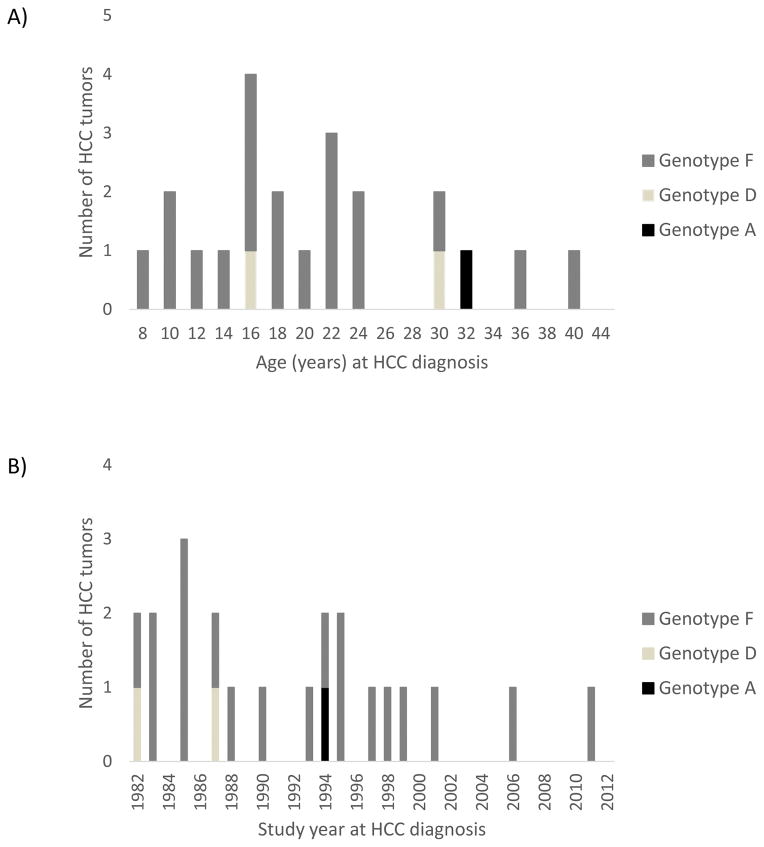
Results: We followed 1083 subjects with HBV (56% male) comprising 5 genotypes (A2 [12.5%], B6 [1.7%], C [5.3%], D [49.7%], F1 [18.6%], unknown [12.4%]) for a median of 23.4 years/person. We observed 22 HCC cases (incidence/1000 person-years follow-up: 1.0); 19 HCC cases among persons with genotype F1. There was no significant difference in HCC incidence between males (1.4) and females (0.6). The HCC incidence was significantly higher for persons with genotype F1 (4.4) compared with genotype A2 (0.4) and D (0.2) and remained higher among persons with HBV genotype F1 excluding persons with HCC family history/cirrhosis (1.9).
Conclusions: Alaska Native children and young adults with HBV genotype F1 are at high risk for HCC and should receive HCC surveillance. For males <40 years of age and females <50 years of age with HBV in regions of the world with a high genotype F prevalence, testing/confirming genotype F can identify persons who could benefit from HCC surveillance.
Keywords: cancer screening; cohort study; diagnosis; epidemiology; incidence study.
Published by Elsevier Inc.
Conflict of interest statement
None of the authors have any conflicts to disclose. No honoraria, grants, or other forms of payment were given to any of the authors to produce the manuscript.
Figures
References
-
- Goldstein ST, Zhou F, Hadler SC, Bell BP, Mast EE, Margolis HS. A mathematical model to estimate global hepatitis B disease burden and vaccination impact. Int J Epidemiol. 2005;34:1329–39. - PubMed
-
- Wasley A, Kruszon-Moran D, Kuhnert W, Simard EP, Finelli L, McQuillan G, et al. The Prevalence of Hepatitis B Virus Infection in the United States in the Era of Vaccination. Journal of Infectious Diseases. 2010;202:192–201. - PubMed
-
- McMahon BJ, Rhoades ER, Heyward WL, Tower E, Ritter D, Lanier AP, et al. A comprehensive programme to reduce the incidence of hepatitis B virus infection and its sequelae in Alaskan natives. Lancet. 1987;2:1134–6. - PubMed
-
- McMahon BJ, Bulkow L, Harpster A, Snowball M, Lanier A, Sacco F, et al. Screening for hepatocellular carcinoma in Alaska natives infected with chronic hepatitis B: a 16-year population-based study. Hepatology. 2000;32:842–6. - PubMed
MeSH terms
Substances
Grants and funding
LinkOut - more resources
Full Text Sources
Other Literature Sources
Medical
