


Airborne spread of infectious agents in the indoor environment
- PMID: 27590694
- PMCID: PMC7115322
- DOI: 10.1016/j.ajic.2016.06.003
Airborne spread of infectious agents in the indoor environment
Abstract
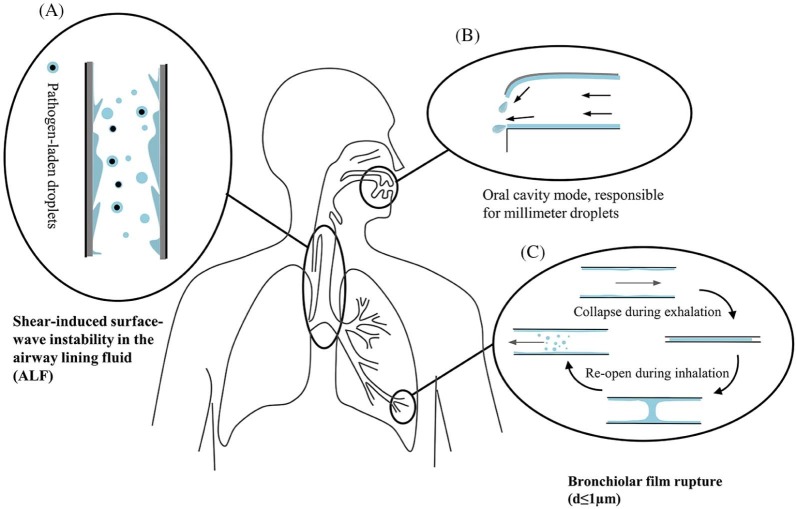
Background: Since the 2003 severe acute respiratory syndrome epidemic, scientific exploration of infection control is no longer restricted to microbiologists or medical scientists. Many studies have reported on the release, transport, and exposure of expiratory droplets because of respiratory activities. This review focuses on the airborne spread of infectious agents from mucus to mucus in the indoor environment and their spread as governed by airflows in the respiratory system, around people, and in buildings at different transport stages.
Methods: We critically review the literature on the release of respiratory droplets, their transport and dispersion in the indoor environment, and the ultimate exposure of a susceptible host, as influenced by airflows.
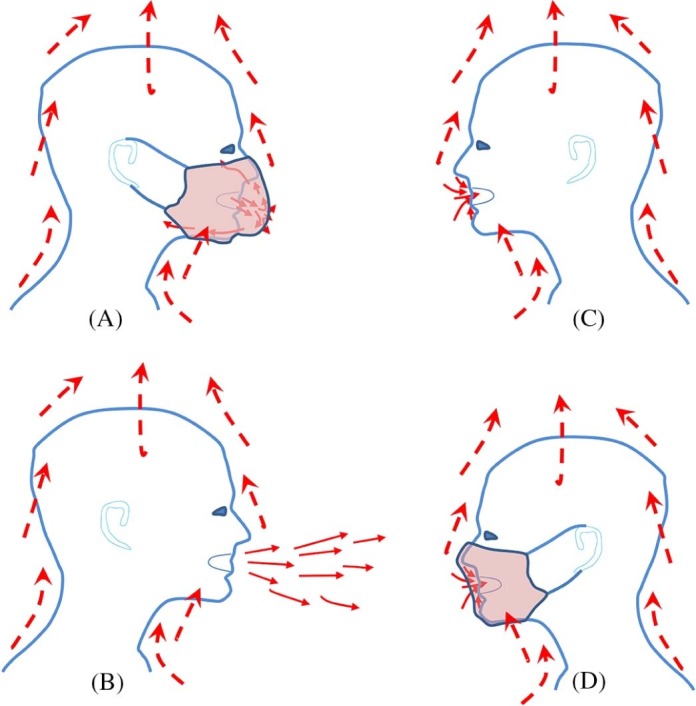
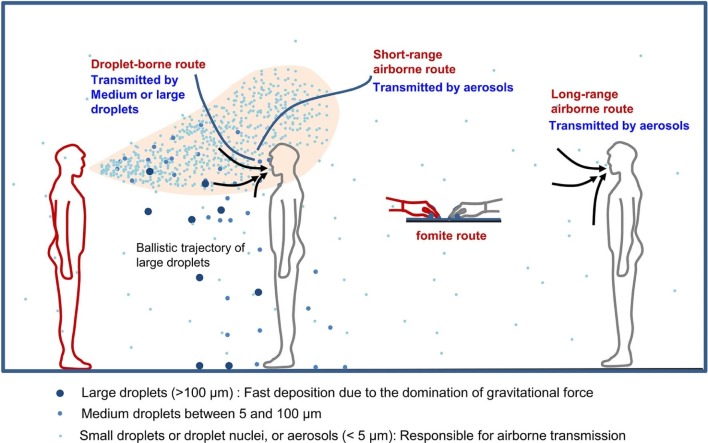
Results: These droplets or droplet nuclei are transported by expired airflows, which are sometimes affected by the human body plume and use of a face mask, as well as room airflow. Room airflow is affected by human activities such as walking and door opening, and some droplets are eventually captured by a susceptible individual because of his or her inspired flows; such exposure can eventually lead to long-range spread of airborne pathogens. Direct exposure to the expired fine droplets or droplet nuclei results in short-range airborne transmission. Deposition of droplets and direct personal exposure to expired large droplets can lead to the fomite route and the droplet-borne route, respectively.
Conclusions: We have shown the opportunities for infection control at different stages of the spread. We propose that the short-range airborne route may be important in close contact, and its control may be achieved by face masks for the source patients and use of personalized ventilation. Our discussion of the effect of thermal stratification and expiratory delivery of droplets leads to the suggestion that displacement ventilation may not be applicable to hospital rooms where respiratory infection is a concern.
Keywords: Respiratory droplet; coughing; droplet dispersion; environmental ventilation; indoor air; infection control.
Copyright © 2016 Association for Professionals in Infection Control and Epidemiology, Inc. Published by Elsevier Inc. All rights reserved.
Figures

References
-
- Yu I.T.S., Li Y., Wong T.W., Tam W., Chan A.T., Lee J.H. Evidence of airborne transmission of the severe acute respiratory syndrome virus. N Engl J Med. 2004;350:1731–1739. - PubMed
-
- Fitzgerald D., Haas D. Mycobacterium tuberculosis. In: Mandell G.L., Bennett J.E., Dolin R., editors. Principles and practice of infectious diseases. 6th ed. Churchill Livingstone; Philadelphia (PA): 2005. pp. 2852–2886.
-
- Hunt J.C.R., Delfos R., Eames I., Perkins R.J. Vortices, complex flows and inertial particles. Flow Turbul Combust. 2007;79:207–234.
-
- Morawska L. Droplet fate in indoor environments, or can we prevent the spread of infection? Indoor Air. 2006;16:335–347. - PubMed
Publication types
MeSH terms
Substances
LinkOut - more resources
Full Text Sources
Other Literature Sources
Medical
