


Health facility factors and quality of services to prevent mother-to-child HIV transmission in Côte d'Ivoire, Kenya, and Mozambique
- PMID: 27590913
- PMCID: PMC5512542
- DOI: 10.1177/0956462416668766
Health facility factors and quality of services to prevent mother-to-child HIV transmission in Côte d'Ivoire, Kenya, and Mozambique
Abstract
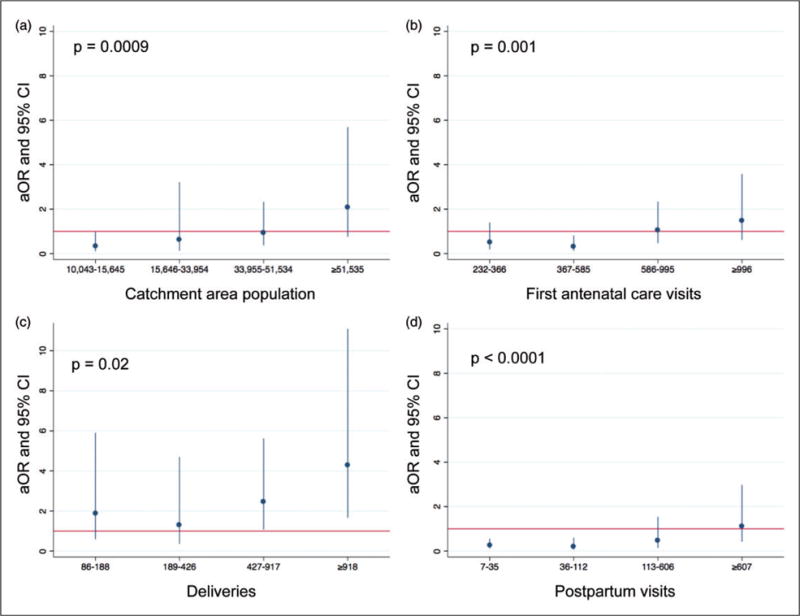
This study aimed to identify facility-level characteristics associated with prevention of mother-to-child HIV transmission service quality. This cross-sectional study sampled 60 health facilities in Mozambique, Côte d'Ivoire, and Kenya (20 per country). Performance score - the proportion of pregnant women tested for HIV in first antenatal care visit, multiplied by the proportion of HIV-positive pregnant women who received appropriate antiretroviral medications - was calculated for each facility using routine data from 2012 to 2013. Facility characteristics were ascertained during on-site visits, including workload. Associations between facility characteristics and performance were quantified using generalized linear models with robust standard errors, adjusting for country. Over six months, facilities saw 38,611 first antenatal care visits in total. On-site CD4 testing, Pima CD4 machine, air conditioning, and low or high (but not mid-level) patient volume were each associated with higher performance scores. Each additional first antenatal care visit per nurse per month was associated with a 4% (95% confidence interval: 1%-6%) decline in the odds that an HIV-positive pregnant woman would receive both HIV testing and antiretroviral medications. Physician workload was only modestly associated with performance. Investments in infrastructure and human resources - particularly nurses - may be critical to improve prevent mother-to-child HIV transmission service delivery and protect infants from HIV.
Keywords: Africa; HIV; highly active antiretroviral therapy; prevention; women.
Conflict of interest statement
The author(s) declared no potential conflicts of interest with respect to the research, authorship, and/or publication of this article.
Figures
References
-
- Forbes JC, Alimenti AM, Singer J, et al. A national review of vertical HIV transmission. AIDS. 2012;26:757–763. - PubMed
-
- UNAIDS. Global report: UNAIDS report on the global AIDS epidemic 2013. 2013 Nov; Available at: http://www.unaids.org/sites/default/files/media_asset/UNAIDS_Global_Repo... (accessed August 2016)
-
- WHO. Everybody’s business: strengthening health systems to improve health outcomes: WHO’S framework for action. Geneva: WHO; 2007.
-
- Moorison JS, Moore A. Health worker shortages challenge PEPFAR options for strengthening health systems: A report of the Task Force on HIV/AIDS. Washington, DC: Center for Strategic and International Studies; Sep, 2007. Available at: https://csis-prod.s3.amazonaws.com/s3fs-public/legacy_files/files/media/... (accessed 30 August 2016)
Publication types
MeSH terms
Substances
Associated data
Grants and funding
LinkOut - more resources
Full Text Sources
Other Literature Sources
Medical
Research Materials
