


Review
doi: 10.1104/pp.16.00793.
Epub 2016 Sep 2.
Examining Plant Physiological Responses to Climate Change through an Evolutionary Lens
Affiliations
- PMID: 27591186
- PMCID: PMC5047093
- DOI: 10.1104/pp.16.00793
Item in Clipboard
Review
Examining Plant Physiological Responses to Climate Change through an Evolutionary Lens
Plant Physiol.
2016 Oct.
Abstract
Integrating knowledge from physiological ecology, evolutionary biology, phylogenetics, and paleobiology provides novel insights into factors driving plant physiological responses to both past and future climate change.
Figures

A, Abiotic conditions directly affect plant physiological traits. Also, the probability that a given species persists with climate change (both in the past and future) is influenced by the degree of phenotypic plasticity in these traits, the ability of populations to migrate and track environmental conditions in space, and the potential for populations to evolve traits that are adaptive in the novel environment. Interactions between plants and other organisms also affect plant physiology, the strength of selection on plant traits, and the probability of persistence. Climate change alters species interactions via direct effects on plant antagonists and mutualists and via changes in plant traits that influence the dynamics of these interactions. B, Following an environmental perturbation (vertical dashed line), plant populations with low genetic and/or phenotypic variability are unlikely to persist (red line). Phenotypic plasticity can facilitate the tolerance of environmental change over the short term (blue line). Migration to a more favorable environment and/or the evolution of adaptive traits (including greater plasticity) can facilitate long-term responses to environmental change (orange line).
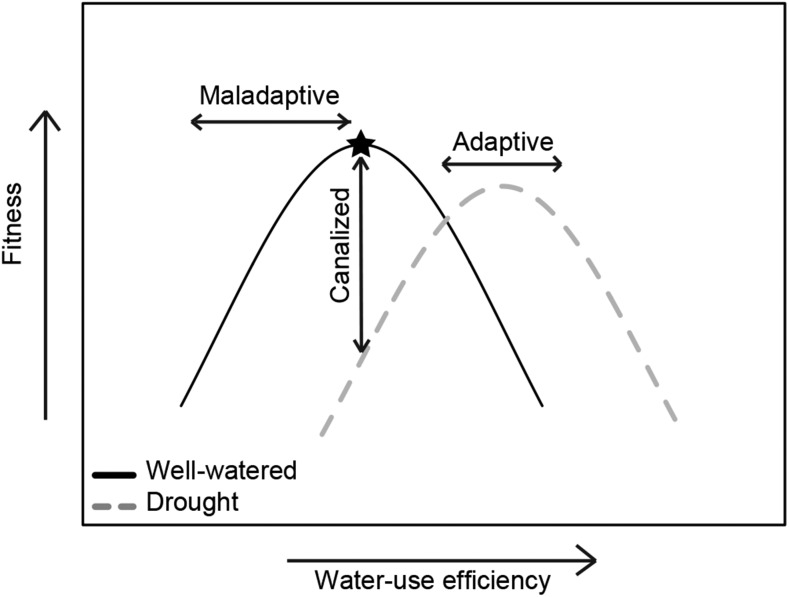
Consider a hypothetical population that is experiencing increasing aridity owing to climate change. Adaptive plasticity in water-use efficiency (WUE) may allow the population to withstand changing conditions. To examine the adaptive value of plasticity, researchers quantify WUE in well-watered and drought treatments. In well-watered historical conditions, stabilizing selection favors intermediate WUE because plants with low WUE risk desiccation and plants with high WUE have reduced growth. Drought stress shifts the fitness function, such that optimal fitness now occurs at higher levels of WUE. Plasticity is adaptive when the novel trait values produce similar or higher fitness than the former trait values could have achieved under drought conditions. If WUE does not change in drought, then trait canalization could restrict population persistence. Maladaptive plasticity reduces fitness and could lead to population declines.
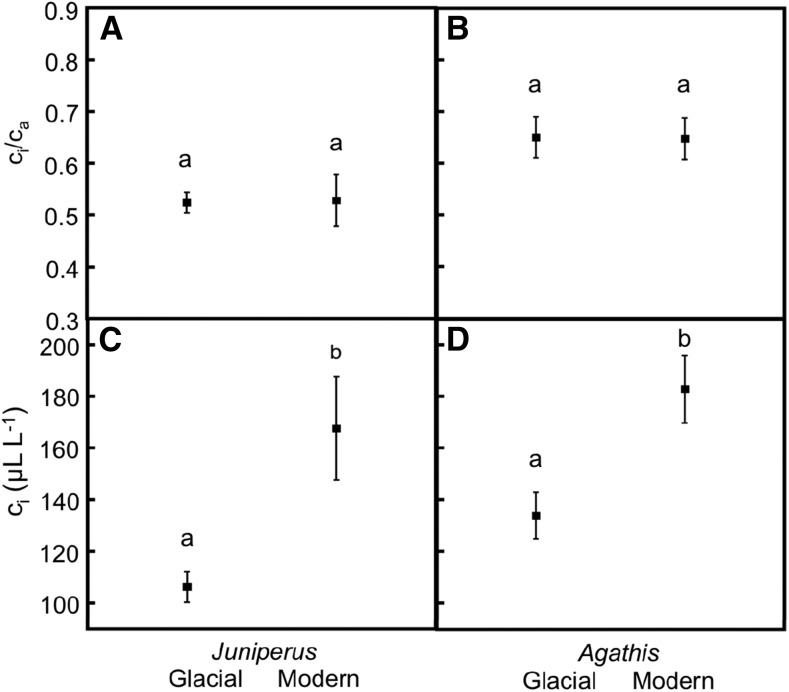
Physiological and growth responses of glacial and modern Juniperus spp. and Agathis spp. A, Juniperus spp. ci/ca. B, Agathis spp. ci/ca. C, Juniperus spp. ci. D, Agathis spp. ci. Data are shown as group means with error bars representing 1 sd . Letters above the error bars represent significance, with different letters indicating P < 0.0003. Juniperus spp. data in A and C are reproduced in summary from Gerhart et al. (2012). Glacial Agathis spp. were excavated from peat bogs surrounding Lake Ngatu near Awanui in Northland (n = 8) and 14C dated from 52.2 thousand years ago to more than 52.8 thousand years ago. Modern Agathis spp. were obtained from remnants of old buildings and piers throughout the Awanui region (n = 8). Consequently, modern specimens ranged in age from 0.9 to 3.7 kyr BP.
References
-
- Ackerly DD, Dudley SA, Sultan SE, Schmitt J, Coleman JS, Linder CR, Sandquist DR, Geber MA, Evans AS, Dawson TE, et al. (2000) The evolution of plant ecophysiological traits: recent advances and future directions. Bioscience 50: 979–995
-
- Ainsworth EA, Rogers A (2007) The response of photosynthesis and stomatal conductance to rising [CO2]: mechanisms and environmental interactions. Plant Cell Environ 30: 258–270 - PubMed
-
- Aitken SN, Whitlock MC (2013) Assisted gene flow to facilitate local adaptation to climate change. Annu Rev Ecol Evol Syst 44: 367–388
-
- Alberton O, Kuyper TW, Gorissen A (2007) Competition for nitrogen between Pinus sylvestris and ectomycorrhizal fungi generates potential for negative feedback under elevated CO2. Plant Soil 296: 159–172
Publication types
MeSH terms
Substances
Grants and funding
LinkOut - more resources
Full Text Sources
Other Literature Sources
Medical
Miscellaneous
