


A randomized trial of lottery-based incentives and reminders to improve warfarin adherence: the Warfarin Incentives (WIN2) Trial
- PMID: 27592594
- PMCID: PMC5093038
- DOI: 10.1002/pds.4094
A randomized trial of lottery-based incentives and reminders to improve warfarin adherence: the Warfarin Incentives (WIN2) Trial
Abstract
Background: Previous research has suggested that daily lottery incentives could improve medication adherence. Such daily incentives include implicit reminders. However, the comparative effectiveness of reminders alone versus daily incentives has not been tested.
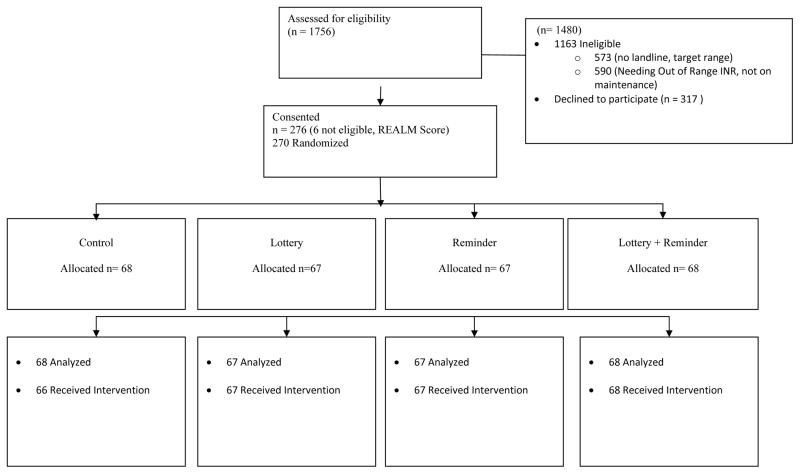
Methods: A total of 270 patients on warfarin were enrolled in a four-arm, multi-center, randomized controlled trial comparing a daily lottery-based incentive, a daily reminder, and a combination of the two against a control group (usual care).
Results: Participants in the reminder group had the lowest percentage of time out of target international normalized ratio (INR) range, the primary outcome, with an adjusted odds of an out-of-range INR 36% lower than among those in the control group, 95%CI [7%, 55%]. No other group had a statistically significant improvement in anticoagulation control relative to the control group or to each other. The only group that had significant improvement in incorrect adherence was the lottery group (incorrect adherence: 12.1% compared with 23.7% in the control group, difference of -7.4% 95%CI [-14%, -0.3%]). However, there was no relationship between changes in adherence and anticoagulation control in the lottery group.
Conclusions: Automated reminders led to the largest improvements in anticoagulation control, although without impacting measured adherence. Lottery-based reminders improved measured adherence but did not lead to improved anticoagulation control. Copyright © 2016 John Wiley & Sons, Ltd.
Trial registration: ClinicalTrials.gov NCT00904982.
Keywords: anticoagulants; behavioral; economics; incentives; pharmacoepidemiology; trials.
Copyright © 2016 John Wiley & Sons, Ltd.
References
-
- Kripalani S, Yao X, Haynes RB. Interventions to enhance medication adherence in chronic medical conditions: a systematic review. Arch Intern Med. 2007;167(6):540–550. - PubMed
-
- Kimmel SE, Chen Z, Price M, et al. The Influence of Patient Adherence on Anticoagulation Control with Warfarin. Arch Intern Med. 2007;167:229–235. - PubMed
-
- Go AS, Hylek EM, Borowsky LH, et al. Warfarin use among ambulatory patients with nonvalvular atrial fibrillation: the Anticoagulation and risk factors in atrial fibrillation (ATRIA) study. Ann Intern Med. 1999;131(12):927–934. - PubMed
Publication types
MeSH terms
Substances
Associated data
Grants and funding
LinkOut - more resources
Full Text Sources
Other Literature Sources
Medical
