Review
. 2017 Feb;13(1):7-16.
doi: 10.1007/s12015-016-9680-6.

Genomic Instability of iPSCs: Challenges Towards Their Clinical Applications

Affiliations
Review

Genomic Instability of iPSCs: Challenges Towards Their Clinical Applications

Masahito Yoshihara et al. Stem Cell Rev Rep. 2017 Feb.

Abstract

Induced pluripotent stem cells (iPSCs) are a type of pluripotent stem cells generated directly from mature cells through the introduction of key transcription factors. iPSCs can be propagated and differentiated into many cell types in the human body, holding enormous potential in the field of regenerative medicine. However, genomic instability of iPSCs has been reported with the advent of high-throughput technologies such as next-generation sequencing. The presence of genetic variations in iPSCs has raised serious safety concerns, hampering the advancement of iPSC-based novel therapies. Here we summarize our current knowledge on genomic instability of iPSCs, with a particular focus on types of genetic variations and their origins. Importantly, it remains elusive whether genetic variations in iPSCs can be an actual risk factor for adverse effects including malignant outgrowth. Furthermore, we discuss novel approaches to generate iPSCs with fewer genetic variations. Lastly, we outline the safety issues and monitoring strategies of iPSCs in clinical settings.

Keywords: Clinical application; Genomic instability; Mutation; Regenerative medicine; iPSCs.


Conflict of interest statement

The authors have no competing interests to declare.

Figures
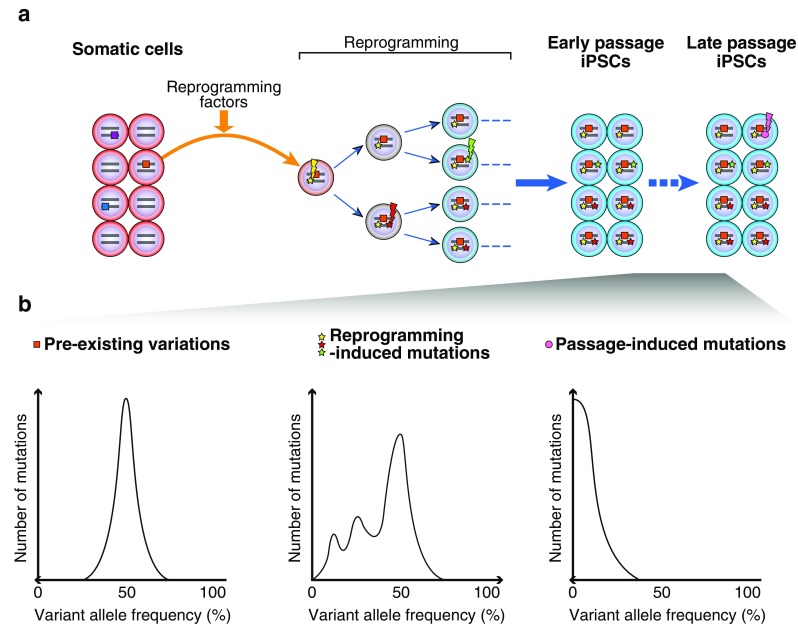
Fig. 1
Fig. 1
Origin of genetic variations in iPSCs. (a) Genetic variations of iPSCs have at least three origins: (i) pre-existingvariations in parental somatic cells, which can be manifested by a cloning procedure during iPSC generation, (ii) reprogramming-induced mutations which occur during the reprogramming process, and (iii) passage-induced mutations which arise during the prolonged culture. (b) (Left) Pre-existing variations (square) that exist in a minority of parental cells are expanded and become detectable as a consequence of iPSC generation (orange square). These variations are present in one allele of all the resulting iPSCs. Thus, their allele frequencies are expected to be ~50 % in iPSCs. (Middle) iPSC reprogramming per se introduces point mutations (star). These reprogramming-induced mutations can occur immediately after the onset of iPSC reprogramming (yellow star), which exhibit ~50 % allele frequencies. Furthermore, these mutations can occur after first- (red star) or second-cell division (green star) during iPSC reprogramming, which are expected to be observed at ~25 % or ~12.5 % allele frequencies, respectively. (Right) Mutations can arise during the prolonged culture (magenta circle), which can be observed at low allele frequencies

References

    1. Takahashi K, Yamanaka S. Induction of pluripotent stem cells from mouse embryonic and adult fibroblast cultures by defined factors. Cell. 2006;126(4):663–676. doi: 10.1016/j.cell.2006.07.024. - DOI - PubMed
    1. Yu J, Vodyanik MA, Smuga-Otto K, et al. Induced pluripotent stem cell lines derived from human somatic cells. Science. 2007;318(5858):1917–1920. doi: 10.1126/science.1151526. - DOI - PubMed
    1. Takahashi K, Tanabe K, Ohnuki M, et al. Induction of pluripotent stem cells from adult human fibroblasts by defined factors. Cell. 2007;131(5):861–872. doi: 10.1016/j.cell.2007.11.019. - DOI - PubMed
    1. Avior Y, Sagi I, Benvenisty N. Pluripotent stem cells in disease modelling and drug discovery. Nature Reviews. Molecular Cell Biology. 2016;17(3):170–182. doi: 10.1038/nrm.2015.27. - DOI - PubMed
    1. Robinton DA, Daley GQ. The promise of induced pluripotent stem cells in research and therapy. Nature. 2012;481(7381):295–305. doi: 10.1038/nature10761. - DOI - PMC - PubMed

Publication types

MeSH terms

Substances
