


Prostate Specific Antigen and Prostate Cancer in Chinese Men Undergoing Initial Prostate Biopsies Compared with Western Cohorts
- PMID: 27593477
- PMCID: PMC5503119
- DOI: 10.1016/j.juro.2016.08.103
Prostate Specific Antigen and Prostate Cancer in Chinese Men Undergoing Initial Prostate Biopsies Compared with Western Cohorts
Abstract
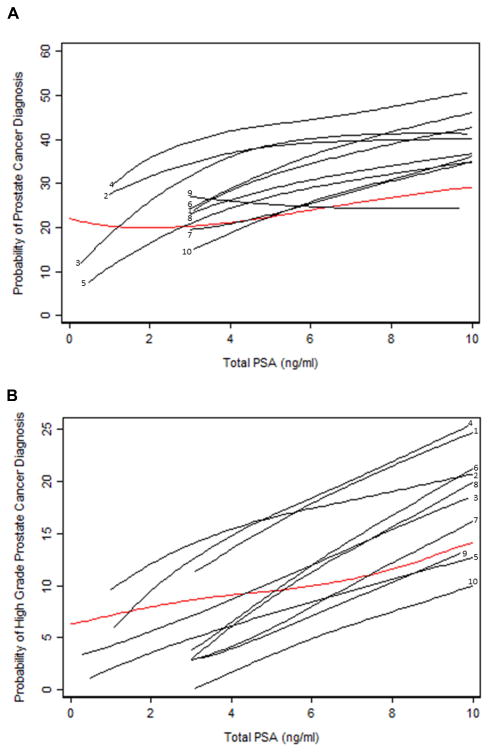
Purpose: We determined the characteristics of Chinese men undergoing initial prostate biopsy and evaluated the relationship between prostate specific antigen levels and prostate cancer/high grade prostate cancer detection in a large Chinese multicenter cohort.
Materials and methods: This retrospective study included 13,904 urology outpatients who had undergone biopsy for the indications of prostate specific antigen greater than 4.0 ng/ml or prostate specific antigen less than 4.0 ng/ml but with abnormal digital rectal examination results. The prostate specific antigen measurements were performed in accordance with the standard procedures at the respective institutions. The type of assay used was documented and recalibrated to the WHO standard.
Results: The incidence of prostate cancer and high grade prostate cancer was lower in the Chinese cohort than the Western cohorts at any given prostate specific antigen level. Around 25% of patients with a prostate specific antigen of 4.0 to 10.0 ng/ml were found to have prostate cancer compared to approximately 40% in U.S. clinical practice. Moreover, the risk curves were generally flatter than those of the Western cohorts, that is risk did not increase as rapidly with higher prostate specific antigen.
Conclusions: The relationship between prostate specific antigen and prostate cancer risk differs importantly between Chinese and Western populations, with an overall lower risk in the Chinese cohort. Further research should explore whether environmental or genetic differences explain these findings or whether they result from unmeasured differences in screening or benign prostate disease. Caution is required for the implementation of prostate cancer clinical decision rules or prediction models for men in China or other Asian countries with similar genetic and environmental backgrounds.
Keywords: China; biopsy; early detection of cancer; prostate-specific antigen; prostatic neoplasms.
Copyright © 2017 American Urological Association Education and Research, Inc. Published by Elsevier Inc. All rights reserved.
Conflict of interest statement
Figures


Comment in
-
Editorial Comment.J Urol. 2017 Jan;197(1):96. doi: 10.1016/j.juro.2016.08.127. Epub 2016 Oct 15. J Urol. 2017. PMID: 27750054 No abstract available.
References
-
- Ferlay J, S I, Ervik M. GLOBOCAN 2012 v1.0, Cancer Incidence and Mortality Worldwide: IARC CancerBase No. 11. Lyon, France: International Agency for Research on Cancer; 2013. [accessed on 2015/08/28]. [Internet] Available from: http://globocan.iarc.fr.
-
- Center MM, Jemal A, Lortet-Tieulent J, et al. International variation in prostate cancer incidence and mortality rates. Eur Urol. 2012;61:1079. - PubMed
-
- Ito K. Prostate cancer in Asian men. Nat Rev Urol. 2014;11:197. - PubMed
Publication types
MeSH terms
Substances
Grants and funding
LinkOut - more resources
Full Text Sources
Other Literature Sources
Medical
