


Coevolutionary interactions with parasites constrain the spread of self-fertilization into outcrossing host populations
- PMID: 27593534
- PMCID: PMC5088054
- DOI: 10.1111/evo.13048
Coevolutionary interactions with parasites constrain the spread of self-fertilization into outcrossing host populations
Abstract
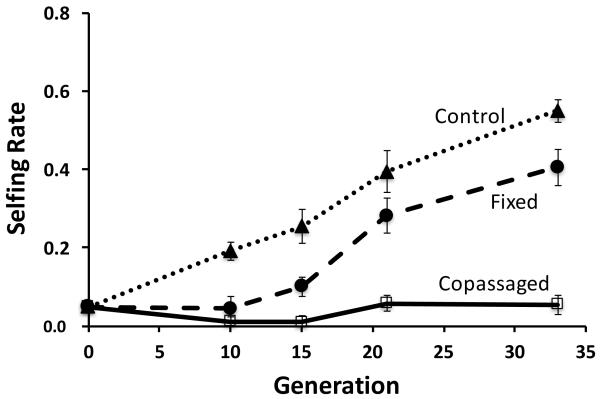
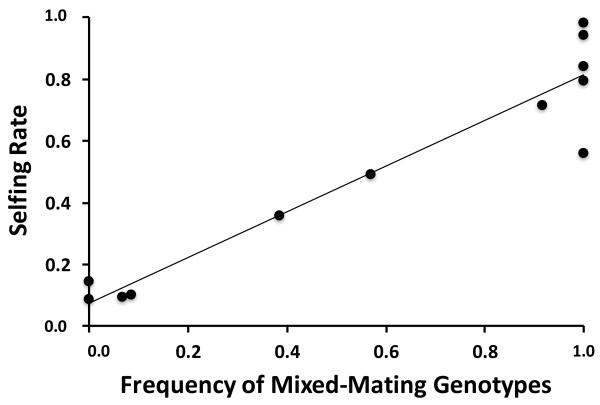
Given the cost of sex, outcrossing populations should be susceptible to invasion and replacement by self-fertilization or parthenogenesis. However, biparental sex is common in nature, suggesting that cross-fertilization has substantial short-term benefits. The Red Queen hypothesis (RQH) suggests that coevolution with parasites can generate persistent selection favoring both recombination and outcrossing in host populations. We tested the prediction that coevolving parasites can constrain the spread of self-fertilization relative to outcrossing. We introduced wild-type Caenorhabditis elegans hermaphrodites, capable of both self-fertilization, and outcrossing, into C. elegans populations that were fixed for a mutant allele conferring obligate outcrossing. Replicate C. elegans populations were exposed to the parasite Serratia marcescens for 33 generations under three treatments: a control (avirulent) parasite treatment, a fixed (nonevolving) parasite treatment, and a copassaged (potentially coevolving) parasite treatment. Self-fertilization rapidly invaded C. elegans host populations in the control and the fixed-parasite treatments, but remained rare throughout the entire experiment in the copassaged treatment. Further, the frequency of the wild-type allele (which permits selfing) was strongly positively correlated with the frequency of self-fertilization across host populations at the end of the experiment. Hence, consistent with the RQH, coevolving parasites can limit the spread of self-fertilization in outcrossing populations.
Keywords: Breeding system; Red Queen hypothesis; coevolution; evolution; host-parasite coevolution; sex.
© 2016 The Author(s). Evolution © 2016 The Society for the Study of Evolution.
Figures
References
-
- Agrawal AF, Lively CM. Parasites and the evolution of self-fertilization. Evolution. 2001;55:869–879. - PubMed
-
- Bell G. The masterpiece of nature: the evolution and genetics of sexuality. University of California Press; Berkeley: 1982.
-
- Charlesworth B. The cost of sex in relation to mating system. Journal of Theoretical Biology. 1980;84:655–671. - PubMed
Publication types
MeSH terms
Substances
Associated data
Grants and funding
LinkOut - more resources
Full Text Sources
Other Literature Sources