


Development and internal validation of a clinical rule to improve antibiotic use in children presenting to primary care with acute respiratory tract infection and cough: a prognostic cohort study
- PMID: 27594440
- PMCID: PMC5080970
- DOI: 10.1016/S2213-2600(16)30223-5
Development and internal validation of a clinical rule to improve antibiotic use in children presenting to primary care with acute respiratory tract infection and cough: a prognostic cohort study
Abstract
Background: Antimicrobial resistance is a serious threat to public health, with most antibiotics prescribed in primary care. General practitioners (GPs) report defensive antibiotic prescribing to mitigate perceived risk of future hospital admission in children with respiratory tract infections. We developed a clinical rule aimed to reduce clinical uncertainty by stratifying risk of future hospital admission.
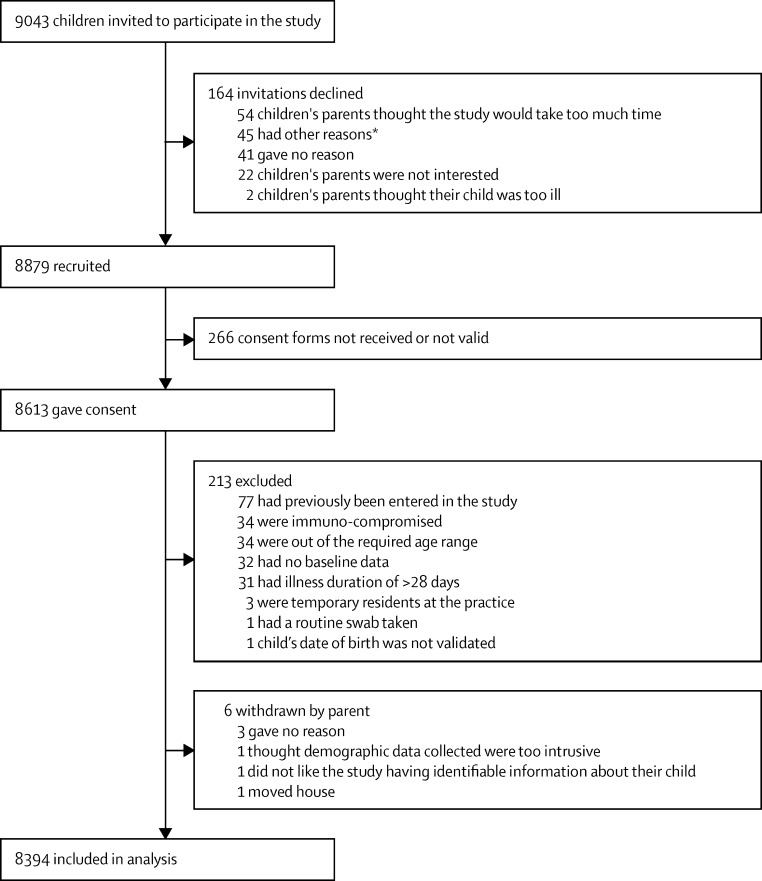
Methods: 8394 children aged between 3 months and 16 years presenting with acute cough (for ≤28 days) and respiratory tract infection were recruited to a prognostic cohort study from 247 general practitioner practices in England. Exposure variables included demographic characteristics, parent-reported symptoms, and physical examination signs. The outcome was hospital admission for respiratory tract infection within 30 days, collected using a structured, blinded review of medical records.
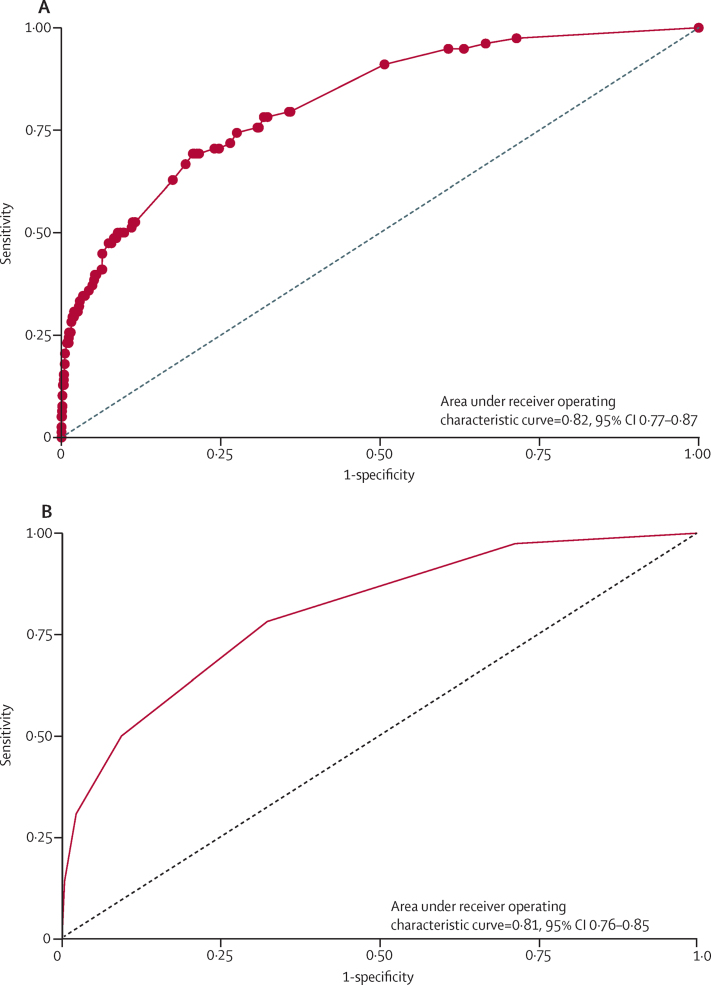
Findings: 8394 (100%) children were included in the analysis, with 78 (0·9%, 95% CI 0·7%-1·2%) admitted to hospital: 15 (19%) were admitted on the day of recruitment (day 1), 33 (42%) on days 2-7; and 30 (39%) on days 8-30. Seven characteristics were independently associated (p<0·01) with hospital admission: age <2 years, current asthma, illness duration of 3 days or less, parent-reported moderate or severe vomiting in the previous 24 h, parent-reported severe fever in the previous 24 h or a body temperature of 37·8°C or more at presentation, clinician-reported intercostal or subcostal recession, and clinician-reported wheeze on auscultation. The area under the receiver operating characteristic (AUROC) curve for the coefficient-based clinical rule was 0·82 (95% CI 0·77-0·87, bootstrap validated 0·81). Assigning one point per characteristic, a points-based clinical rule consisting of short illness, temperature, age, recession, wheeze, asthma, and vomiting (mnemonic STARWAVe; AUROC 0·81, 0·76-0·85) distinguished three hospital admission risk strata: very low (0·3%, 0·2-0·4%) with 1 point or less, normal (1·5%, 1·0-1·9%) with 2 or 3 points, and high (11·8%, 7·3-16·2%) with 4 points or more.
Interpretation: Clinical characteristics can distinguish children at very low, normal, and high risk of future hospital admission for respiratory tract infection and could be used to reduce antibiotic prescriptions in primary care for children at very low risk.
Funding: National Institute for Health Research (NIHR).
Copyright © 2016 The Author(s). Published by Elsevier Ltd. This is an Open Access article under the CC BY-NC-ND license. Published by Elsevier Ltd.. All rights reserved.
Figures
Comment in
-
A practical tool for primary care antimicrobial stewardship in children.Lancet Respir Med. 2016 Nov;4(11):850-852. doi: 10.1016/S2213-2600(16)30272-7. Epub 2016 Sep 1. Lancet Respir Med. 2016. PMID: 27594439 No abstract available.
References
-
- Department of Health UK Five Year Antimicrobial Resistance Strategy 2013 to 2018. https://www.gov.uk/government/uploads/system/uploads/attachment_data/fil... (accessed Aug 19, 2016).
-
- The White House Washington National Strategy for Combating Antibiotic Resistant Bacteria. http://www.cdc.gov/drugresistance/pdf/carb_national_strategy.pdf (accessed Aug 19, 2016).
-
- WHO Antimicrobial resistance: Global Report on Surveillance. http://apps.who.int/iris/bitstream/10665/112642/1/9789241564748_eng.pdf?... (accessed Aug 19, 2016).
-
- NHS England The NHS Atlas of Variation in Healthcare: reducing unwarranted variation to increase value and improve quality. http://www.rightcare.nhs.uk/atlas/RC_nhsAtlas3_HIGH_150915.pdf (accessed Aug 19, 2016).
-
- Public Health England English surveillance programme for antimicrobial utilisation and resistance (ESPAUR). Report 2014. https://www.gov.uk/government/uploads/system/uploads/attachment_data/fil... (accessed Aug 19, 2016).
Publication types
MeSH terms
Substances
Grants and funding
LinkOut - more resources
Full Text Sources
Other Literature Sources
Medical
