


Analysis of Seasonal Risk for Importation of the Mediterranean Fruit Fly, Ceratitis capitata (Diptera: Tephritidae), via Air Passenger Traffic Arriving in Florida and California
- PMID: 27594703
- PMCID: PMC5225961
- DOI: 10.1093/jee/tow196
Analysis of Seasonal Risk for Importation of the Mediterranean Fruit Fly, Ceratitis capitata (Diptera: Tephritidae), via Air Passenger Traffic Arriving in Florida and California
Abstract
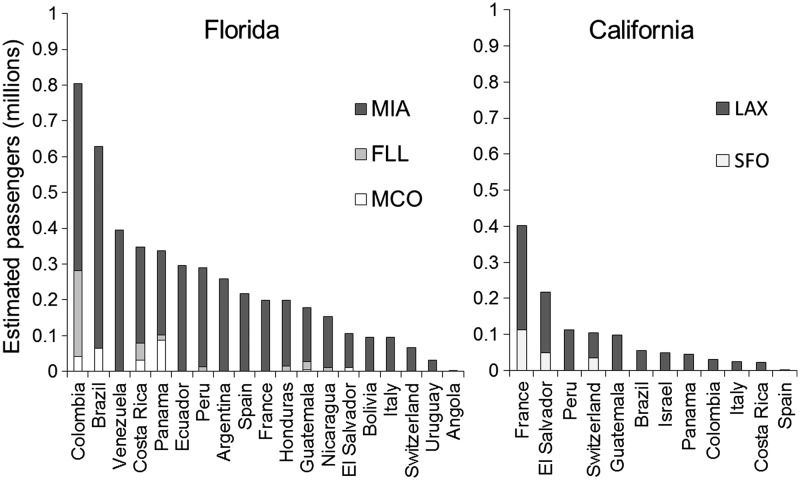
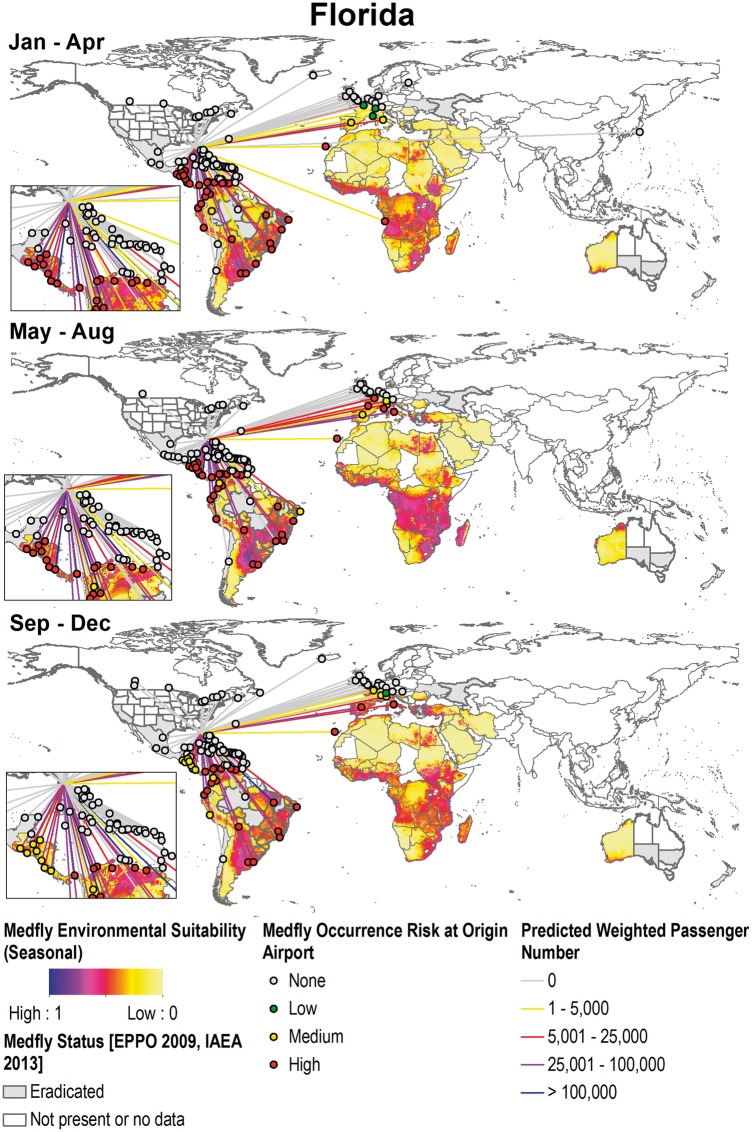
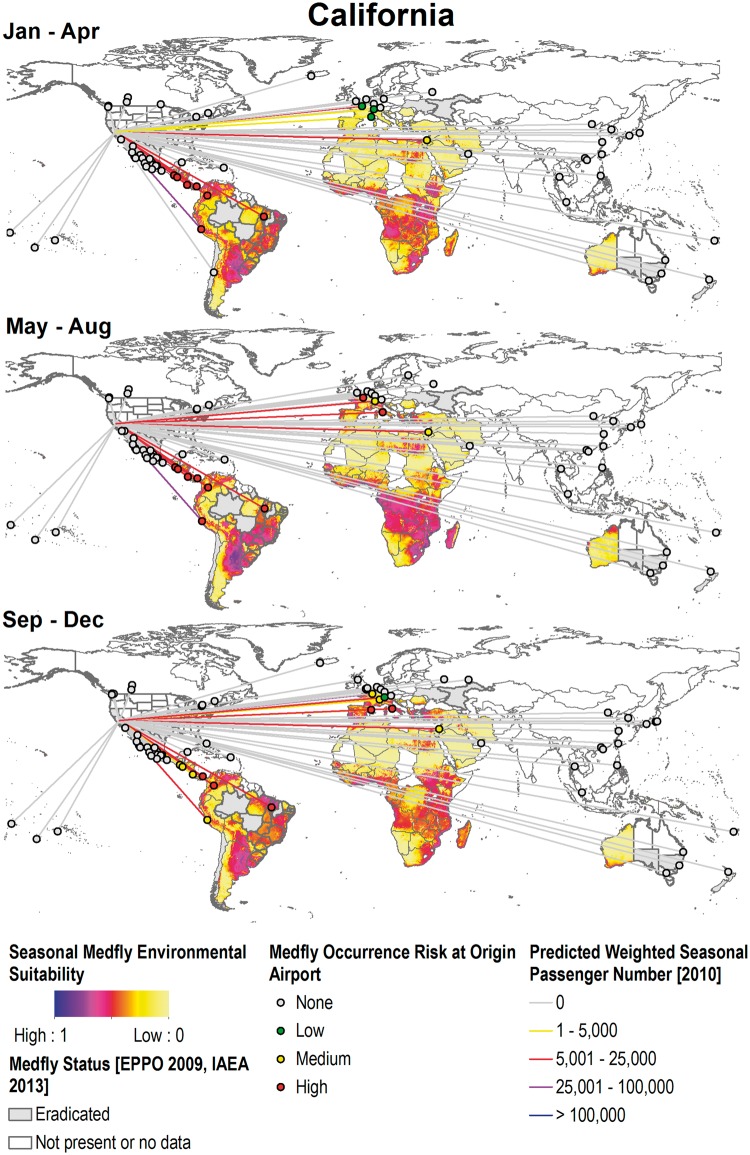
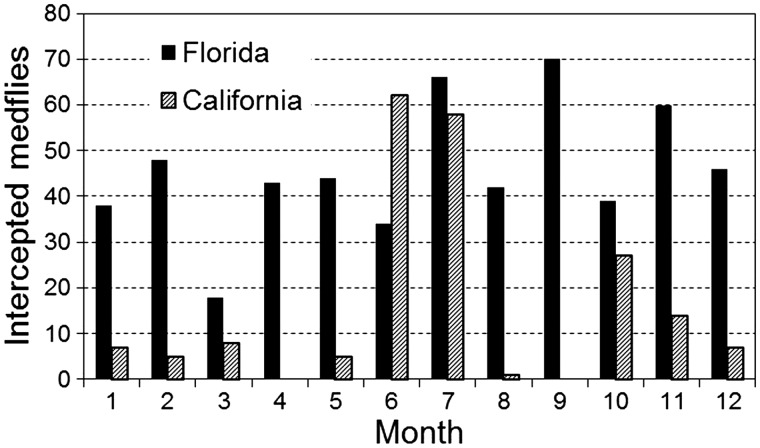
The Mediterranean fruit fly, Ceratitis capitata (Wiedemann), is one of the most economically damaging pests in the world and has repeatedly invaded two major agricultural states in the United States, Florida and California, each time requiring costly eradication. The Mediterranean fruit fly gains entry primarily in infested fruit carried by airline passengers and, since Florida and California each receive about 13 million international passengers annually, the risk of Mediterranean fruit fly entering the United States is potentially very high. The risk of passengers bringing the pest into Florida or California from Mediterranean fruit fly-infested countries was determined with two novel models, one estimated seasonal variation in airline passenger number and the other defined the seasonal and spatial variability in Mediterranean fruit fly abundance. These models elucidated relationships among the risk factors for Mediterranean fruit fly introduction, such as amount of passenger traffic, routes traveled, season of travel, abundance of Mediterranean fruit fly in countries where flights departed, and risk of the pest arriving at destination airports. The risk of Mediterranean fruit fly being introduced into Florida was greatest from Colombia, Brazil, Panama, Venezuela, Argentina, and Ecuador during January-August, whereas primarily the risk to California was from Brazil, Panama, Colombia, and Italy in May-August. About three times more Mediterranean fruit flies were intercepted in passenger baggage at airports in Florida than California, although the data were compromised by a lack of systematic sampling and other limitations. Nevertheless, this study achieved the goal of analyzing available data on seasonal passenger flow and Mediterranean fruit fly population levels to determine when surveillance should be intensified at key airports in Florida and California.
Keywords: Ceratitis capitata; Mediterranean fruit fly; risk analysis.
© The Authors 2016. Published by Oxford University Press on behalf of Entomological Society of America. All rights reserved. For Permissions, please email: journals.permissions@oup.com.
Figures
References
-
- APHIS. 1992.. Risk assessment, Mediterranean fruit fly. Planning and Risk Analysis Systems. Policy and Program Development. USDA, Animal and Plant Health Inspection Service, Washington, DC.
-
- Badii K. B., Billah M. K., Afreh Nuamah K., Obeng Ofori D., Nyarko G. 2015.. Review of the pest status, economic impact and management of fruit-infesting flies (Diptera: Tephritidae) in Africa. Afr. J. Agric. Res. 10: 1488–1498.
-
- Bakri A. 2013.. Geographical distribution map of the Mediterranean fruit fly Ceratitis capitata (Wiedemann). Designed by FAO/IAEA. (https://nucleus.iaea.org/sites/naipc/twd/Picture%20Gallery/Forms/DispFor...) (accessed 24 August 2016).
-
- Carey J. R. 2010.. The Mediterranean Fruit Fly. Am. Entomol. 56: 159–163.
MeSH terms
LinkOut - more resources
Full Text Sources
Other Literature Sources
