. 2016 Aug 19:10:378.
doi: 10.3389/fnins.2016.00378. eCollection 2016.

Ecological Origins of Object Salience: Reward, Uncertainty, Aversiveness, and Novelty

Affiliations

Ecological Origins of Object Salience: Reward, Uncertainty, Aversiveness, and Novelty

Ali Ghazizadeh et al. Front Neurosci. .

Abstract

Among many objects around us, some are more salient than others (i.e., attract our attention automatically). Some objects may be inherently salient (e.g., brighter), while others may become salient by virtue of their ecological relevance through experience. However, the role of ecological experience in automatic attention has not been studied systematically. To address this question, we let subjects (macaque monkeys) view a large number of complex objects (>300), each experienced repeatedly (>5 days) with rewarding, aversive or no outcome association (mere-perceptual exposure). Test of salience was done on separate days using free viewing with no outcome. We found that gaze was biased among the objects from the outset, affecting saccades to objects or fixations within objects. When the outcome was rewarding, gaze preference was stronger (i.e., positive) for objects with larger or equal but uncertain rewards. The effects of aversive outcomes were variable. Gaze preference was positive for some outcome associations (e.g., airpuff), but negative for others (e.g., time-out), possibly due to differences in threat levels. Finally, novel objects attracted gaze, but mere perceptual exposure of objects reduced their salience (learned negative salience). Our results show that, in primates, object salience is strongly influenced by previous ecological experience and is supported by a large memory capacity. Owing to such high capacity for learned salience, the ability to rapidly choose important objects can grow during the entire life to promote biological fitness.

Keywords: aversiveness; novelty; object salience; reward; uncertainty.


Figures
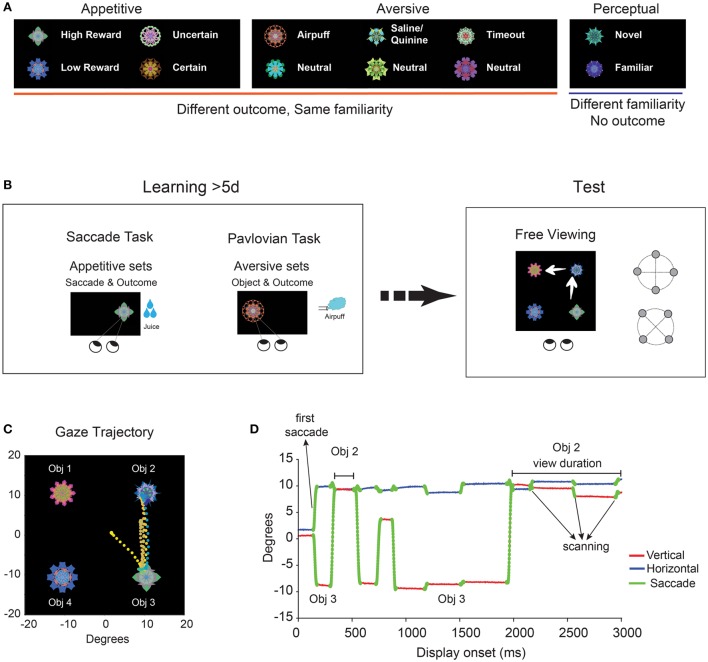
Figure 1
Figure 1
Experimental paradigm and measures of learned salience. (A) Subjects (macaque monkeys) viewed fractal objects in three ecological dimensions (appetitive, aversive, and perceptual) and their sub-dimensions. (B) Ecological learning and salience test. Procedures used for learning: Saccade task (appetitive), Pavlovian task (aversive), Free viewing (perceptual, not shown). The learning for each object lasted for more than 5 days. Free viewing in the absence of outcome was used to test the salience of individual objects in each sub-dimension. (C) Example of gaze trajectory composed of saccades and object fixations during a single free viewing trial (3 s). Eye position is shown by time-dependent color-coded dots (2 ms/sample, from orange: display onset to blue: display offset). (D) The time course of gaze during the same free viewing. Three metrics were used to quantify object salience: first saccade, object scanning and view duration (see Figure 3).
Figure 2
Figure 2
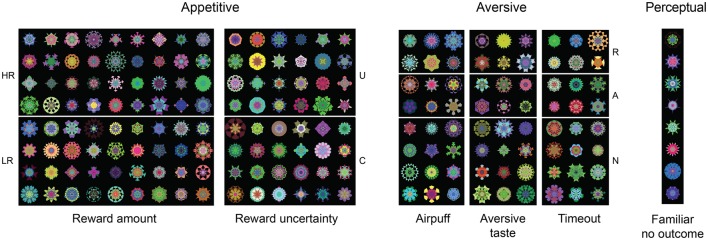
Fractals experienced along various dimensions by a single subject (monkey U) with fractal numbers summarized in Table 1. Not shown here are fractals used for reward gradient (Figure 3D, n = 15), reward probability (Figure 4D, n = 15), 45-trial free viewing (Figure 8C, n = 72), and novel fractals (Figure 6A, n = 32) as well as face stimuli (Figure 6D, n = 40). HR, high reward; LR, low reward; U, uncertain reward; C, certain reward; R, reward; A, aversive (airpuff, aversive taste, or timeout); N, neutral (no outcome). For perceptual dimension (right), eight fractals were experienced in free viewing with no outcome so that they became familiar objects. All subjects experienced the same number of fractals.
Figure 3
Figure 3
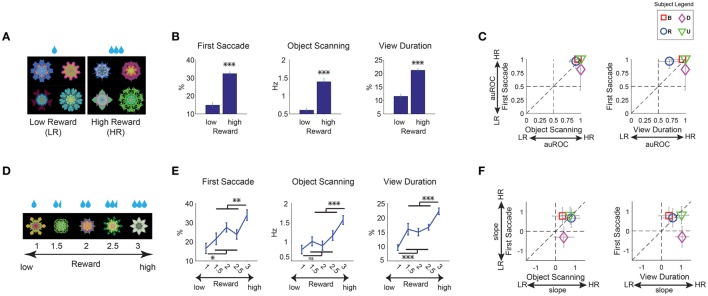
Positive learned salience of appetitive objects: reward amount. (A–C) Effects of large and small reward. (A) Example set of 8 objects. They were associated with low or high reward during learning, but not during salience test (free viewing). (B) Three measures of gaze bias. First Saccade: percentage of the first saccade directed from outside to inside object. Object Scanning: rate of within-object saccades. View Duration: total trial time during which gaze stayed inside object. See Figure 1D. These measures were averaged for high- and low-reward objects separately (n = 36 viewing sessions). (C) Gaze bias of individual subjects, shown by area under receiver operating characteristics (auROC). Error bar indicates 95% confidence interval. (D) Example set of 5 objects which were associated with a linear gradient of reward amount. (E) Three measures of gaze bias were averaged separately for the 5 different levels of reward amount. The statistical difference between highest and lowest reward levels compared with the three middle reward levels (Bonferroni post-hoc) are marked for significance (n = 24 viewing sessions). (F) Gaze bias of individual subjects, shown by the slope of a linear fit to gaze metrics as a function of reward amount. *p < 0.05, **p < 0.01, ***p < 0.001.
Figure 4
Figure 4
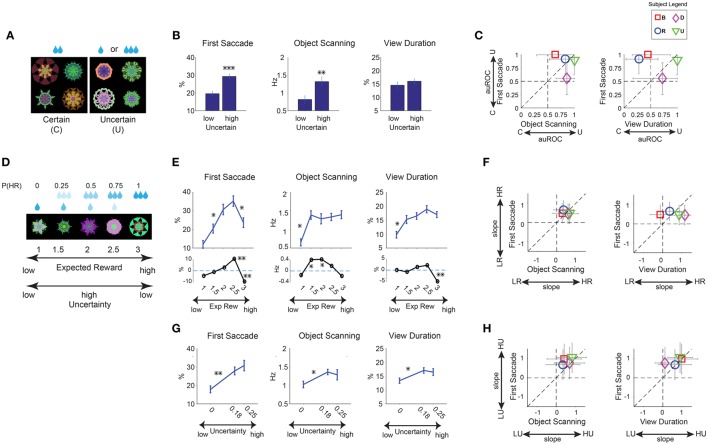
Positive learned salience of appetitive objects: reward uncertainty. (A–C) Same format as in Figures 3A–C for effects of reward uncertainty. (n = 24 viewing sessions). (D) Example set of 5 objects which were associated with a linear gradient of large reward probability, P(HR). (E) Three measures of gaze bias were averaged separately for the 5 different levels of reward probability (top plot). The statistical difference between reward probabilities (hsd post-hoc) are marked for significance (n = 24 viewing sessions). Subtraction of gaze bias in reward amount sets from reward probability (bottom plot, black lines) shows enhancement of salience by uncertainty for midlevel reward probabilities (significant differences from zero are marked). (F) Same format as Figure 3F but showing gaze bias slope as a function of reward probability for individual subjects. (G) Same format as (E) top but when objects were grouped by 3 different levels of reward variance (P(HR) = [0,1] with 0, P(HR) = [0.25,0.75] with 0.18 and P(HR) = 0.5 with 0.25 reward variance). The statistical differences between reward variances (hsd post-hoc) are marked for significance. (H) Same format as (F) but showing gaze bias slope for uncertainty levels for individual subjects. *p < 0.05, **p < 0.01, ***p < 0.001.
Figure 5
Figure 5
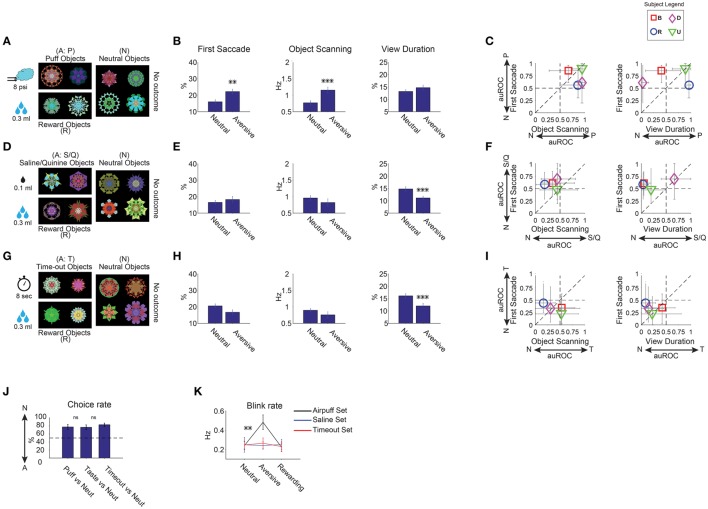
Positive and negative learned salience of aversive objects. (A–C) Effects of air puff. (D–F) Effects of aversive taste. (G–I) Effects of timeout. Same format as in Figures 3A–C (n = 30 free viewing sessions in each sub-dimension). Reward-associated objects were included during learning and test (A,D,G) but are not shown in (B–C, E–F, H–I). (J) Choice of neutral objects against aversive objects, shown separately for three sub-dimensions (n = 12 choice sessions). (K) Rate of blinking when viewing an object during free viewing in the three sub-dimensions. Blinking increased only when gaze was directed to airpuff-associated objects. Otherwise, the rate remained low, even when airpuff-associated objects were present, but outside gaze. **p < 0.01, ***p < 0.001.
Figure 6
Figure 6
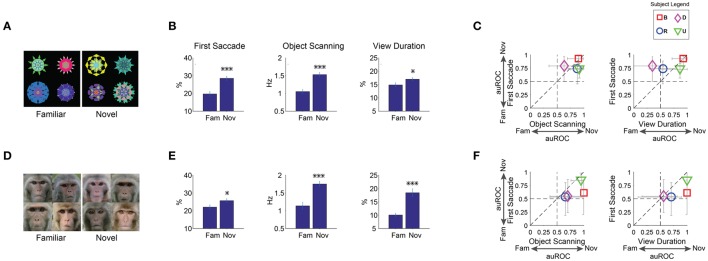
Positive salience of novel objects (or, negative learned salience of familiar objects). (A–C) Effects of familiarity on fractal objects (n = 36 viewing sessions). (D–F) Effects of familiarity on faces (n = 32). Same format as in Figures 3A–C. Before the salience test, each subject had viewed 8 fractals and 8 faces repeatedly in >5 free viewing sessions for familiarity training. Novel fractals and faces were viewed only in one test session. *p < 0.05, ***p < 0.001.
Figure 7
Figure 7
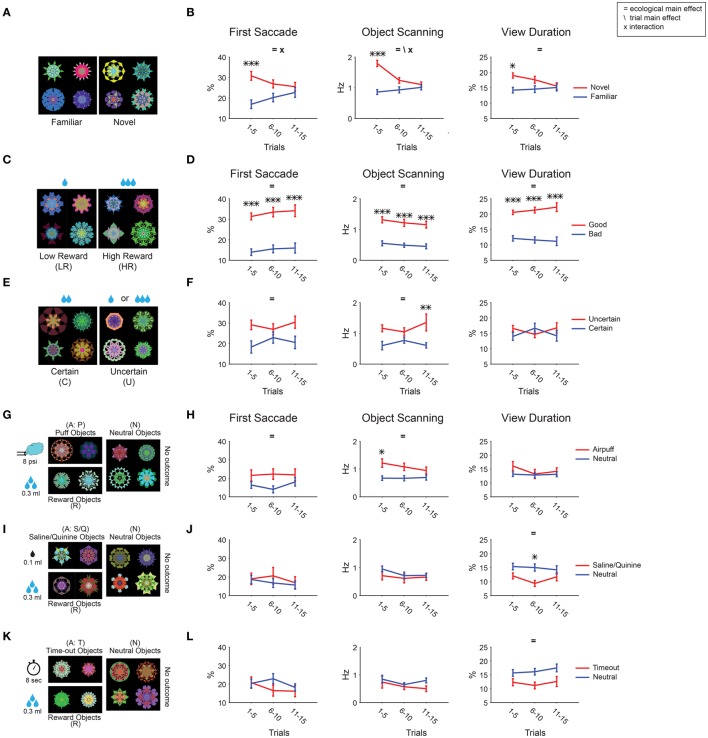
Changes in object salience by repeated viewing with no outcome. Gaze bias was measured during each session of free viewing, and averaged separately for the early (1–5 trials), middle (6–10 trials), and late (11–15 trials) periods. (A,B) Novel/familiar. (C,D) Low/high reward. (E,F) Certain/uncertain. (G,H) Airpuff/neutral. (I,J) Aversive taste/neutral. (K,L) Timeout/neutral. Main effect of ecological sub-dimension and trial number as well as the interaction between the two are marked. Post-hoc tests are marked with asterisks.
Figure 8
Figure 8
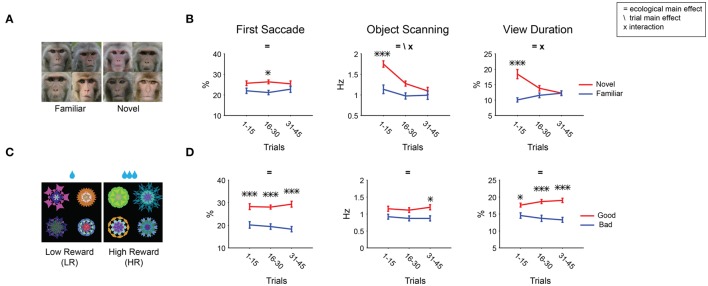
Changes in object salience by longer repeated viewing with no outcome. Free viewing test consisted of 45 trials (instead of 15 trials, Figure 7). (A,B) Novel/familiar faces. (C,D) Low/high reward fractals (additional 72 fractals, different from Figures 7C,D). Gaze bias for novel/familiar faces (B) declined more slowly than for novel/familiar fractals (Figure 7B). In contrast, gaze bias for low/high reward fractals never declined (D). Main effect of ecological dimension and trial number as well as the interaction between the two are marked. Post-hoc tests are marked with asterisks.
Figure 9
Figure 9
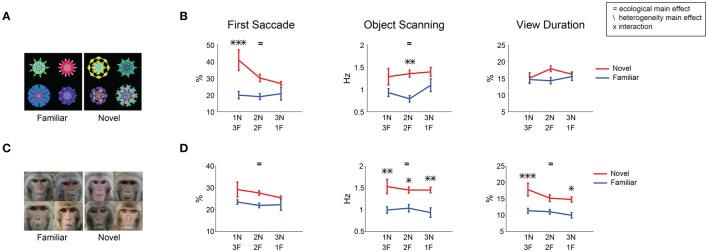
Changes in novelty salience by varying its prevalence. Free viewing trials were grouped into 3 display conditions: 1-novel/3-familiar, 2-novel/2-familiar, 3-novel/1-familiar objects, and analyzed for each gaze metric. (A,B) Novel/familiar fractals. (C,D) Novel/familiar faces. In both stimulus category and across the gaze metrics, novelty bias was observed regardless of condition (blue did not cross over red). Main effect of ecological factor and display condition as well as the interaction between the two are marked. Post-hoc tests are marked with asterisks.
Figure 10
Figure 10
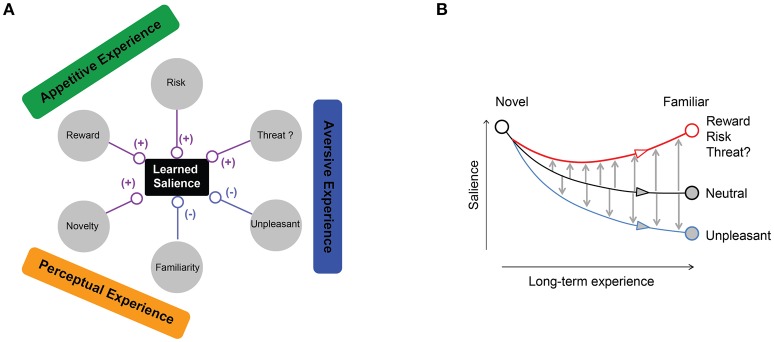
Multiple ecological factors influencing objects learned salience. (A) Appetitive dimension (reward amount or risk) enhances object salience. Aversive dimension enhances or suppresses object salience depending on the outcome type. Mere perceptual exposure suppresses object salience compared to novel objects. (B) Proposed dynamics of salience modification by ecological experience. Novel objects lose their salience through perceptual exposure (black line). Non-threatening but unpleasant outcomes further decrease object salience compared to neutral familiar objects. Rewarding, risky, or threatening outcomes counteract familiarity and enhance object salience.

References

    1. Anderson B. A., Laurent P. A., Yantis S. (2011). Value-driven attentional capture. Proc. Natl. Acad. Sci. U.S.A. 108, 10367–10371. 10.1073/pnas.1104047108 - DOI - PMC - PubMed
    1. Azrin N. H., Hutchins R. R., Hake D. F. (1967). Attack avoidance and escape reactions to aversive shock. J. Exp. Anal. Behav. 10, 131–148. 10.1901/jeab.1967.10-131 - DOI - PMC - PubMed
    1. Balaban M. T., Taussig H. N. (1994). Salience of fear/threat in the affective modulation of the human startle blink. Biol. Psychol. 38, 117–131. 10.1016/0301-0511(94)90033-7 - DOI - PubMed
    1. Berlyne D. E. (1970). Novelty, complexity, and hedonic value. Percept. Psychophys. 8, 279–286. 10.3758/BF03212593 - DOI
    1. Bradley B. P., Mogg K., Millar N. H. (2000). Covert and overt orienting of attention to emotional faces in anxiety. Cogn. Emot. 14, 789–808. 10.1080/02699930050156636 - DOI

LinkOut - more resources