


Infliximab versus ciclosporin for steroid-resistant acute severe ulcerative colitis (CONSTRUCT): a mixed methods, open-label, pragmatic randomised trial
- PMID: 27595142
- PMCID: PMC4994668
- DOI: 10.1016/S2468-1253(16)30003-6
Infliximab versus ciclosporin for steroid-resistant acute severe ulcerative colitis (CONSTRUCT): a mixed methods, open-label, pragmatic randomised trial
Abstract
Background: Infliximab and ciclosporin are of similar efficacy in treating acute severe ulcerative colitis, but there has been no comparative evaluation of their relative clinical effectiveness and cost-effectiveness.
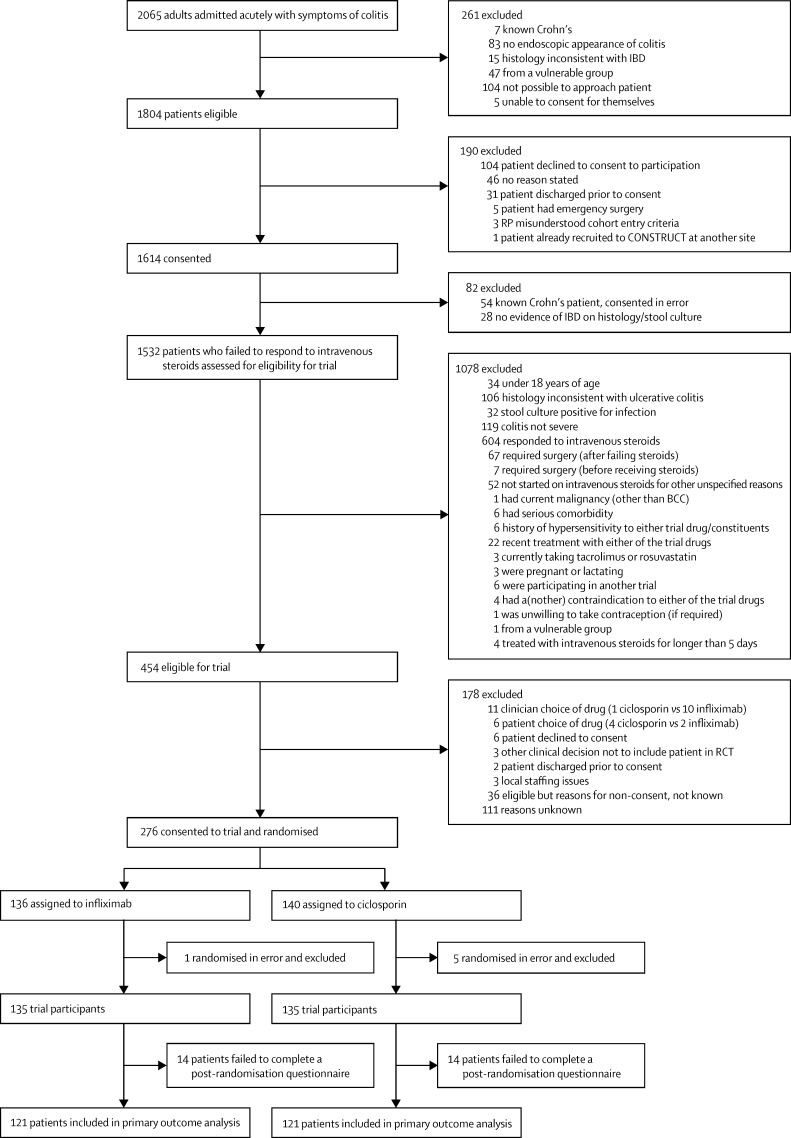
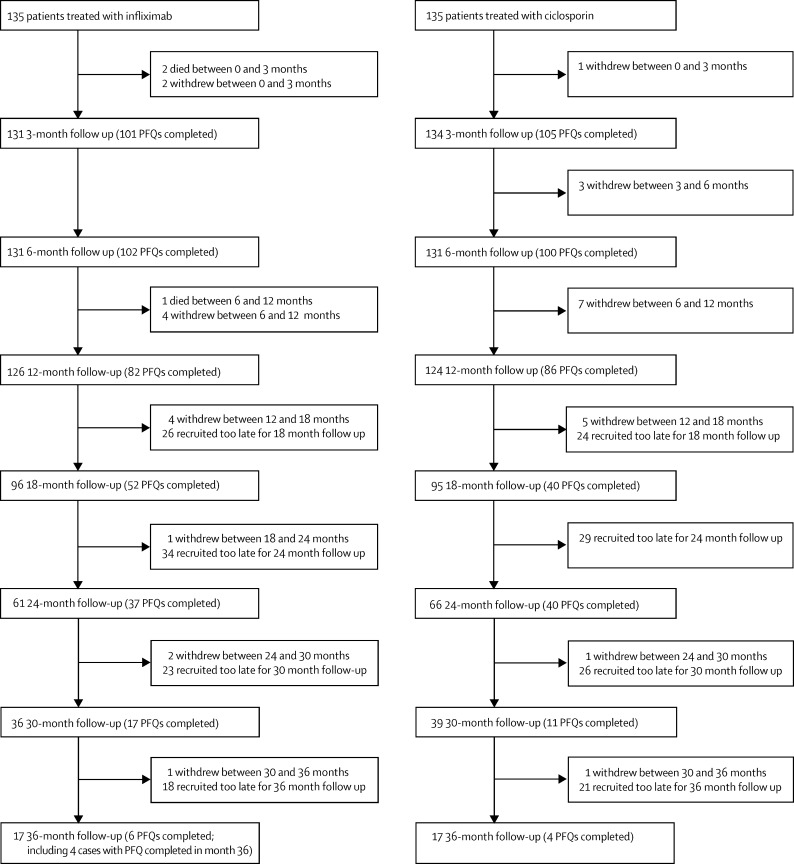
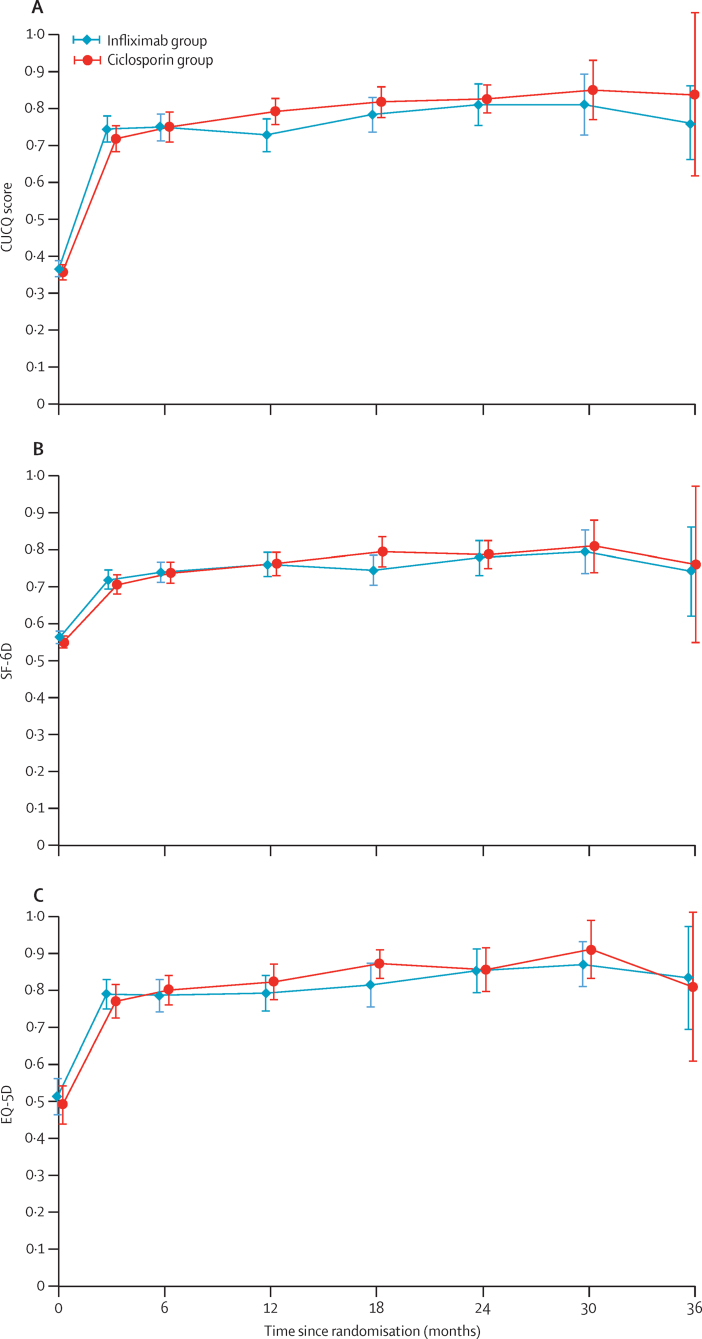
Methods: In this mixed methods, open-label, pragmatic randomised trial, we recruited consenting patients aged 18 years or older at 52 district general and teaching hospitals in England, Scotland, and Wales who had been admitted, unscheduled, with severe ulcerative colitis and failed to respond to intravenous hydrocortisone within about 5 days. Patients were randomly allocated (1:1) to receive either infliximab (5 mg/kg intravenous infusion given over 2 h at baseline, and again at 2 weeks and 6 weeks after the first infusion) or ciclosporin (2 mg/kg per day by continuous infusion for up to 7 days, followed by twice-daily tablets delivering 5·5 mg/kg per day for 12 weeks). Randomisation used a web-based password-protected site, with a dynamic algorithm to generate allocations on request, thus protecting against investigator preference or other subversion, while ensuring that each trial group was balanced by centre, which was the only stratification used. Local investigators and participants were aware of the treatment allocated, but the chief investigator and analysts were masked. Analysis was by treatment allocated. The primary outcome was quality-adjusted survival-ie, the area under the curve (AUC) of scores from the Crohn's and Ulcerative Colitis Questionnaire (CUCQ) completed by participants at baseline, 3 months, and 6 months, then every 6 months from 1 year to 3 years. This trial is registered with the ISRCTN Registry, number ISRCTN22663589.
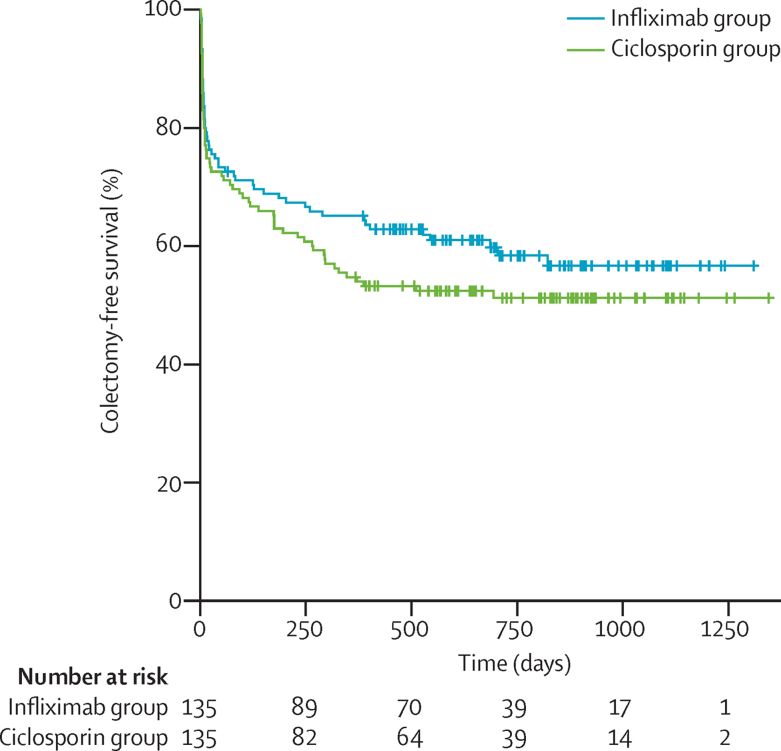
Findings: Between June 17, 2010, and Feb 26, 2013, 270 patients were recruited. 135 patients were allocated to the infliximab group and 135 to the ciclosporin group. 121 (90%) patients in each group were included in the analysis of the primary outcome. There was no significant difference between groups in quality-adjusted survival (mean AUC 564·0 [SD 241·9] in the infliximab group vs 587·0 [226·2] in the ciclosporin group; mean adjusted difference 7·9 [95% CI -22·0 to 37·8]; p=0·603). Likewise, there were no significant differences between groups in the secondary outcomes of CUCQ scores, EQ-5D, or SF-6D scores; frequency of colectomy (55 [41%] of 135 patients in the infliximab group vs 65 [48%] of 135 patients in the ciclosporin group; p=0·223); or mean time to colectomy (811 [95% CI 707-912] days in the infliximab group vs 744 [638-850] days in the ciclosporin group; p=0·251). There were no differences in serious adverse reactions (16 reactions in 14 participants receiving infliximab vs ten in nine patients receiving ciclosporin); serious adverse events (21 in 16 patients vs 25 in 17 patients); or deaths (three in the infliximab group vs none in the ciclosporin group).
Interpretation: There was no significant difference between ciclosporin and infliximab in clinical effectiveness.
Funding: NIHR Health Technology Assessment programme.
Figures
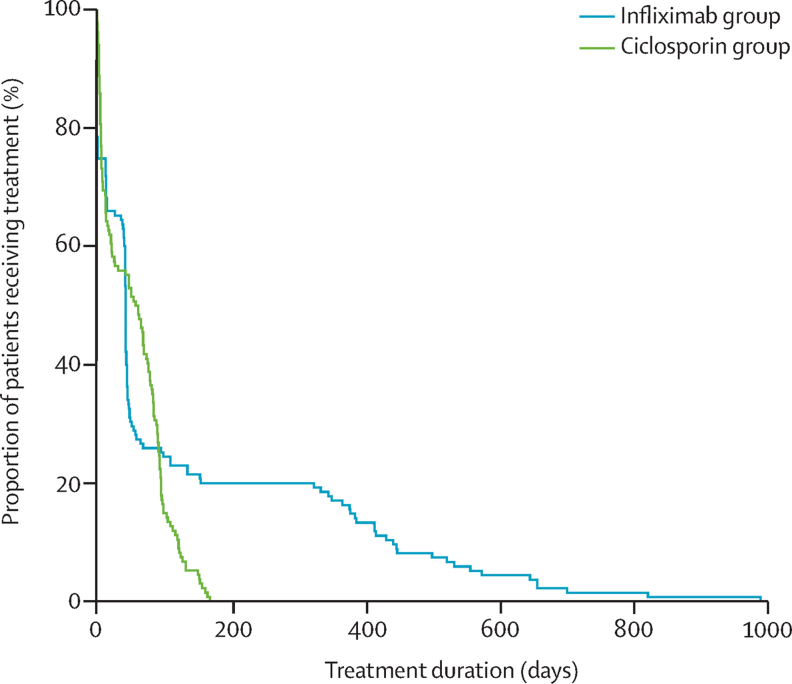
Comment in
-
IBD: Treatment for acute severe ulcerative colitis.Nat Rev Gastroenterol Hepatol. 2016 Aug;13(8):436. doi: 10.1038/nrgastro.2016.112. Epub 2016 Jul 13. Nat Rev Gastroenterol Hepatol. 2016. PMID: 27407042 No abstract available.
-
Infliximab or ciclosporin for acute severe ulcerative colitis?Lancet Gastroenterol Hepatol. 2016 Sep;1(1):2-3. doi: 10.1016/S2468-1253(16)30016-4. Epub 2016 Jun 21. Lancet Gastroenterol Hepatol. 2016. PMID: 28404107 Free PMC article. No abstract available.
References
-
- Dignass A, Eliakim R, Magro F. Second European evidence-based consensus on the diagnosis and management of ulcerative colitis part 1: definitions and diagnosis. J Crohns Colitis. 2012;6:965–990. - PubMed
-
- Burisch J, Jess T, Martinato M, Lakatos PL, ECCO EpiCom The burden of inflammatory bowel disease in Europe. J Crohns Colitis. 2013;7:322–337. - PubMed
-
- Dinesen LC, Walsh AJ, Protic MN. The pattern and outcome of acute severe colitis. J Crohns Colitis. 2010;4:431–437. - PubMed
-
- Chang KH, Burke JP, Coffey JC. Infliximab versus cyclosporine as rescue therapy in acute severe steroid-refractory ulcerative colitis: a systematic review and meta-analysis. Int J Colorectal Dis. 2013;28:287–293. - PubMed
-
- Jarnerot G, Rolny P, Sandberg-Gertzen H. Intensive intravenous treatment of ulcerative colitis. Gastroenterology. 1985;89:1005–1013. - PubMed
Publication types
MeSH terms
Substances
Associated data
LinkOut - more resources
Full Text Sources
Other Literature Sources
Medical
