


High correlation of Middle East respiratory syndrome spread with Google search and Twitter trends in Korea
- PMID: 27595921
- PMCID: PMC5011762
- DOI: 10.1038/srep32920
High correlation of Middle East respiratory syndrome spread with Google search and Twitter trends in Korea
Abstract
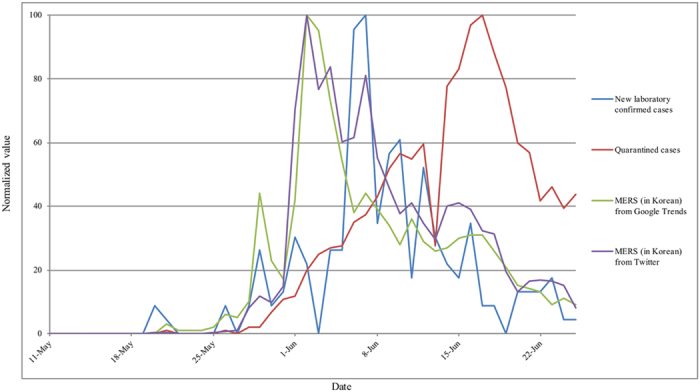
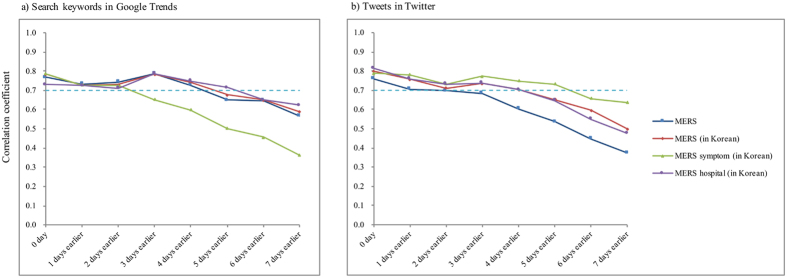
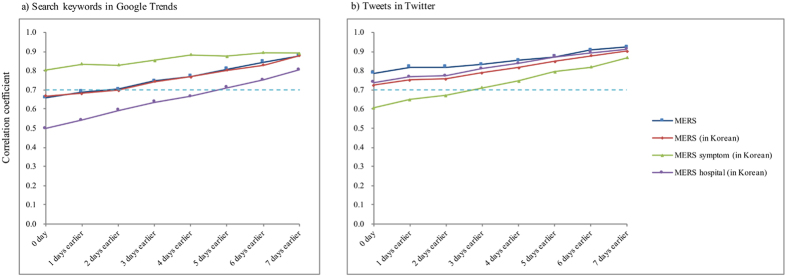
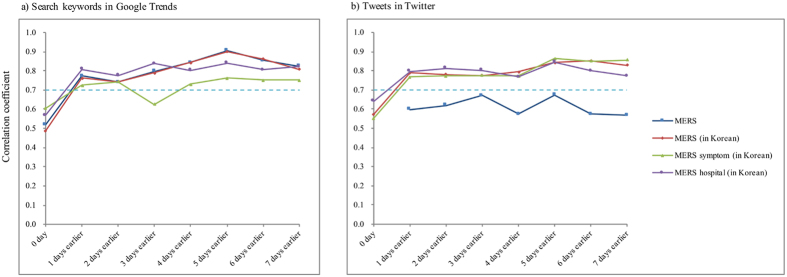
The Middle East respiratory syndrome coronavirus (MERS-CoV) was exported to Korea in 2015, resulting in a threat to neighboring nations. We evaluated the possibility of using a digital surveillance system based on web searches and social media data to monitor this MERS outbreak. We collected the number of daily laboratory-confirmed MERS cases and quarantined cases from May 11, 2015 to June 26, 2015 using the Korean government MERS portal. The daily trends observed via Google search and Twitter during the same time period were also ascertained using Google Trends and Topsy. Correlations among the data were then examined using Spearman correlation analysis. We found high correlations (>0.7) between Google search and Twitter results and the number of confirmed MERS cases for the previous three days using only four simple keywords: "MERS", "" ("MERS (in Korean)"), "" ("MERS symptoms (in Korean)"), and "" ("MERS hospital (in Korean)"). Additionally, we found high correlations between the Google search and Twitter results and the number of quarantined cases using the above keywords. This study demonstrates the possibility of using a digital surveillance system to monitor the outbreak of MERS.
Figures
References
-
- Novel swine-origin influenza A (H1N1) virus investigation team. Emergence of a novel swine-origin influenza A (H1N1) virus in humans. N. Engl. J. Med. 360, 2605–2615 (2009). - PubMed
-
- Zaki A. M., van Boheemen S., Bestebroer T. M., Osterhaus A. D. M. E. & Fouchier R. A. M. Isolation of a Novel Coronavirus from a Man with Pneumonia in Saudi Arabia. New Engl. J. Med. 367, 1814–1820 (2012). - PubMed
-
- World Health Organization. WHO Middle East respiratory syndrome coronavirus (MERS-CoV). Available at: http://www.who.int/emergencies/mers-cov/en/. (Accessed: 20th July 2016).
MeSH terms
LinkOut - more resources
Full Text Sources
Other Literature Sources
