. 2016 Sep 6:6:32831.
doi: 10.1038/srep32831.

Progression of temporal processing deficits in the HIV-1 transgenic rat

Affiliations

Progression of temporal processing deficits in the HIV-1 transgenic rat

Kristen A McLaurin et al. Sci Rep. .

Abstract

The HIV-1 transgenic (Tg) rat, which expresses 7 of the 9 HIV-1 genes, was used to investigate the effect(s) of long-term HIV-1 viral protein exposure on chronic neurocognitive deficits observed in pediatric HIV-1 (PHIV). A longitudinal experimental design was used to assess the progression of temporal processing deficits, a potential underlying dimension of neurocognitive impairment in HIV-1. Gap prepulse inhibition (gap-PPI), a translational experimental paradigm, was conducted every thirty days from postnatal day (PD) 30 to PD 180. HIV-1 Tg animals, regardless of sex, displayed profound alterations in the development of temporal processing, assessed using prepulse inhibition. A differential sensitivity to the manipulation of interstimulus interval was observed in HIV-1 Tg animals in comparison to control animals. Moreover, presence of the HIV-1 transgene was diagnosed with 90.8% accuracy using measures of prepulse inhibition and temporal sensitivity. Progression of temporal processing deficits in the HIV-1 Tg rat affords a relatively untapped opportunity to increase our mechanistic understanding of the role of long-term exposure to HIV-1 viral proteins, observed in pediatric HIV-1, in the development of chronic neurological impairment, as well as suggesting an innovative clinical diagnostic screening tool.


Figures
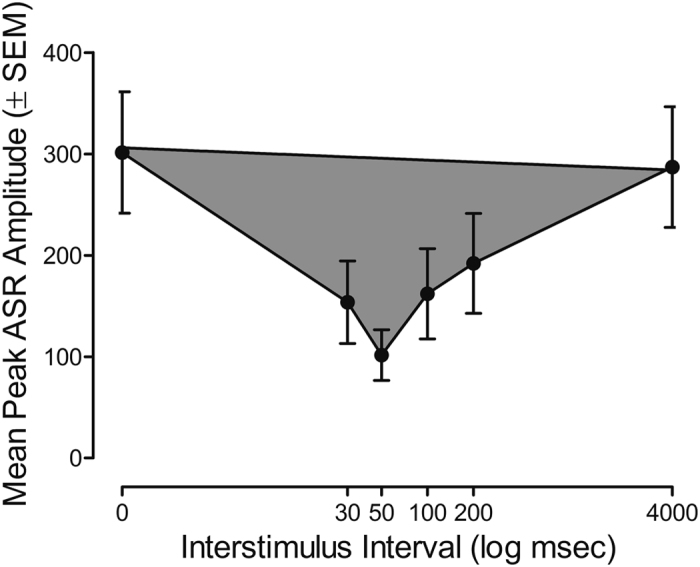
Figure 1
Figure 1. Diagram of the methodology used to derive prepulse inhibition and cumulative frequencies.
Prepulse inhibition was derived using area of the peak inflection, which is shaded in gray. The double arrow indicates the potential shift in maximal inhibition, which occurred as a function of age.
Figure 2
Figure 2
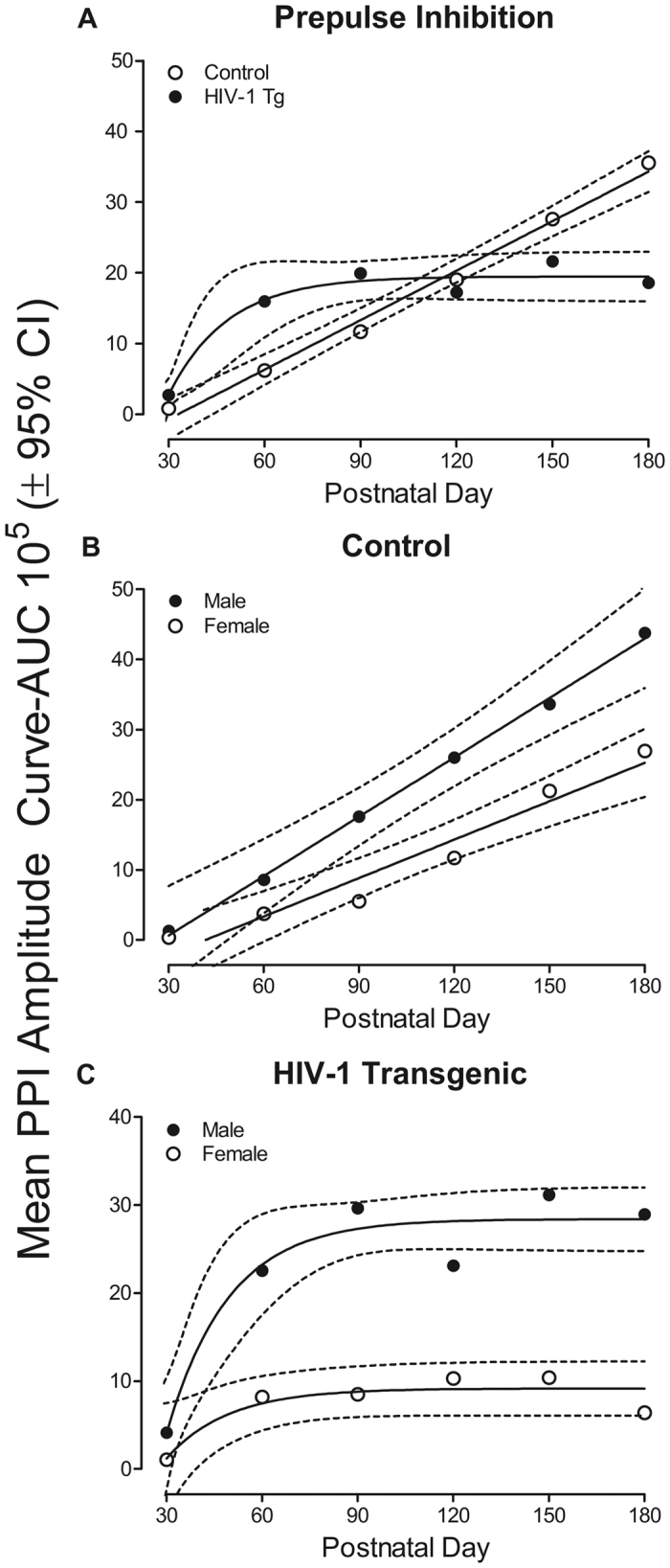
(a) Prepulse inhibition, assessed using mean area of the peak inflection, is illustrated as a function of genotype (HIV-1 Tg or Control) and age (±95% CI). As age increases, control animals exhibit an linear increase in prepulse inhibition. Prepulse inhibition for HIV-1 Tg animals, however, was best fit using a one-phase association. Although control animals develop increased prepulse inhibition across age, HIV-1 Tg animals failed to exhibit an increase in prepulse inhibition after PD 90. Linear regression fit (R2): HIV-1 Tg, 0.96; Control, 0.99. (b) Prepulse inhibition for control animals is illustrated as a function of sex (Male or Female) and age (±95% CI). A first-order polynomial was fit to both male and female control animals. Although a linear increase prepulse inhibition was exhibited by both male and female control animals, there was a significant difference between groups in the rate at which prepulse inhibition increases [F (1,230) = 4.3, p ≤ 0.04]. Linear regression fit (R2): Male, 0.99; Female, 0.95. (c) Prepulse inhibition for HIV-1 Tg animals is illustrated as a function of sex (Male or Female) and age (±95% CI). Prepulse inhibition for both male and female HIV-1 Tg animals was best fit using a one-phase association. Female HIV-1 Tg animals displayed significantly less prepulse inhibition than male HIV-1 Tg animals. Linear regression fit (R2): Male, 0.92; Female, 0.82.
Figure 3
Figure 3
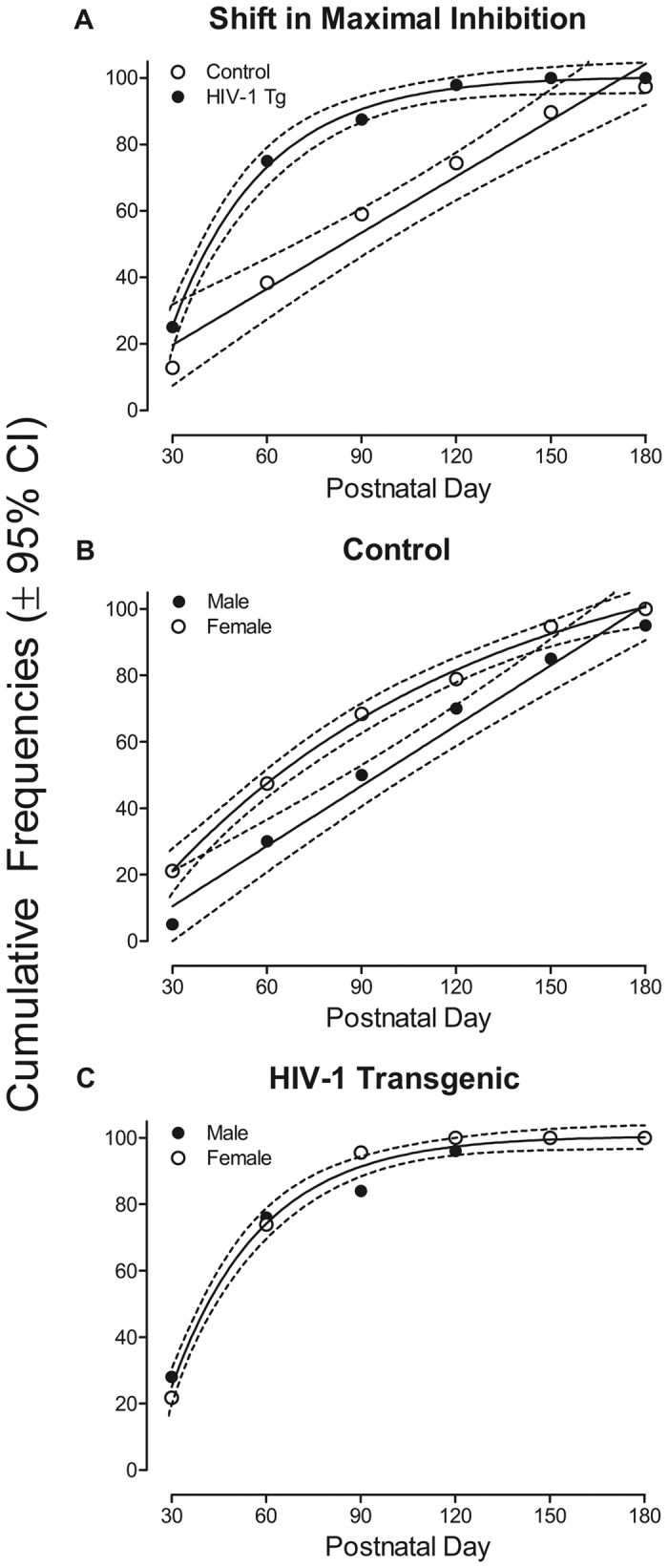
(a) The cumulative frequency for the shift in maximal inhibition from 30 msec to 50 msec is illustrated as a function of genotype (HIV-1 Tg or Control) and age (±95% CI). A shift in temporal processing occurred in both the HIV-1 Tg and control animals, however, the shift occurred significantly earlier in the HIV-1 Tg animals. A one-phase association was the best fit for HIV-1 Tg animals, while a first-order polynomial was the best fit for control animals. Linear regression fit (R2): HIV-1 Tg, 0.99; Control, 0.97. (b) The cumulative frequencies for the shift in maximal inhibition from 30 msec to 50 msec for control animals are illustrated as a function of sex (Male or Female) and age (±95% CI). Female control animals, which were fit using a one-phase association, exhibited a significantly earlier shift in maximal inhibition in comparison to control animals, which were best fit using a first-order polynomial. Linear regression fit (R2): Male, 0.98; Female, 0.99. (c) The cumulative frequencies for the shift in maximal inhibition from 30 msec to 50 msec for HIV-1 Tg animals are illustrated as a function of sex (Male or Female) and age (±95% CI). A one-phase association global fit was the best fit for both male and female HIV-1 Tg animals. Sex, therefore, did not have a significant effect on sensitivity to the manipulation of ISI in HIV-1 Tg animals. Linear regression fit (R2): 0.99.
Figure 4
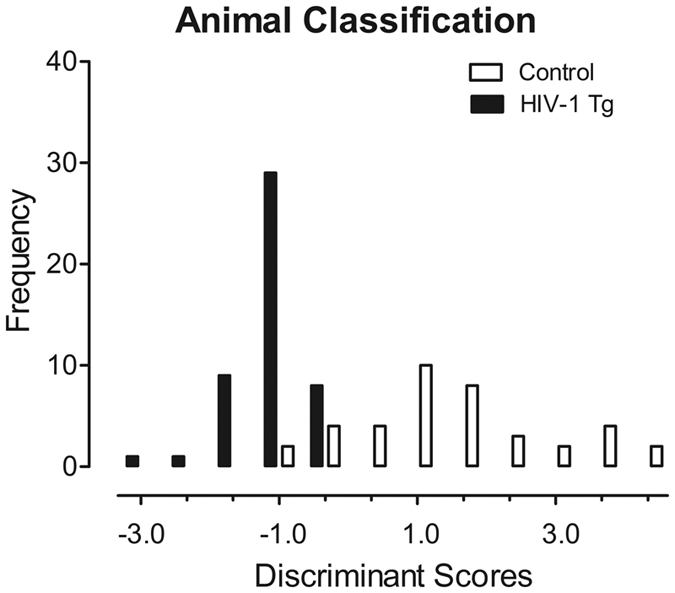
Figure 4. Animal classification is illustrated as a function of the canonical variable representing the simplest linear function that best separated the HIV-1 Tg and control groups (canonical correlation 0.80) and correctly identified (jackknife classification) group membership with 90.8% accuracy (79.5% of controls, and 100% of HIV-1 Tg animals).

References

    1. Franklin S. et al. Longitudinal intellectual assessment of children with HIV infection. J Clin Psychol Med Settings 12, 367–376 (2005).
    1. Paramesparan Y. High rates of asymptomatic neurocognitive impairment in vertically acquired HIV-1-infected adolescents surviving into adulthood. J Acquir Immune Defic Syndr 55, 134–136 (2010). - PubMed
    1. Smith R. & Wilkins M. Perinatally acquired HIV infection: long-term neuropsychological consequences and challenges ahead. Child Neuropsychol 21, 234–268 (2015). - PubMed
    1. Crowell C. S., Malee K. M., Yogev R. & Muller W. J. Neurologic disease in HIV-infected children and the impact of combination antiretroviral therapy. Rev Med Virol 24, 316–331 (2014). - PubMed
    1. Centers for Disease Control and Prevention., Diagnosis of HIV infection in the United States and Dependent Areas (25). Available at: http://www.cdc.gov/hiv/pdf/g-l/hiv_surveillance_ report_vol_25.pdf. (Accessed: 20th June 2016) (2013).

Publication types