


Mexico's path towards the Sustainable Development Goal for health: an assessment of the feasibility of reducing premature mortality by 40% by 2030
- PMID: 27596038
- PMCID: PMC5024342
- DOI: 10.1016/S2214-109X(16)30181-4
Mexico's path towards the Sustainable Development Goal for health: an assessment of the feasibility of reducing premature mortality by 40% by 2030
Abstract
Background: The United Nations Sustainable Development Goal for health (SDG3) poses complex challenges for signatory countries that will require clear roadmaps to set priorities over the next 15 years. Building upon the work of the Commission on Investing in Health and published estimates of feasible global mortality SDG3 targets, we analysed Mexico's mortality to assess the feasibility of reducing premature (0-69 years) mortality and propose a path to meet SDG3.
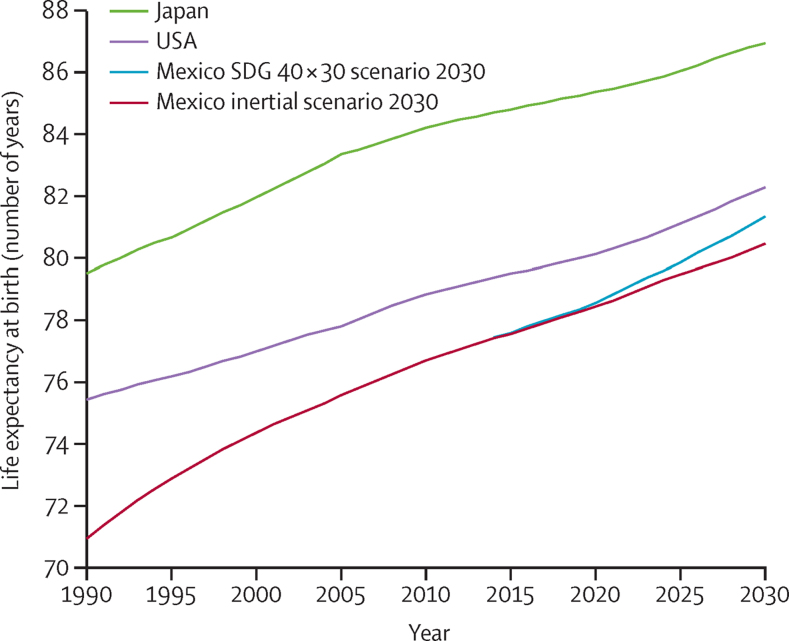
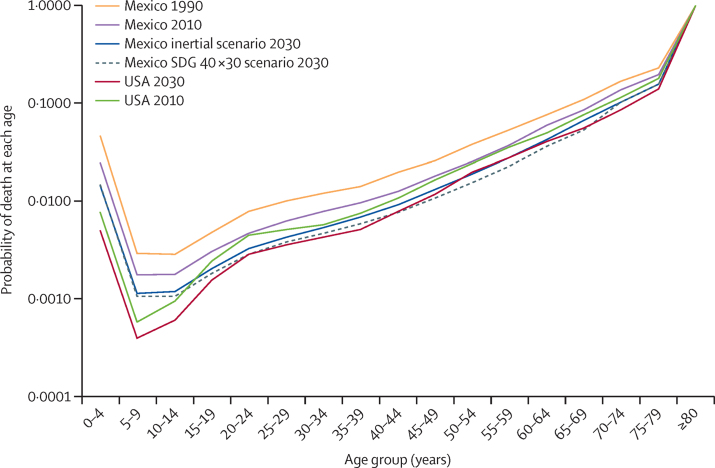
Methods: We developed a baseline scenario applying 2010 age-specific and cause-specific mortality rates from the Mexican National Institute of Statistics and Geography (INEGI) to the 2030 UN Population Division (UNPD) population projections. In a second scenario, INEGI age-specific and cause-specific trends in death rates from 2000 to 2014 were projected to 2030 and adjusted to match the UNPD 2030 mortality projections. A third scenario assumed a 40% reduction in premature deaths across all ages and causes. By comparing these scenarios we quantified shortfalls in mortality reductions by age group and cause, and forecasted life expectancy pathways for Mexico to converge to better performing countries.
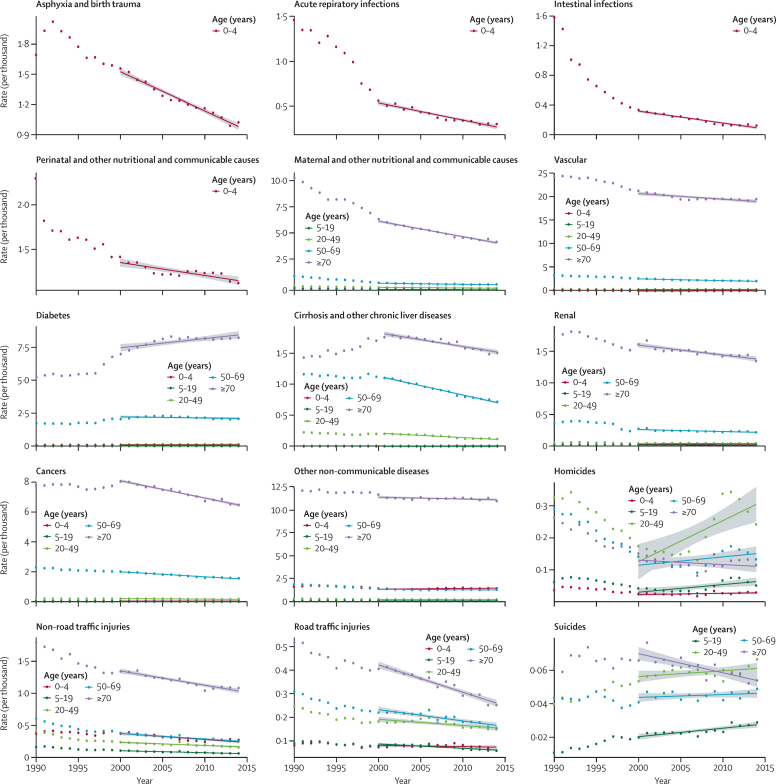
Findings: UNPD-projected death rates yield a 25·9% reduction of premature mortality for Mexico. Accelerated reductions in adult mortality are necessary to reach a 40% reduction by 2030. Mortality declines aggregated across all age groups mask uneven gains across health disorders. Injuries, particularly road traffic accidents and homicides, are the main health challenge for young adults (aged 20-49 years) whereas unabated diabetes mortality is the single most important health concern for older adults (aged 50-69 years).
Interpretation: Urgent action is now required to control non-communicable diseases and reduce fatal injuries in Mexico, making a 40% reduction in premature mortality by 2030 feasible and putting Mexico back on a track of substantial life expectancy convergence with better performing countries. Our study provides a roadmap for setting national health priorities. Further analysis of the equity implications of following the suggested pathway remains a subject of future research.
Funding: Mexico's Ministry of Health, University of California, San Francisco, and Bill & Melinda Gates Foundation.
Copyright © 2016 The Author(s). Published by Elsevier Ltd. This is an Open Access article under the CC BY license. Published by Elsevier Ltd.. All rights reserved.
Figures
Comment in
-
No easy answer for how to tackle Mexico's health challenges.Lancet Glob Health. 2016 Oct;4(10):e668-9. doi: 10.1016/S2214-109X(16)30209-1. Epub 2016 Aug 30. Lancet Glob Health. 2016. PMID: 27596039 No abstract available.
References
-
- United Nations Sustainable Development Goals. 17 goals to transform our world. http://www.un.org/sustainabledevelopment/summit/ (accessed Nov 27, 2015).
-
- Kontis V, Mathers CD, Rehm J. Contribution of six risk factors to achieving the 25 × 25 non-communicable disease mortality reduction target: a modelling study. Lancet. 2014;384:427–437. - PubMed
-
- Norheim OF, Jha P, Admasu K. Avoiding 40% of the premature deaths in each country, 2010–30: review of national mortality trends to help quantify the UN sustainable development goal for health. Lancet. 2015;385:239–252. - PubMed
-
- Stenberg K, Axelson H, Sheehan P, the Study Group for the Global Investment Framework for Women's Children's Health Advancing social and economic development by investing in women's and children's health: a new Global Investment Framework. Lancet. 2014;383:1333–1354. - PubMed
-
- Verguet S, Norheim OF, Olson ZD, Yamey G, Jamison DT. Annual rates of decline in child, maternal, HIV, and tuberculosis mortality across 109 countries of low and middle income from 1990 to 2013: an assessment of the feasibility of post-2015 goals. Lancet Glob Health. 2014;2:e698–e709. - PubMed
Publication types
MeSH terms
LinkOut - more resources
Full Text Sources
Other Literature Sources
Medical
