


The prevalence of women's emotional and physical health problems following a postpartum haemorrhage: a systematic review
- PMID: 27596720
- PMCID: PMC5011962
- DOI: 10.1186/s12884-016-1054-1
The prevalence of women's emotional and physical health problems following a postpartum haemorrhage: a systematic review
Abstract
Background: Postpartum Haemorrhage (PPH) is a leading cause of maternal mortality with approximately 225 women dying as a result of it each day especially in low income countries. However, much less is known about morbidity after a PPH. This systematic review aimed to determine the overall prevalence of emotional and physical health problems experienced by women following a postpartum haemorrhage.
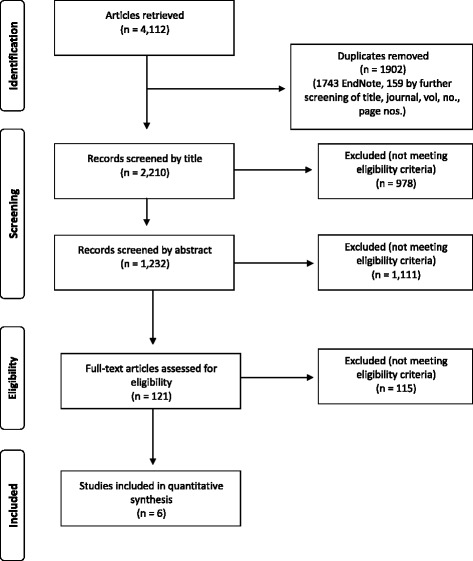
Methods: Eight databases were searched for published non-randomised, observational, including cohort, primary research studies that reported on the prevalence of emotional and/or physical health problems following a PPH. Intervention studies were included and data, if available, were abstracted on the control group. All authors independently screened the papers for inclusion. Of the 2210 papers retrieved, six met the inclusion criteria. Data were extracted independently by two authors. The methodological quality of the included studies was assessed using a modified Newcastle Ottawa Scale (NOS). The primary outcome measure reported was emotional and physical health problems up to 12 months postpartum following a postpartum haemorrhage.
Results: Two thousand two hundred ten citations were identified and screened with 2089 excluded by title and abstract. Following full-text review of 121 papers, 115 were excluded. The remaining 6 studies were included. All included studies were judged as having strong or moderate methodological quality. Five studies had the sequelae of PPH as their primary focus, and one study focused on morbidity postnatally, from which we could extract data on PPH. Persistent morbidities following PPH (at ≥ 3 and < 6 months postpartum) included postnatal depression (13 %), post-traumatic stress disorder (3 %), and health status 'much worse than one year ago' (6 %). Due to the different types of health outcomes reported in the individual studies, it was possible to pool results from only four studies, and only then by accepting the slightly differing definitions of PPH. Those that could be pooled reported rates of acute renal failure (0.33 %), coagulopathy (1.74 %) and re-admission to hospital following a PPH between 1 and 3 months postpartum (3.6 %), an appreciable indication of underlying physical problems.
Conclusion: This systematic review demonstrates that the existence and type of physical and emotional health problems post PPH, regardless of the volume of blood lost, are largely unknown. Further large cohort or case control studies are necessary to obtain better knowledge of the sequelae of this debilitating morbidity.
Keywords: Emotional health problems; Physical health problems; Postpartum haemorrhage; Systematic review.
Figures
References
-
- World Health Organisation . WHO recommendations for the prevention and treatment of postpartum haemorrhage. 2012. - PubMed
-
- Knight M, Tuffnell D, Kenyon S, Shakespeare J, Gray R, Kurinczuk JJ, on behalf of MBRRACE-UK . Saving lives, improving mothers’ care - surveillance of maternal deaths in the UK 2011–13 and lessons learned to inform maternity care from the UK and Ireland confidential enquiries into maternal deaths and morbidity 2009–13. Oxford: National Perinatal Epidemiology Unit, University of Oxford; 2015.
-
- Rocha Filho EA, Costa ML, Cecatti JG, Parpinelli MA, Haddad SM, Pacagnella RC, Sousa MH, Melo EF, Jr, Surita FG, Souza JP. Severe maternal morbidity and near miss due to postpartum haemorrhage in a national multicenter surveillance study. Int J Gynecol Obstet. 2015;128(2):131–6. doi: 10.1016/j.ijgo.2014.08.023. - DOI - PubMed
Publication types
MeSH terms
LinkOut - more resources
Full Text Sources
Other Literature Sources
Medical
Molecular Biology Databases
Miscellaneous
