


Association of Overall Opioid Prescriptions on Adolescent Opioid Abuse
- PMID: 27596964
- PMCID: PMC6212368
- DOI: 10.1016/j.jemermed.2016.06.049
Association of Overall Opioid Prescriptions on Adolescent Opioid Abuse
Abstract
Background: Opioid abuse is a public health epidemic in the United States. Much literature has focused on the prescribing practices of physicians and opioid misuse by adults. However, there are limited data on the effect of opioid prescriptions on adolescent recreational ingestion of these medications.
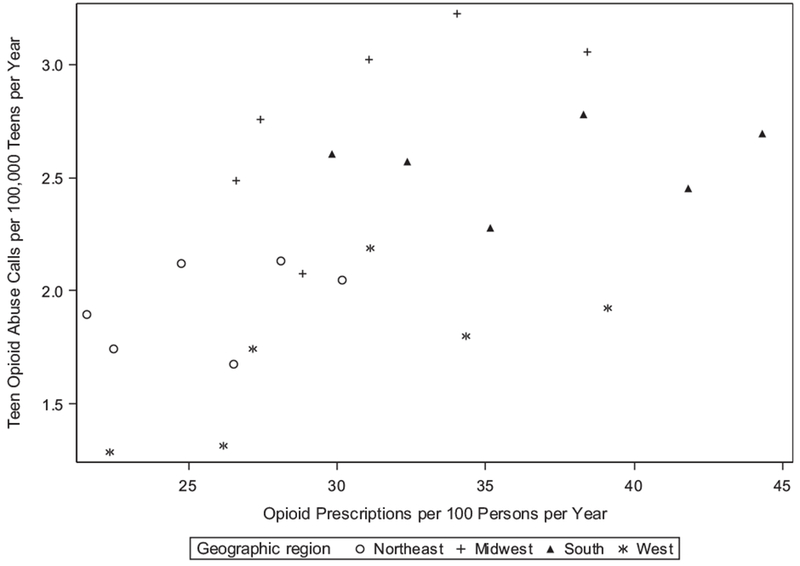
Objectives: The objective of this study was to assess for a relationship between opioid prescribing practices across the United States and adolescent opioid ingestion calls to poison centers.
Methods: This was an observational study using the National Poison Data System. The study population consisted of poison center calls regarding adolescents between 2005 and 2010 in the database with a coding of "intentional abuse" and an opioid ingestion. National opioid prescription estimates were generated using nationally representative outpatient and inpatient databases.
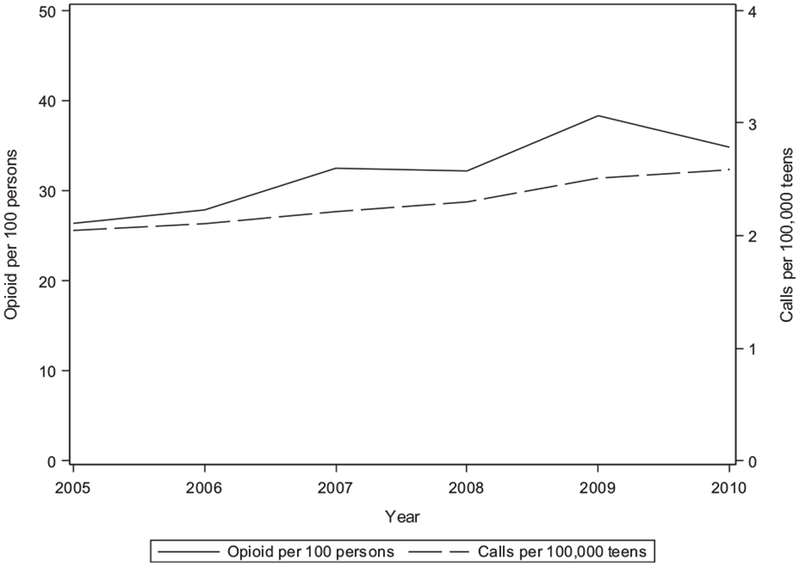
Results: There were 4186 adolescent opioid ingestion calls during the study period. There was a general increase between 2005 and 2010 in both teen opioid abuse calls (617 in 2005 to 782 in 2010) and national opioid prescriptions (approximately 78 million in 2005 to 108 million in 2010). For each opioid prescription increase per 100 persons per year, the annual teen opioid abuse calls increased by 1.8% (95% confidence interval 0.9-2.8%), equivalent to an absolute increase of about 0.04 to 0.05 calls per 100,000 teens annually.
Conclusions: There appears to be an association between opioid prescriptions nationally and poison center calls for adolescent opioid ingestions. This is particularly important in this patient population because of impulsivity and early exposure to substance abuse. Providers should be aware of the nonmedical use of opioids by adolescents and educate patients accordingly.
Keywords: adolescent; child; ingestion; medicine; opioid pain.
Copyright © 2016 Elsevier Inc. All rights reserved.
Figures
References
-
- Mazer-Amirshahi M, Mullins PM, Rasooly I, van den Anker J, Pines JM. Rising opioid prescribing in adult U.S. emergency department visits: 2001–2010. Acad Emerg Med 2014;21:236–43. - PubMed
-
- Mazer-Amirshahi M, Mullins PM, Rasooly IR, van den Anker J, Pines JM. Trends in prescription opioid use in pediatric emergency department patients. Pediatr Emerg Care 2014;30:230–5. - PubMed
Publication types
MeSH terms
Substances
Grants and funding
LinkOut - more resources
Full Text Sources
Other Literature Sources
Medical
