


Urinary Polyamines: A Pilot Study on Their Roles as Prostate Cancer Detection Biomarkers
- PMID: 27598335
- PMCID: PMC5012650
- DOI: 10.1371/journal.pone.0162217
Urinary Polyamines: A Pilot Study on Their Roles as Prostate Cancer Detection Biomarkers
Abstract
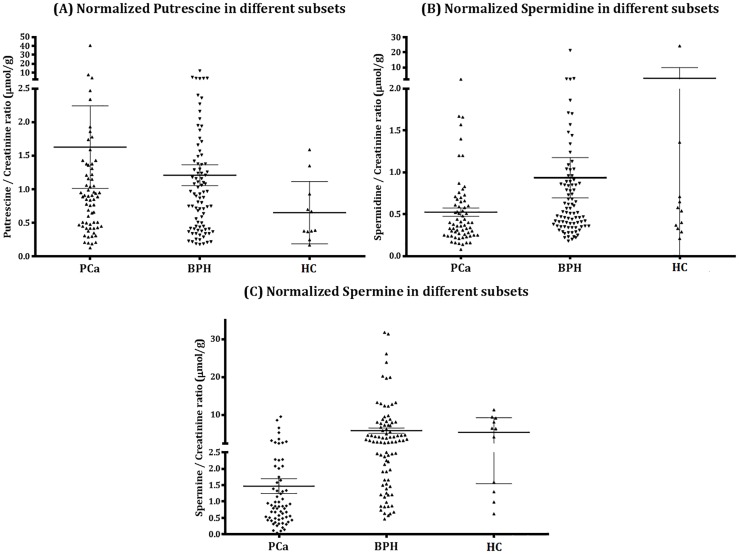
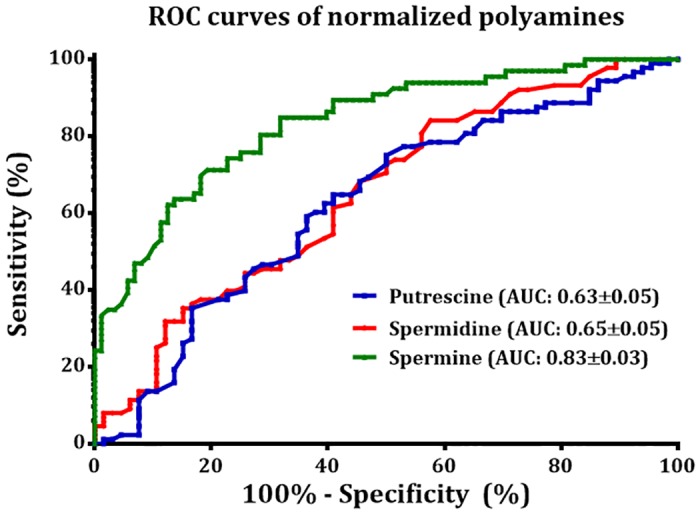
Current screening methods towards prostate cancer (PCa) are not without limitations. Research work has been on-going to assess if there are other better tests suitable for primary or secondary screening of PCa to supplement the serum prostate specific antigen (PSA) test, which fails to work accurately in a grey zone of 4-10ng/ml. In this pilot study, the potential roles of urinary polyamines as prostate cancer biomarkers were evaluated. PCa, benign prostatic hyperplasia (BPH) patients and healthy controls (HC) showing PSA>4.0ng/ml were enrolled in the study. Their urine samples were obtained, and the urinary levels of putrescine (Put), spermidine (Spd) and spermine (Spm) were determined by ultra-high performance liquid chromatography coupled with triple quadrupole mass spectrometer (UPLC-MS/MS). Receiver operating characteristics (ROC) curve and Student's t-test were used to evaluate their diagnostic accuracies. Among the three biogenic polyamines, Spm had demonstrated a good diagnostic performance when comparing their levels in PCa patients with BPH patients (1.47 in PCa vs 5.87 in BPH; p<0.0001). Results are in accordance with transrectal ultrasound prostatic biopsy (TRUSPB) results, with an area under curve (AUC) value of 0.83±0.03. Therefore urinary Spm shows potential to serve as a novel PCa diagnostic biomarker, which in turn can help to address the limited sensitivity and specificity problem of serum PSA test.
Conflict of interest statement
The authors have declared that no competing interests exist.
Figures
References
-
- Schroder FH, Kruger AB, Rietbergen J, Kranse R. Evaluation of the Digital Rectal Examination as a Screening Test for Prostate Cancer. JNCI. 1998;90(23):1817–23. - PubMed
-
- Benson MC, Whang IS, Pantuck A, Ring K, Kaplan SA, Olsson CA, et al. Prostate specific antigen density: a means of distinguishing benign prostatic hypertrophy and prostate cancer. J Urol. 1992;147:815–6. - PubMed
MeSH terms
Substances
LinkOut - more resources
Full Text Sources
Other Literature Sources
Medical
Research Materials
Miscellaneous
