


Screening for ROS1 gene rearrangements in non-small-cell lung cancers using immunohistochemistry with FISH confirmation is an effective method to identify this rare target
- PMID: 27599111
- PMCID: PMC5225047
- DOI: 10.1111/his.13076
Screening for ROS1 gene rearrangements in non-small-cell lung cancers using immunohistochemistry with FISH confirmation is an effective method to identify this rare target
Abstract
Aims: To assess the prevalence of ROS1 rearrangements in a retrospective and prospective diagnostic Australian cohort and evaluate the effectiveness of immunohistochemical screening.
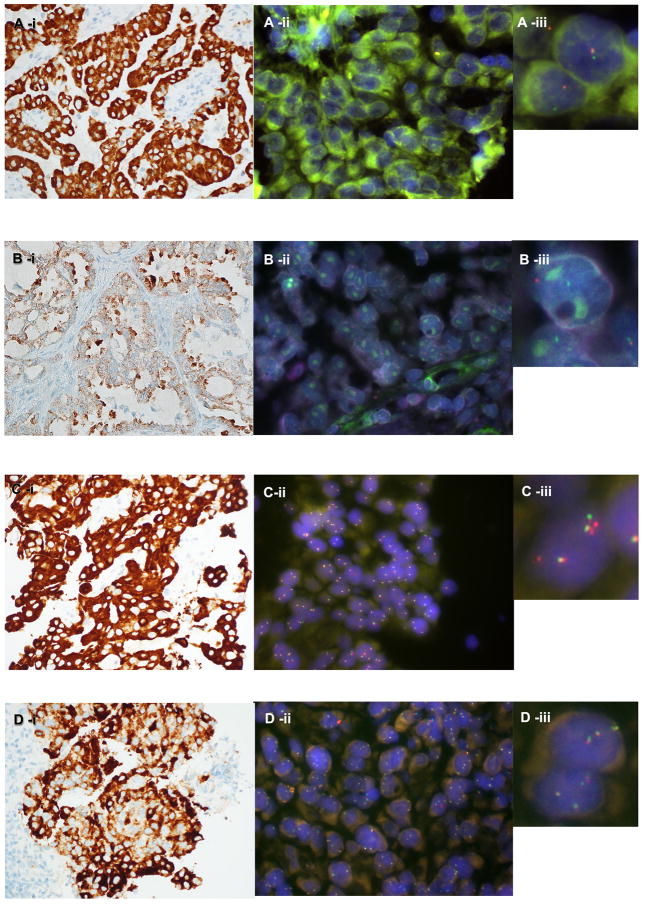
Methods and results: A retrospective cohort of 278 early stage lung adenocarcinomas and an additional 104 prospective non-small-cell lung cancer (NSCLC) cases referred for routine molecular testing were evaluated. ROS1 immunohistochemistry (IHC) was performed (D4D6 clone, Cell Signaling Technology) on all cases as well as fluorescence in-situ hybridization (FISH) using the ZytoVision and Abbott Molecular ROS1 FISH probes, with ≥15% of cells with split signals considered positive for rearrangement. Eighty-eight cases (32%) from the retrospective cohort showed staining by ROS1 IHC, and one case (0.4%) showed ROS1 rearrangement by FISH. Nineteen of the prospective diagnostic cases showed ROS1 IHC staining, 12 (12%) cases of which were confirmed as ROS1 rearranged by FISH. There were no ROS1 rearranged cases that showed no expression of ROS1 with IHC. The ROS1 rearranged cases in the prospective cohort were all EGFR wild-type and anaplastic lymphoma kinase (ALK) rearrangement-negative. The sensitivity of ROS1 IHC in the retrospective cohort was 100% and specificity was 76%.
Conclusions: ROS1 rearrangements are rare events in lung adenocarcinomas. Selection of cases for ROS1 FISH testing, by excluding EGFR/ALK-positive cases and use of IHC to screen for potentially positive cases, can be used to enrich for the likelihood of identifying a ROS1 rearranged lung cancer and prevent the need to undertake expensive and time-consuming FISH testing in all cases.
Keywords: c-ros oncogene 1 (ROS1); fluorescence in-situ hybridization (FISH); immunohistochemistry (IHC); non-small-cell lung cancer (NSCLC).
© 2016 John Wiley & Sons Ltd.
Conflict of interest statement
W. Cooper has participated in Lung Cancer Advisory Boards and has received honoraria from Pfizer Oncology. S. O’Toole has received honoraria from Roche, Pfizer, and Lilly Oncology. A. Gill has received honoraria from Pfizer Oncology and Astra Zeneca. N. Pavlakis has participated in Lung Cancer Advisory Boards for Pfizer, and received honoraria. The other authors state that they have no conflicts of interest.
Figures
References
-
- Ou S-HI, Tan J, Yen Y, Soo RA. ROS1 as a “druggable” receptor tyrosine kinase: lessons learned from inhibiting the ALK pathway. Expert Rev Anticancer Ther. 2012 Apr;12(4):447–56. - PubMed
-
- Uttamsingh S, Zong CS, Wang L-H. Matrix-independent activation of phosphatidylinositol 3-kinase, Stat3, and cyclin A-associated Cdk2 Is essential for anchorage-independent growth of v-Ros-transformed chicken embryo fibroblasts. J Biol Chem. 2003 May 23;278(21):18798–810. - PubMed
MeSH terms
Substances
Grants and funding
LinkOut - more resources
Full Text Sources
Other Literature Sources
Medical
Research Materials
Miscellaneous
