Comment
doi: 10.7554/eLife.20196.
Signaling a link between interferon and the traits of Down syndrome
Affiliations
- PMID: 27599162
- PMCID: PMC5012856
- DOI: 10.7554/eLife.20196
Item in Clipboard
Comment
Signaling a link between interferon and the traits of Down syndrome
Elife.
.
Abstract
Elevated interferon signaling is a hallmark of Down syndrome.
Keywords: JAK inhibitors; chromosomes; down syndrome; genes; human; human biology; interferon; medicine; mouse; ruxolitinib; trisomy 21.
Conflict of interest statement
The authors declare that no competing interests exist.
Figures
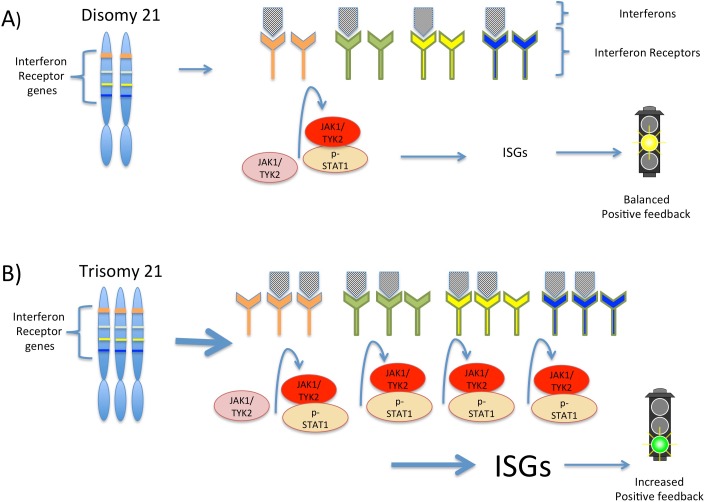
(A) Chromosome 21 encodes four types of interferon receptors. In cells with two copies of this chromosome (disomy 21), the binding of interferons to the receptors activates two kinases, JAK1and TYK2. These kinases activate the transcription factor STAT1, which then transcribes a set of genes known as interferon stimulated genes (ISGs). (B) In cells with three copies of chromosome 21 (trisomy 21), as in Down syndrome, the increased abundance of interferon receptors increases the transcription of ISGs, including the genes that encode interferons themselves. This ultimately leads to increased positive feedback and hyperactivated interferon signaling, which can damage the cell.
Comment on
-
Trisomy 21 consistently activates the interferon response.Elife. 2016 Jul 29;5:e16220. doi: 10.7554/eLife.16220. Elife. 2016. PMID: 27472900 Free PMC article.
References
-
- Li Z, Yu T, Morishima M, Pao A, LaDuca J, Conroy J, Nowak N, Matsui S, Shiraishi I, Yu YE. Duplication of the entire 22.9 Mb human chromosome 21 syntenic region on mouse chromosome 16 causes cardiovascular and gastrointestinal abnormalities. Human Molecular Genetics. 2007;16:1359–1366. doi: 10.1093/hmg/ddm086. - DOI - PubMed
Publication types
MeSH terms
Substances
Grants and funding
LinkOut - more resources
Full Text Sources
Other Literature Sources
Medical