. 2016 Nov 18;84(12):3268-3281.
doi: 10.1128/IAI.00608-16. Print 2016 Dec.

Genomic Landscape of Intrahost Variation in Group A Streptococcus: Repeated and Abundant Mutational Inactivation of the fabT Gene Encoding a Regulator of Fatty Acid Synthesis

Affiliations

Genomic Landscape of Intrahost Variation in Group A Streptococcus: Repeated and Abundant Mutational Inactivation of the fabT Gene Encoding a Regulator of Fatty Acid Synthesis

Jesus M Eraso et al. Infect Immun. .

Abstract

To obtain new information about Streptococcus pyogenes intrahost genetic variation during invasive infection, we sequenced the genomes of 2,954 serotype M1 strains recovered from a nonhuman primate experimental model of necrotizing fasciitis. A total of 644 strains (21.8%) acquired polymorphisms relative to the input parental strain. The fabT gene, encoding a transcriptional regulator of fatty acid biosynthesis genes, contained 54.5% of these changes. The great majority of polymorphisms were predicted to deleteriously alter FabT function. Transcriptome-sequencing (RNA-seq) analysis of a wild-type strain and an isogenic fabT deletion mutant strain found that between 3.7 and 28.5% of the S. pyogenes transcripts were differentially expressed, depending on the growth temperature (35°C or 40°C) and growth phase (mid-exponential or stationary phase). Genes implicated in fatty acid synthesis and lipid metabolism were significantly upregulated in the fabT deletion mutant strain. FabT also directly or indirectly regulated central carbon metabolism genes, including pyruvate hub enzymes and fermentation pathways and virulence genes. Deletion of fabT decreased virulence in a nonhuman primate model of necrotizing fasciitis. In addition, the fabT deletion strain had significantly decreased survival in human whole blood and during phagocytic interaction with polymorphonuclear leukocytes ex vivo We conclude that FabT mutant progeny arise during infection, constitute a metabolically distinct subpopulation, and are less virulent in the experimental models used here.


Figures

FIG 1
FIG 1
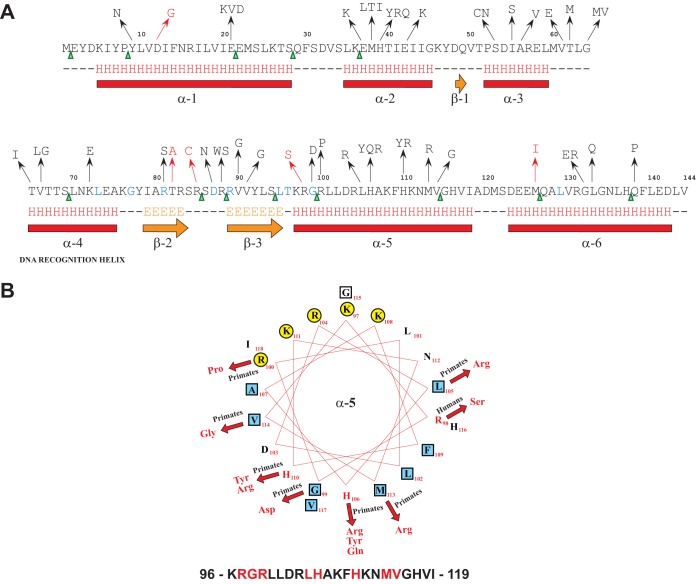
Location of nonsynonymous substitutions within FabT. (A) Secondary-structure prediction for FabT derived from Jpred. Nonsynonymous substitutions are represented in black (mutations identified in isolates cultured from nonhuman primates) and red (mutations identified in isolates cultured from humans). Stop codons are represented by green arrowheads (mutations identified in isolates cultured from nonhuman primates). The residues in blue are conserved among members of the MarR superfamily of proteins. (B) Helical-wheel representation of the FabT amphipathic alpha helix 5 (α5). The amino acid sequence, with the mutated residues in red, is shown at the bottom; polar and hydrophobic residues are represented by yellow circles and blue squares, respectively. The resulting nonsynonymous substitutions are shown in red, and the arrows denote the corresponding changes. Primates, nonhuman primates; Humans, host from which the respective mutated GAS strain was isolated.
FIG 2
FIG 2
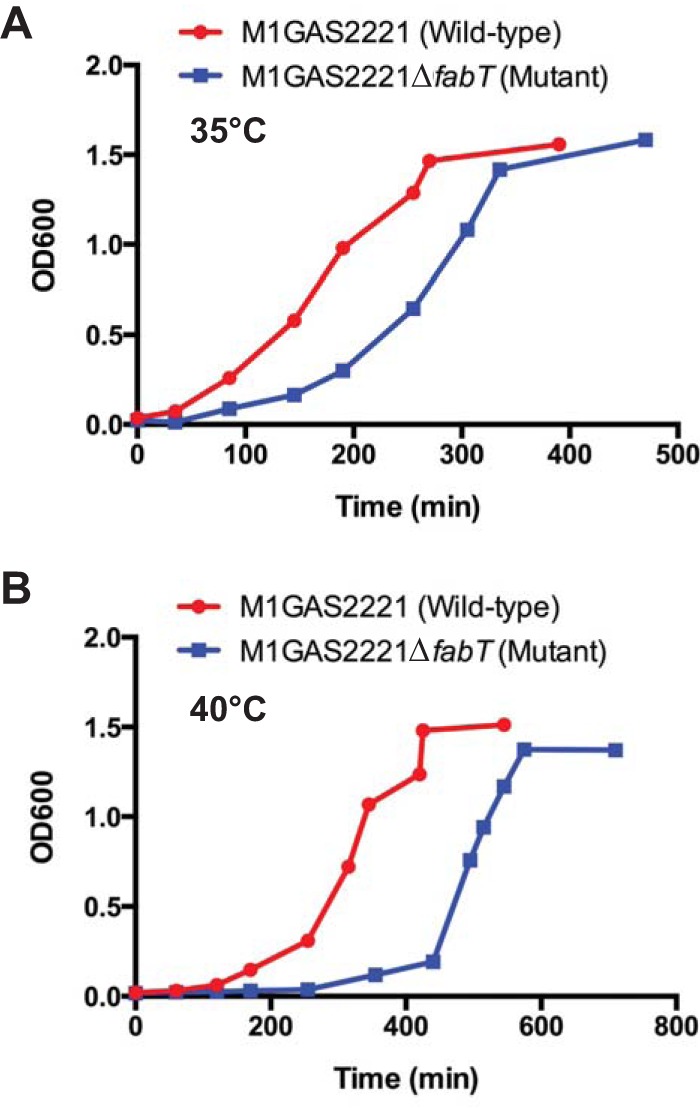
Growth curves. The wild-type strain MGAS2221 and the FabT deletion strain MGAS2221ΔfabT were grown at 35°C (A) and 40°C (B) in THY medium.
FIG 3
FIG 3
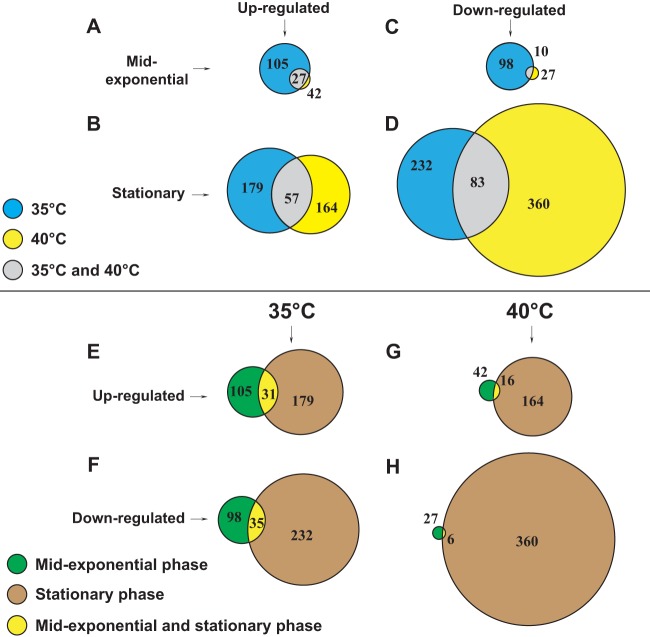
Area-proportional Venn diagrams representing differentially expressed genes. (A to D) Genes differentially expressed at 35°C and 40°C. Common genes differentially expressed at both growth temperatures are also depicted. (A) Genes upregulated during mid-exponential phase. (B) Genes upregulated during stationary phase. (C) Genes downregulated during mid-exponential phase. (D) Genes downregulated during stationary phase. (E to H) Genes differentially expressed during mid-exponential and stationary phases. Common genes differentially expressed during both phases of growth are also depicted (E) Genes upregulated at 35°C. (F) Genes downregulated at 35°C. (G) Genes upregulated at 40°C. (H) Genes downregulated at 40°C.
FIG 4
FIG 4
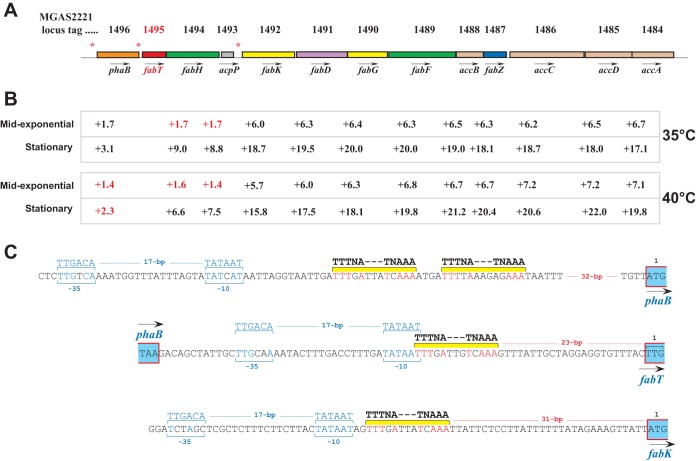
Regulation of fab genes by FabT. (A) The Fab cluster of GAS, showing the locations of three putative FabT-binding DNA sequences (asterisks) located in front of phaB, fabT, and fabK. fabT is depicted in red. (B) Fold expression of each gene at both temperatures and phases of growth. The values in red indicate either that the differential fold expression was below the allotted 1.5 or that the P value was excluded after applying the Bonferroni correction. (C) Figure representing the regulatory regions of phaB, fabT, and fabK, with putative promoter sequences and FabT-binding DNA sequences indicated. Nucleotide residues matching the promoter sequence and FabT site are indicated in blue and red, respectively.
FIG 5
FIG 5
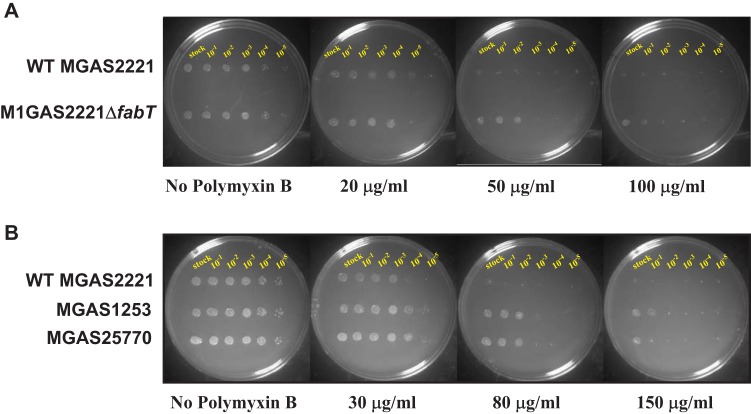
MGAS2221ΔfabT shows increased resistance to polymyxin B. (A) Spot dilution assay of wild-type strain MGAS2221 and the fabT deletion mutant on THY plates containing either 0, 20, 50, or 100 μg/ml polymyxin B. Shown from left to right are undiluted and 10−1- to 10−5-diluted samples of a mid-logarithmic phase culture grown in THY medium. (B) Spot dilution assay of wild-type strain MGAS2221 and strains MGAS1253 and MGAS25770 on THY plates containing 0, 30, 80, or 150 μg/ml polymyxin B. The last two strains were isolated from patients with invasive disease and contain single nucleotide insertions within the fabT gene: MGAS1253, A15 insertion, SF370-like strain isolated around 1920 (12); MGAS25770, A106 insertion, 5005-like strain isolated in 2006 (12).
FIG 6
FIG 6
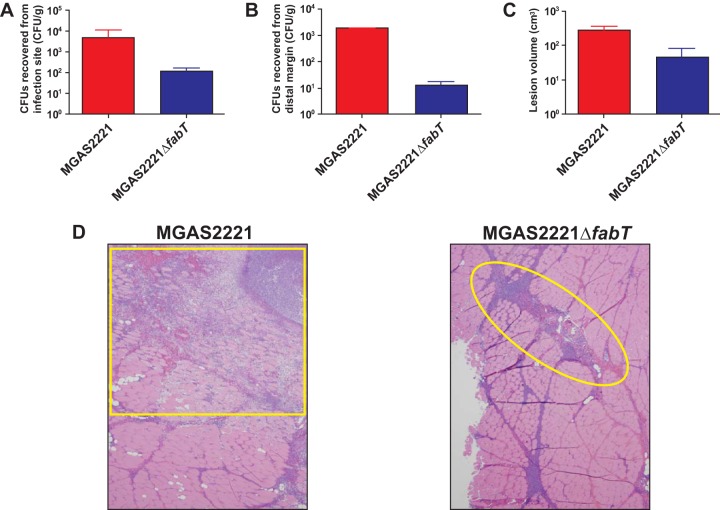
The fabT deletion strain is less virulent in a nonhuman primate model of necrotizing fasciitis. Cynomolgus macaques were inoculated intramuscularly in the anterior thigh. (A) CFU recovered from the inoculation site in the thigh. (B) CFU recovered from the distal muscle margin near the hip. (C) Lesion size. The error bars indicate standard errors of the mean (SEM). (D) Histopathology. The boxed region in the left micrograph shows that the wild-type strain causes extensive fascial necrosis, muscle cell destruction, and hemorrhage at the inoculation site. The circled region in the right micrograph shows that strain MGAS2221ΔfabT causes less severe necrotizing fasciitis. Original magnification, ×4.
FIG 7
FIG 7
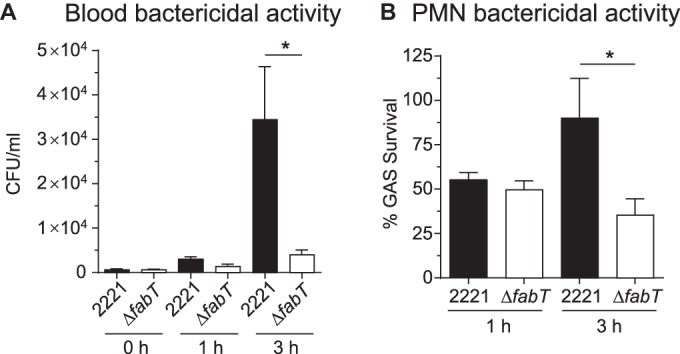
The fabT deletion strain is more susceptible to blood and PMN killing than the wild-type strain. (A) Strains were exposed to blood bactericidal activity and assayed at 0, 1, and 3 h. (B) Strains were exposed to PMNs, and bactericidal activity was assayed at 0 and 3 h. The results are means and SEM of data from 9 separate experiments. *, P < 0.05 using a paired t test.

References

    1. Cunningham MW. 2000. Pathogenesis of group A streptococcal infections. Clin Microbiol Rev 13:470–511. doi: 10.1128/CMR.13.3.470-511.2000. - DOI - PMC - PubMed
    1. Musser JM, Shelburne SA III. 2009. A decade of molecular pathogenomic analysis of group A Streptococcus. J Clin Invest 119:2455–2463. doi: 10.1172/JCI38095. - DOI - PMC - PubMed
    1. Henningham A, Barnett TC, Maamary PG, Walker MJ. 2012. Pathogenesis of group A streptococcal infections. Discov Med 13:329–342. - PubMed
    1. Cohen-Poradosu R, Kasper DL. 2007. Group A streptococcus epidemiology and vaccine implications. Clin Infect Dis 45:863–865. doi: 10.1086/521263. - DOI - PubMed
    1. Bessen DE. 2009. Population biology of the human restricted pathogen, Streptococcus pyogenes. Infect Genet Evol 9:581–593. doi: 10.1016/j.meegid.2009.03.002. - DOI - PMC - PubMed