Review
. 2016 Sep 6;11(1):115.
doi: 10.1186/s13014-016-0693-8.

A critical review of recent developments in radiotherapy for non-small cell lung cancer

Affiliations
Review

A critical review of recent developments in radiotherapy for non-small cell lung cancer

Sarah Baker et al. Radiat Oncol. .

Abstract

Lung cancer is the leading cause of cancer mortality, and radiotherapy plays a key role in both curative and palliative treatments for this disease. Recent advances include stereotactic ablative radiotherapy (SABR), which is now established as a curative-intent treatment option for patients with peripheral early-stage NSCLC who are medically inoperable, or at high risk for surgical complications. Improved delivery techniques have facilitated studies evaluating the role of SABR in oligometastatic NSCLC, and encouraged the use of high-technology radiotherapy in some palliative settings. Although outcomes in locally advanced NSCLC remain disappointing for many patients, future progress may come about from an improved understanding of disease biology and the development of radiotherapy approaches that further reduce normal tissue irradiation. At the moment, the benefits, if any, of radiotherapy technologies such as proton beam therapy remain unproven. This paper provides a critical review of selected aspects of modern radiotherapy for lung cancer, highlights the current limitations in our understanding and treatment approaches, and discuss future treatment strategies for NSCLC.

Keywords: Intensity-modulated radiotherapy; Non-small cell lung cancer; Proton therapy; Radiotherapy; Stereotactic ablative radiotherapy.


Figures
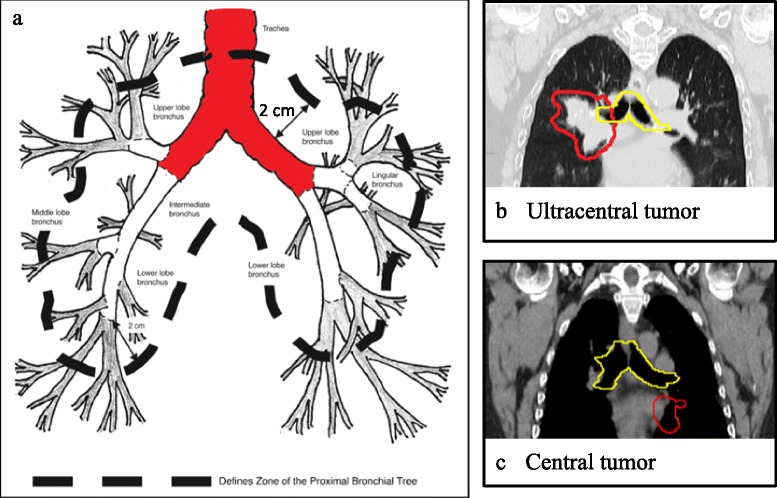
Fig. 1
Fig. 1
Definitions and examples of central and ultra-central lung tumors. a Diagram of the central airways of the lung. Reprinted with permission. ©2006. American Society of Clinical Oncology. All rights reserved. Timmerman, R et al.: J Clin Oncol 24(30), 2006: 4833–9. The black dashed line defines the location of tumors that are central relative to the proximal bronchial tree. The term central has been widened to include the region within 2 cm in all directions of any mediastinal critical structure, including the bronchial tree/trachea, esophagus, heart, brachial plexus, major vessels, spinal cord, phrenic nerve, and recurrent laryngeal nerve. The region shaded red shows the trachea and main bronchi, and lesions with a PTV which overlaps \this region are considered as ultracentral. b Example of an ultracentral tumor (planning target volume in red, and main bronchi/trachea in yellow). c Example of a central tumor
Fig. 2
Fig. 2
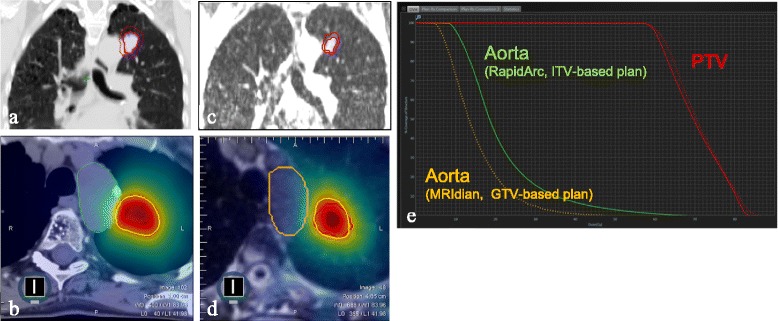
Comparative treatment plans for MRI-guided radiotherapy using breath-hold versus a standard free-breathing internal target volume (ITV)-based approach for a central tumor in a patient with interstitial lung disease. Panel a shows the ITV (7.8 cc) for a RapidArc (volumetric modulated arc therapy) plan, to which a 5 mm margin was added to derive a planning target volume (PTV, 26 cc); panel b the corresponding dose color-wash for an 8 fraction stereotactic ablative radiotherapy scheme to 60 Gy. Treatment was delivered using on-line MRI guided breath-hold on the MRIdian in which the target was the gross tumor volume (6.9 cc, Panel c), to which a 3 mm setup PTV margin was added (PTV 13.6 cc). Panel d shows the MRIdian dose color-wash, and Panel e the dose volume histograms for the adjacent aorta for both plans
Fig. 3
Fig. 3
A comparison of two radiotherapy techniques delivering 66 Gy in 33 fractions to a locally-advanced lung tumor. Panels a-c show axial, coronal, and sagittal views of a hybrid-intensity-modulated radiotherapy (IMRT) plan; panels d-f show the corresponding views of a volumetric modulated arc therapy (VMAT) plan for the same tumor. Panel g shows the dose-volume histogram of the hybrid IMRT plan (triangles) and VMAT plan (squares); the red and blue lines to the right represent the planning target volume (PTV) and internal target volume (ITV) respectively; the remaining pair of blue lines represent the lung volume (lung tissue outside the PTV). PTV and ITV coverage is comparable for both techniques (g). The VMAT plan has a more conformal 95 % isodose (green line) around the PTV (d-f compared with a-c), however the maximum dose in the PTV is higher (g). The amount of lung receiving ≤20 Gy is very similar with both techniques (g), but the VMAT plan has a lower mean lung dose (19.5 Gy vs 22 Gy with hybrid-IMRT) and the hybrid-IMRT plan has more contralateral lung sparing, as seen by the position of low-dose isodose lines (orange [1320 cGy] and light blue [660 cGy])
Fig. 4
Fig. 4
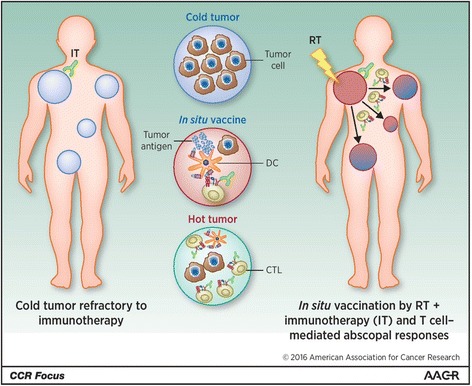
Reprinted with permission. Theresa L. Whiteside et al. Clin Cancer Res 2016;22:1845–1855. Schematic representation of immune-mediated abscopal effects. The systemic proinflamatory effects of irradiating a tumor mass results in it being ‘hot’, and acting as an ‘in situ tumor vaccine’ against distant non-irradiated tumors. Such a local response could be enhanced by administering immunostimulatory antibodies in order to attain an enhanced systemic effect, thereby exploiting the immune effects of radiotherapy. CTL, cytotoxic T cell; RT, radiotherapy

References

    1. Ferlay J, Soerjomataram I, Dikshit R, Eser S, Mathers C, Rebelo M, et al. Cancer incidence and mortality worldwide: sources, methods and major patterns in GLOBOCAN 2012. Int J Cancer. 2015;136:E359–86. doi: 10.1002/ijc.29210. - DOI - PubMed
    1. Eberhardt WE, De Ruysscher D, Weder W, Le Péchoux C, De Leyn P, Hoffmann H, et al. 2nd ESMO consensus conference in lung cancer: locally advanced stage III non-small-cell lung cancer. Ann Oncol. 2015;26:1573–88. doi: 10.1093/annonc/mdv187. - DOI - PubMed
    1. Vansteenkiste J, De Ruysscher D, Eberhardt WEE, Lim E, Senan S, Felip E, et al. Early and locally advanced non-small-cell lung cancer (NSCLC): ESMO clinical practice guidelines for diagnosis, treatment and follow-up. Ann Oncol. 2013;24:vi89–98. doi: 10.1093/annonc/mdt241. - DOI - PubMed
    1. Chetty IJ, Devpura S, Liu D, Chen D, Li H, Wen NW, et al. Correlation of dose computed using different algorithms with local control following stereotactic ablative radiotherapy (SABR)-based treatment of non-small-cell lung cancer. Radiother Oncol. 2013;109:498–504. doi: 10.1016/j.radonc.2013.10.012. - DOI - PubMed
    1. Keall PJ, Mageras GS, Balter JM, Emery RS, Forster KM, Jiang SB, et al. The management of respiratory motion in radiation oncology report of AAPM task group 76. Med Phys. 2006;33:3874–900. doi: 10.1118/1.2349696. - DOI - PubMed

MeSH terms