


Review
doi: 10.1038/ncomms12647.
Multidimensional materials and device architectures for future hybrid energy storage
Affiliations
- PMID: 27600869
- PMCID: PMC5023960
- DOI: 10.1038/ncomms12647
Item in Clipboard
Review
Multidimensional materials and device architectures for future hybrid energy storage
Nat Commun.
.
Abstract
Electrical energy storage plays a vital role in daily life due to our dependence on numerous portable electronic devices. Moreover, with the continued miniaturization of electronics, integration of wireless devices into our homes and clothes and the widely anticipated ‘Internet of Things', there are intensive efforts to develop miniature yet powerful electrical energy storage devices. This review addresses the cutting edge of electrical energy storage technology, outlining approaches to overcome current limitations and providing future research directions towards the next generation of electrical energy storage devices whose characteristics represent a true hybridization of batteries and electrochemical capacitors.
Figures
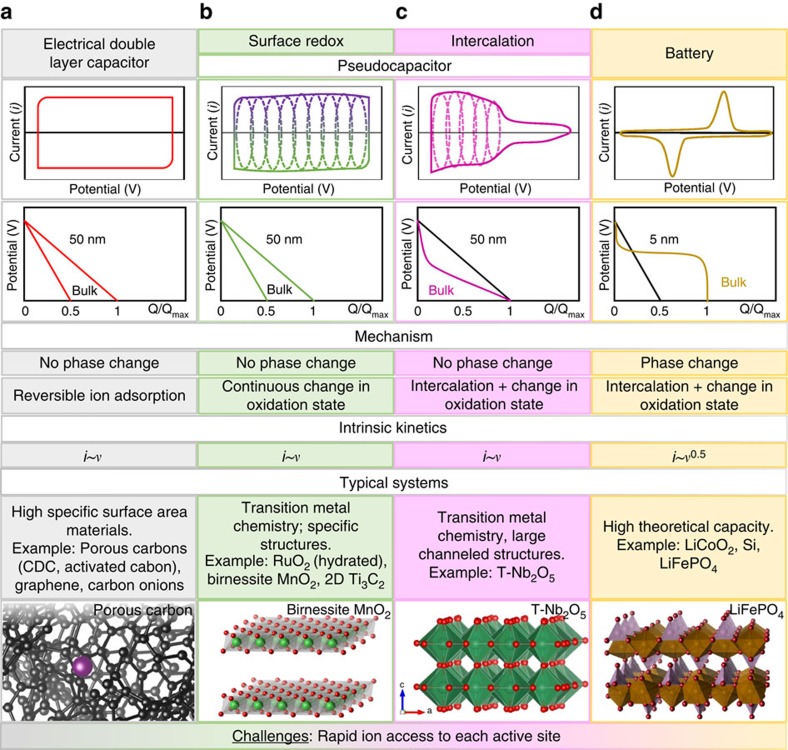
Summary of the characteristic metrics such as cyclic voltammetry, galvanostatic profiles, key mechanism descriptions and typical systems that are known to utilize the mentioned charge storage mechanisms: (a) double-layer capacitor (examples: porous carbons (carbide derived carbon, activated carbon91), graphene, carbon onions and nanotubes92), (b) surface redox pseudocapacitance due to adsorption and/or fast intercalation of ions (examples: hydrated RuO2 (ref. 93), birnessite MnO2 (ref. 12), MXene Ti3C2 (ref. 15)), (c) intercalation pseudocapacitance (example: T-Nb2O5 (ref. 17)) and (d) batteries (examples: LiCoO2 (ref. 94), Si, LiFePO4 (ref. 1)). i=current, v=sweep rate. Crystal structures were plotted in Vesta. Different colours in the plots indicate different storage mechanisms.
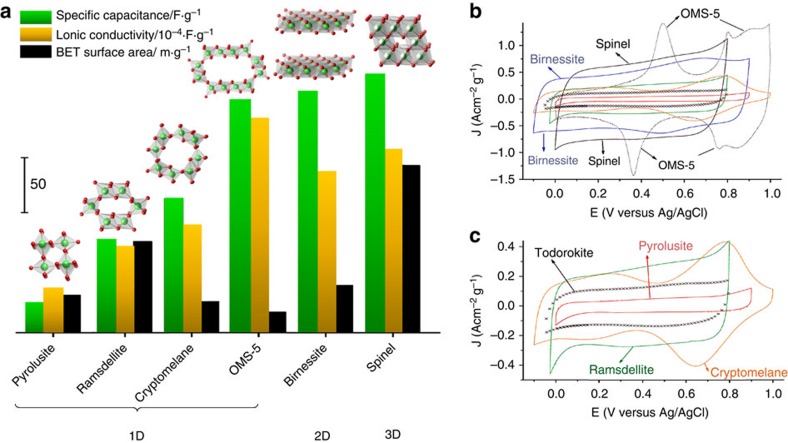
(a) Relative values of the specific capacitance, ionic conductivity and SSA of different MnO2 forms with 1D, 2D and 3D pore channels. (b,c) CV profiles collected in 0.5 M K2SO4 at 5 mVs−1 show distinctly different behaviour as a function of structure for materials of the same chemical composition (MnO2), but having different crystal structures with different sizes and shapes of crystallographic channels. Adapted from ref. (Copyright 2009 American Chemical Society).
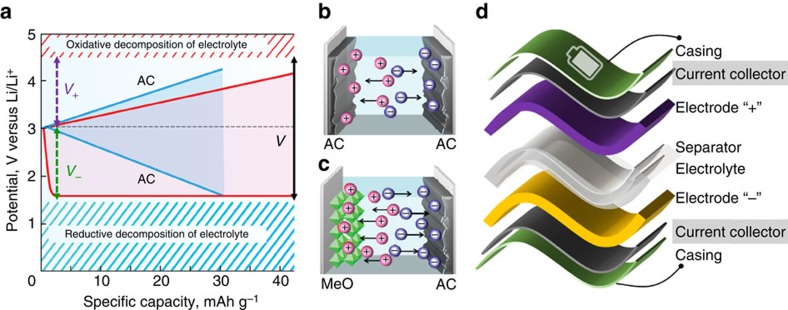
(a) Schematic plot of the electrode potentials (V+ and V−) and cell potential (V) versus specific capacity for symmetric (blue lines) and hybrid (red lines) configurations. (b) Typical symmetric configuration featuring activated carbon (AC) as both positive and negative electrodes. (c) Example of hybrid device consisting of an insertion metal oxide (MeO) negative electrode (anode) combined with a high surface area carbon positive electrode (cathode) such as AC. Panels (a–c) were reproduced from ref. (Copyright 2013 American Chemical Society). (d) Components of typical energy storage cell.
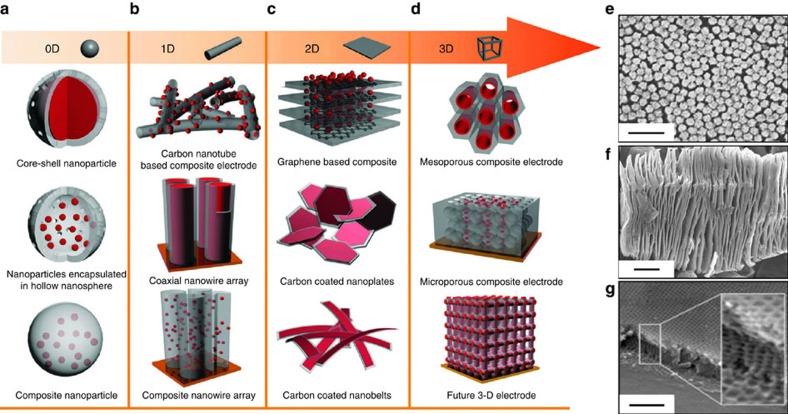
Schematic of heterogeneous nanostructures based on 0D (a), 1D (b), 2D (c), 3D (d) structure motifs. Panels (a–d) reproduced from ref. (Copyright 2011 Royal Society of Chemistry) and pomegranate composite electrode illustration from ref. (Copyright 2014 Nature Publishing Group). Examples of mesoporous architectures. (e) CdSe nanoparticles assembly. Reproduced from ref. (Copyright 2011 Nature Publishing Group). (f) Ti3C2Tx nanolaminates (MXene). Reproduced from ref. (Copyright 2014 Elsevier Publishing Company). (g) Mesoporous Nb2O5 film. Reproduced from ref. (Copyright 2010 American Chemical Society).

(a) Insertion materials: change in electrode oxidation state (+/− me−) is accompanied by cation (Cat) insertion/extraction. Black colour signifies electrode material in its original state, green colour stands for reduced state (+me−), and violet colour stands for oxidized state (−me−). (b) Rechargeable metal anodes: charge-carrying cations (orange spheres) are reversibly reduced to metal (green block) on the negative electrode, (c) charge-carrying ions change their oxidation state without conversion to solid phase. Left side of the schematic stands for the processes related to cations which get reduced by me− on the negative electrode; right side of the schematic illustrates generalized processes that take place on the positive electrode, when anions (An) are oxidized losing ne−. (d) Sample cyclic voltammogram in electrolyte containing organic molecules with multiple redox-active groups.
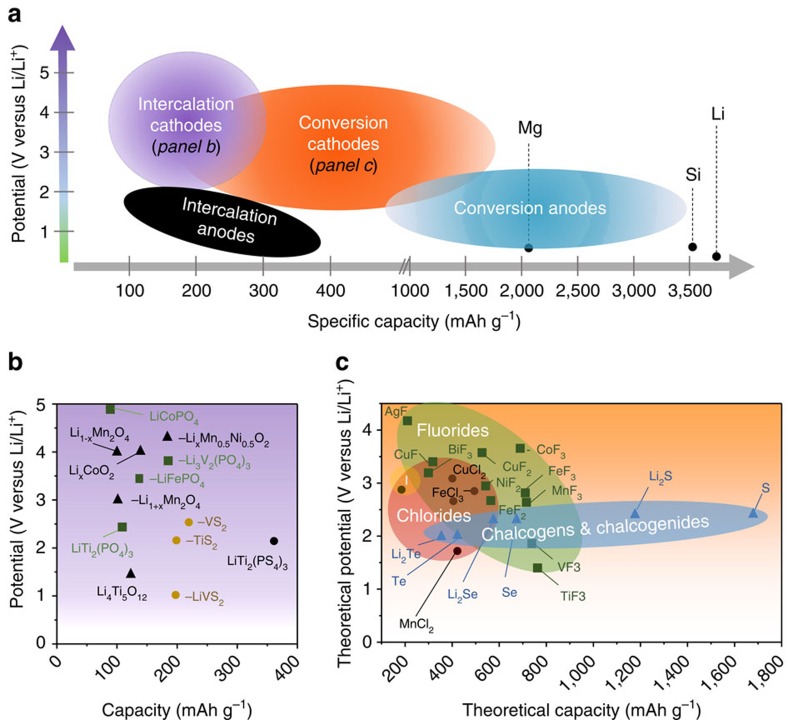
(a) Overview of the average discharge potentials and specific capacities for different types of electrodes. Adapted from ref. (Copyright 2014 Elsevier Publishing Company). (b) Intercalation-type cathodes (experimental). Adapted from ref. (Copyright 2010 American Chemical Society). (c) Conversion-type cathodes (theoretical). Adapted from ref. (Copyright 2014 Elsevier Publishing Company).
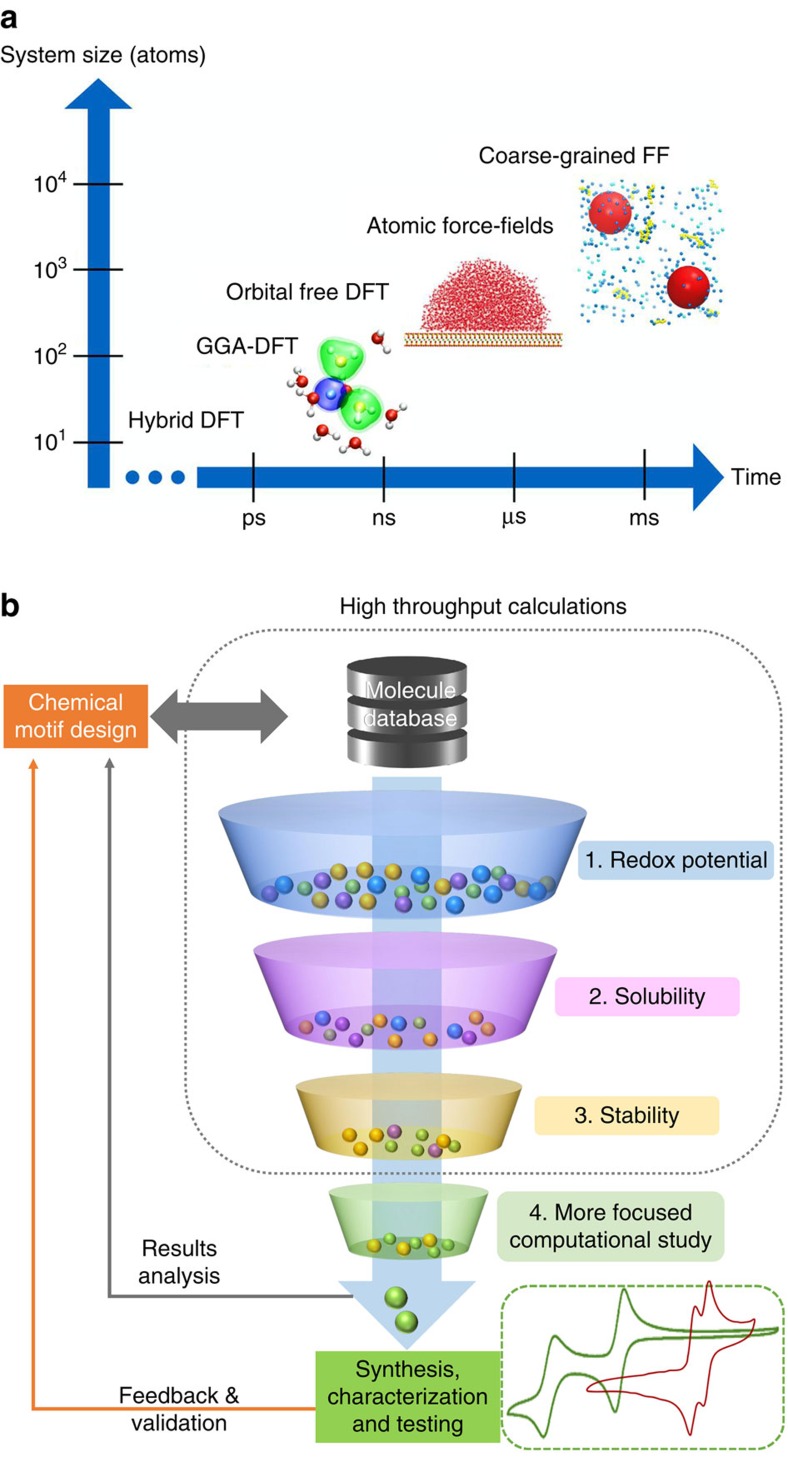
(a) Schematic representation of the computational techniques applied depending on system size; increased system complexity results in longer computation times. FF stands for force field. Image is courtesy of M. Salanne, Pierre and Marie Curie University, with snapshots reproduced from ref. (Copyright 2012 American Institute of Physics), ref. (Copyright 2011 American Chemical Society) and adapted from ref. (Copyright 2007 American Institute of Physics). (b) Schematic of down-selection of candidate molecules for electrical energy storage applications based on high-throughput computations using quantum chemical calculations of specific properties. Based on screening, selected molecules can be subjected to further focused computational studies and proposed for synthesis and testing. Adapted from ref. (Copyright 2015 American Chemical Society).
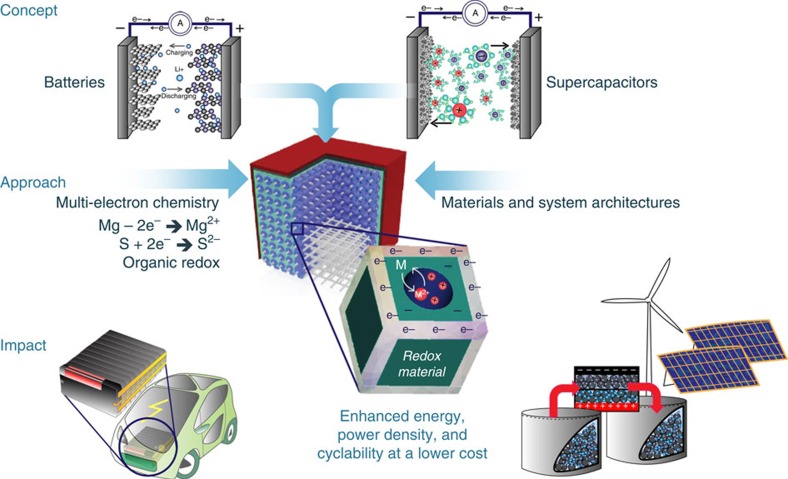
Conceptual presentation of development of fully integrated rechargeable hybrid battery-supercapacitor (supercapbattery) electrical energy storage devices. Image courtesy of K. Jost, Drexel University.
References
-
- Armand M. & Tarascon J. M. Building better batteries. Nature 451, 652–657 (2008). - PubMed
-
- Simon P. & Gogotsi Y. Materials for electrochemical capacitors. Nat. Mater. 7, 845–854 (2008) Defined key research directions in the field of supercapacitors and pseudocapacitors. - PubMed
-
- Chu S. & Majumdar A. Opportunities and challenges for a sustainable energy future. Nature 488, 294–303 (2012). - PubMed
-
- Dunn B., Kamath H. & Tarascon J. M. Electrical energy storage for the grid: a battery of choices. Science 334, 928–935 (2011). - PubMed
-
- Dubal D. P., Ayyad O., Ruiz V. & Gomez-Romero P. Hybrid energy storage: the merging of battery and supercapacitor chemistries. Chem. Soc. Rev. 44, 1777–1790 (2015) Review of current approaches to hybrid energy storage. - PubMed
Publication types
LinkOut - more resources
Full Text Sources
Other Literature Sources
