


Risk of global spread of Middle East respiratory syndrome coronavirus (MERS-CoV) via the air transport network
- PMID: 27601536
- PMCID: PMC7531608
- DOI: 10.1093/jtm/taw063
Risk of global spread of Middle East respiratory syndrome coronavirus (MERS-CoV) via the air transport network
Abstract
Background: Middle East respiratory syndrome coronavirus (MERS-CoV) emerged from the Kingdom of Saudi Arabia (KSA) in 2012 and has since spread to 26 countries. All cases reported so far have either been in the Middle East or linked to the region through passenger air travel, with the largest outbreak outside KSA occurring in South Korea. Further international spread is likely due to the high travel volumes of global travel, as well as the occurrence of large annual mass gathering such as the Haj and Umrah pilgrimages that take place in the region.
Methods: In this study, a transport network modelling framework was used to quantify the risk of MERS-CoV spreading internationally via air travellers. All regions connected to MERS-CoV affected countries via air travel are considered, and the countries at highest risk of travel-related importations of MERS-CoV were identified, ranked and compared with actual spread of MERS cases.
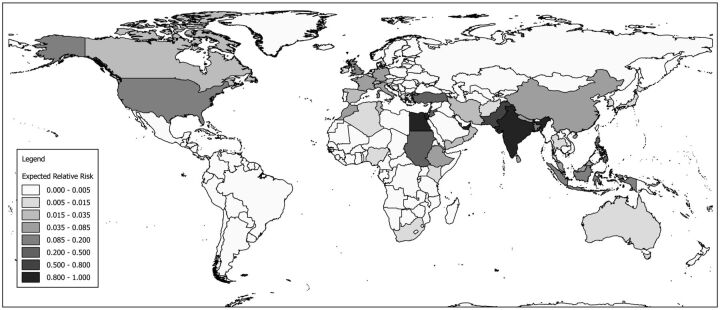
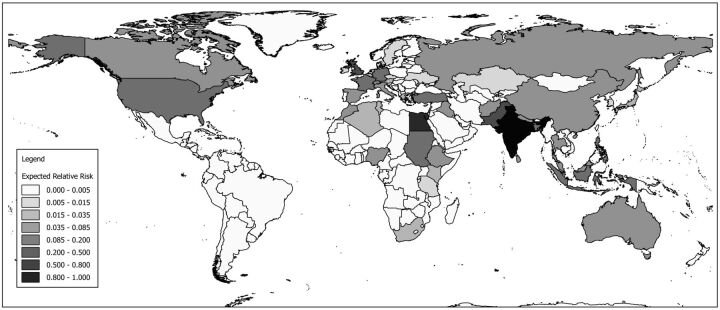
Results: The model identifies all countries that have previously reported a travel acquired case to be in the top 50 at-risk countries. India, Pakistan and Bangladesh are the highest risk countries which have yet to report a case, and should be prepared for the possibility of (pilgrims and general) travellers returning infected with MERS-CoV. In addition, the UK, Egypt, Turkey and the USA are at risk of more cases.
Conclusions: We have demonstrated a risk-analysis approach, using travel patterns, to prioritize countries at highest risk for MERS-CoV importations. In order to prevent global outbreaks such as the one seen in South Korea, it is critical for high-risk countries to be prepared and have appropriate screening and triage protocols in place to identify travel-related cases of MERS-CoV. The results from the model can be used by countries to prioritize their airport and hospital screening and triage protocols.
Keywords: MERS-CoV; air travel; network modeling; risk.
© International Society of Travel Medicine, 2016. All rights reserved. Published by Oxford University Press. For permissions, please e-mail: journals.permissions@oup.com.
Figures
References
-
- World Health Organisation (WHO). Middle East Respiratory Syndrome Coronavirus (MERS-CoV). Vol 2016: World Health Organization, 2016.
-
- World Health Organisation (WHO). Middle East Respiratory Syndrome Coronavirus (MERS-CoV) fact sheet. Vol 2016: World Health Organization, 2016.
-
- World Health Organisation (WHO). Outbreaks and Emergencies. MERS-CoV in Republic of Korea at a Glance as of 29 July 2015. Vol 2016: World Health Organization, 2016.
-
- IATA (IATA). Air passenger market analysis, December 2015. http://www.iata.org/whatwedo/Documents/economics/passenger-analysis-dec-....
MeSH terms
LinkOut - more resources
Full Text Sources
Other Literature Sources
Medical
