. 2016 Sep 20;113(38):10655-60.
doi: 10.1073/pnas.1611596113. Epub 2016 Sep 6.

Circulating microRNA signature for the diagnosis of very high-risk prostate cancer

Affiliations

Circulating microRNA signature for the diagnosis of very high-risk prostate cancer

Ali H Alhasan et al. Proc Natl Acad Sci U S A. .

Abstract

We report the identification of a molecular signature using the Scano-miR profiling platform based on the differential expression of circulating microRNAs (miRNA, miR) in serum samples specific to patients with very high-risk (VHR) prostate cancer (PCa). Five miRNA PCa biomarkers (miR-200c, miR-605, miR-135a*, miR-433, and miR-106a) were identified as useful for differentiating indolent and aggressive forms of PCa. All patients with VHR PCa in the study had elevated serum levels of miR-200c. Circulating miR-433, which was differentially expressed in patients with VHR versus low-risk (LR) forms of PCa, was not detectable by quantitative real-time PCR in samples from healthy volunteers. In blind studies, the five miRNA PCa biomarkers were able to differentiate patients with VHR PCas from those with LR forms as well as healthy individuals with at least 89% accuracy. Biological pathway analysis showed the predictive capability of these miRNA biomarkers for the diagnosis and prognosis of VHR aggressive PCa.

Keywords: Scano-miR; biomarker; microRNA; prostate cancer; spherical nucleic acid.


Conflict of interest statement

The authors declare no conflict of interest.

Figures
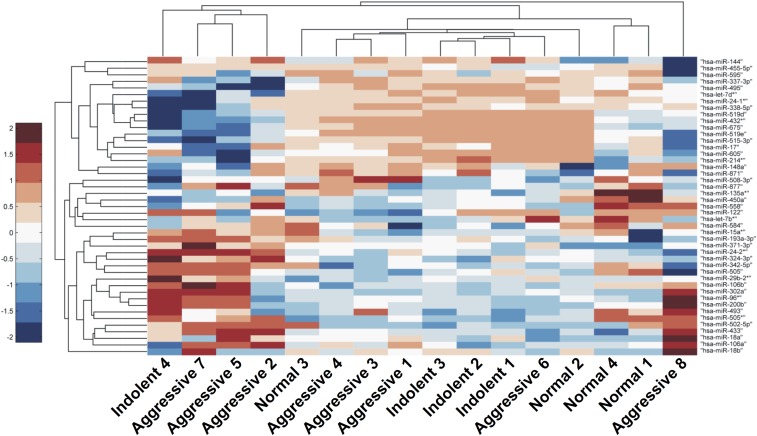
Fig. S1.
Fig. S1.
Heat map of all coexpressed miRNAs. Hierarchical clustering was performed on 45 coexpressed miRNAs using the Pearson correlation metric. Included miRNA are expressed to some extent in aggressive (n = 8) and control samples (indolent PCa and healthy individuals, n = 8). Samples from patients with aggressive PCa generally cluster together and have globally up-regulated serum miRNA expression.
Fig. S2.
Fig. S2.
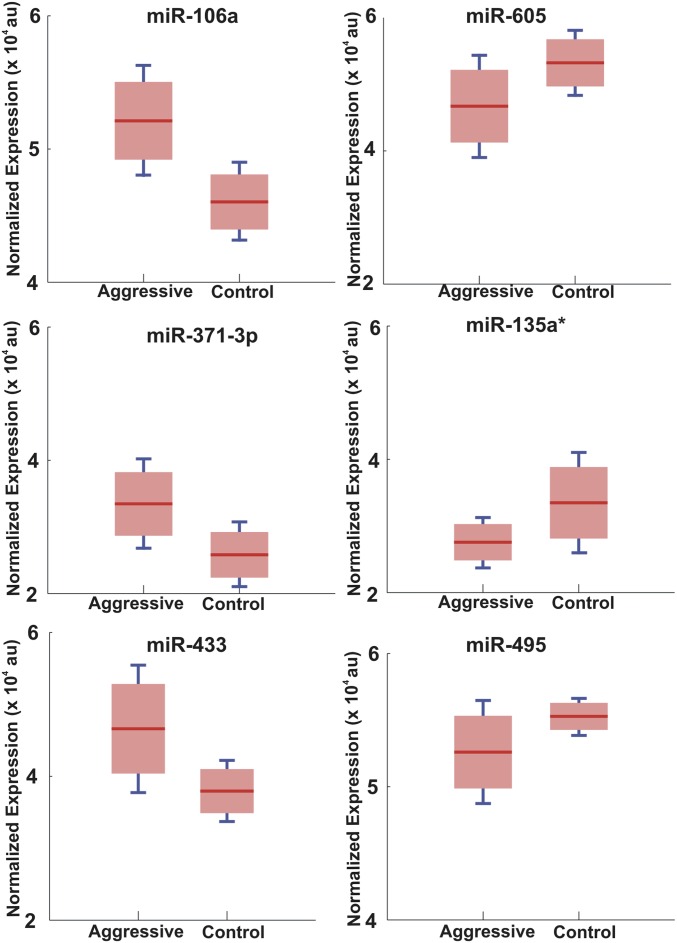
Identification of differentially expressed miRNAs using the Scano-miR assay. Boxplots represent the background-subtracted, normalized distributions of six differentially expressed miRNAs. The red bar represents the median, whereas the blue bar represents the interquartile range of distribution (permutation t test; miR-106a, P = 0.0017; miR-371–3p, P = 0.0089; miR-433, P = 0.0115; miR = 605, P = 0.0301; miR-135a*, P = 0.0319; miR-495, P = 0.0411).
Fig. 1.
Fig. 1.
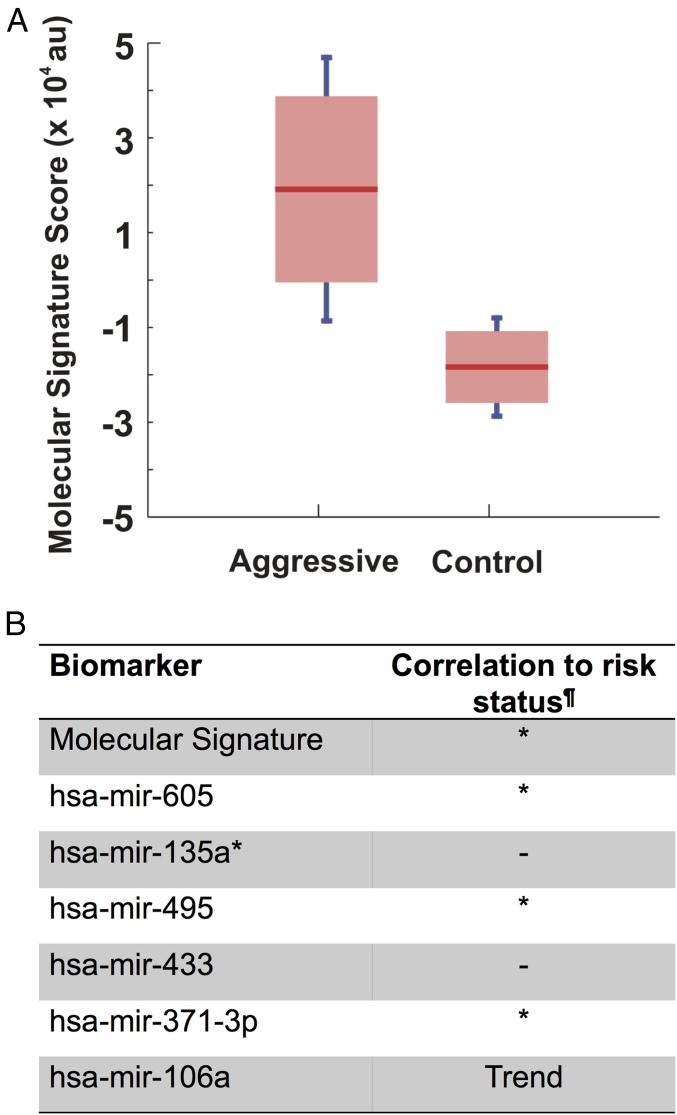
Molecular signature score of six miRNAs. (A) The molecular signature score was calculated for the six differentially expressed miRNAs using the procedure described in Zeng et al. (31). Distinct ranges of the combined intensity score show that there is little overlap between aggressive and control group expression when using an aggregate score (P = 0.0036). (B) Aggregate of six miRNAs showing a significant correlation to VHR PCa. The combined signature intensity is correlated to the degree of PCa aggressiveness (n = 16). Correlation between miRNA expression and patient risk was analyzed using the Wilcoxon rank-sum test. Correlation P value; P < 0.1, Trend; P < 0.05, *; no correlation, –.
Fig. S3.
Fig. S3.
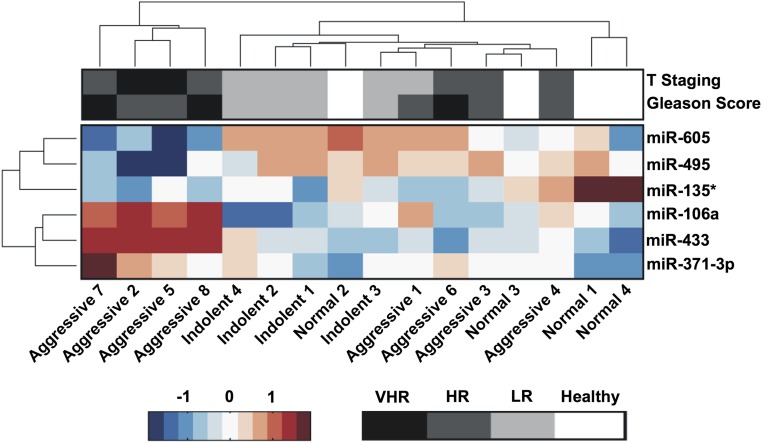
Heat map of clustering and clinical association for six differentially expressed miRNAs. Unsupervised hierarchical clustering performed on expression profiles for 16 serum samples reveals that, in general, samples of similar histology are clustered together. Interestingly, a subgroup of four samples identified to be indicative of VHR aggressive PCa cluster together using this molecular signature. Gleason scores are on the range of 9 (black) to 6 (light gray) to healthy (white). Tumor staging is on the range of T3 (black) to T1 (light gray) to healthy (white). Risk status scale is VHR, very high risk; HR, high risk; LR, low risk; or healthy. Patients were categorized based on the 2015 NCCN Guidelines for Prostate Cancer (Version 1.2015).
Fig. 2.
Fig. 2.
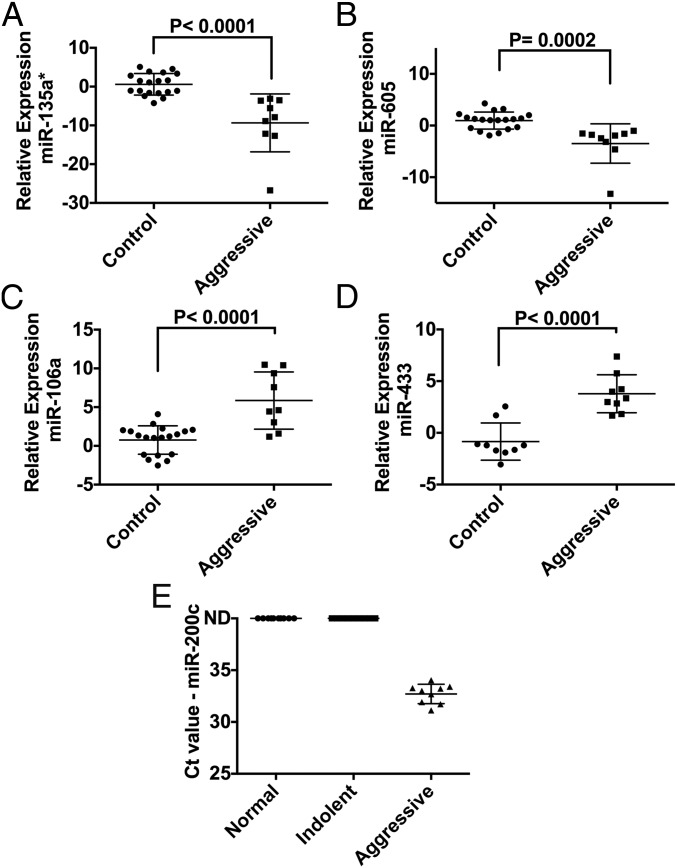
qRT-PCR validation of the blinded samples. (A–D) Blinded qRT-PCR analysis of patient serum samples successfully validated four coexpressed miRNAs (miR-605, miR-135a*, miR-433, and miR-106a) (fold change >1.5). (E) Blinded qRT-PCR analysis of a validated, exclusively expressed miRNA: miR-200c.
Fig. S4.
Fig. S4.
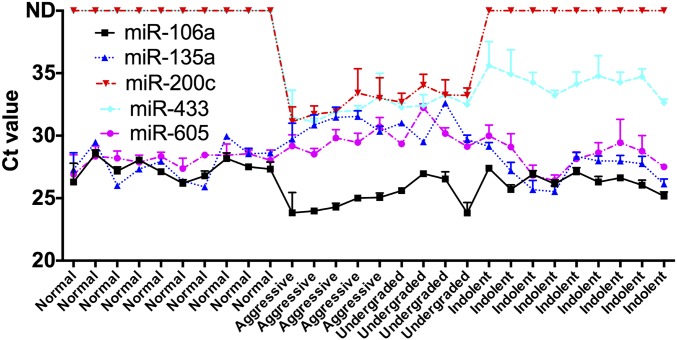
Ct profiles of validated miRNAs. Five successfully validated miRNAs (miR-200c, miR-605, miR-135a*, miR-433, and miR-106a) using blinded qRT-PCR analysis from patient serum samples showed distinct patterns that correlate with healthy specimens, VHR aggressive PCa, or indolent PCa.
Fig. 3.
Fig. 3.
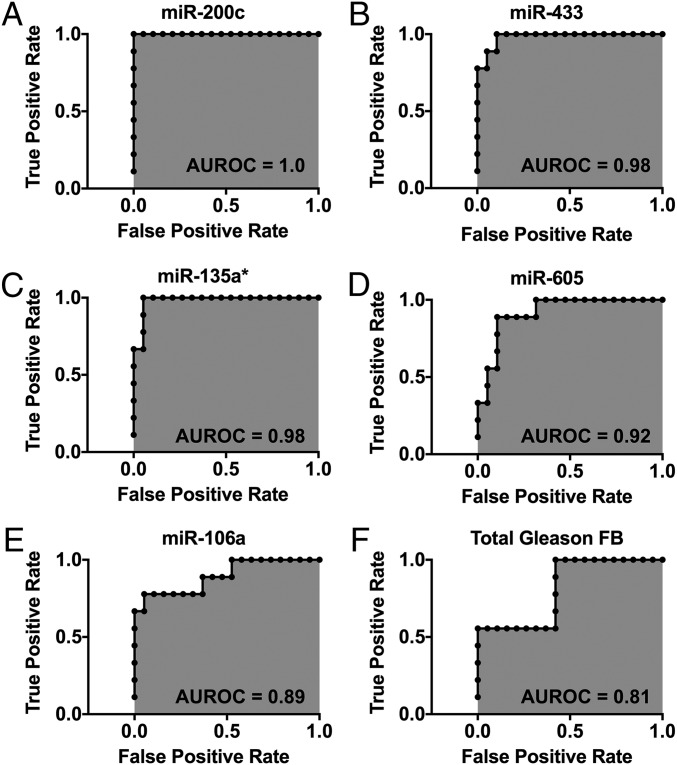
Specificity and sensitivity analysis. ROC curves were generated to compare the ROC of the Scano-miR miRNAs (A–E) to the Gleason sum from the first prostatic needle biopsy (FB) (F). The miRNAs identified by the Scano-miR bioassay yielded an ROC of at least 0.89 in differentiating between VHR PCa versus control group.
Fig. 4.
Fig. 4.
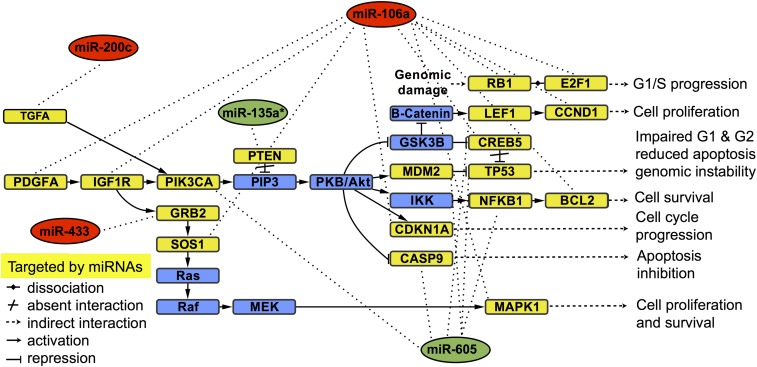
KEGG pathway analysis of the validated miRNAs. Target genes and biological pathways for up-regulated miRNAs (red oval) and down-regulated miRNAs (green oval) were identified using microT-CDS and TarBase to classify the GO category and KEGG pathway enrichment with a corrected P value threshold of <0.05. The yellow squares represent target genes potentially altered by the expression of the validated miRNAs, and blue squares represent genes that are not directly targeted by the validated miRNAs.

References

    1. Jemal A, et al. Cancer statistics, 2007. CA Cancer J Clin. 2007;57(1):43–66. - PubMed
    1. Siegel RL, Miller KD, Jemal A. Cancer statistics, 2015. CA Cancer J Clin. 2015;65(1):5–29. - PubMed
    1. Heijnsdijk EA, et al. Overdetection, overtreatment and costs in prostate-specific antigen screening for prostate cancer. Br J Cancer. 2009;101(11):1833–1838. - PMC - PubMed
    1. Grubb RL, 3rd, et al. PLCO Project Team Serum prostate-specific antigen hemodilution among obese men undergoing screening in the Prostate, Lung, Colorectal, and Ovarian Cancer Screening Trial. Cancer Epidemiol Biomarkers Prev. 2009;18(3):748–751. - PubMed
    1. Andriole GL, et al. PLCO Project Team Mortality results from a randomized prostate-cancer screening trial. N Engl J Med. 2009;360(13):1310–1319. - PMC - PubMed

Publication types