


Treatment outcomes with hypofractionated high-dose radiation therapy for prostate cancer
- PMID: 27601945
- PMCID: PMC5002023
- DOI: 10.1016/j.rpor.2015.12.003
Treatment outcomes with hypofractionated high-dose radiation therapy for prostate cancer
Abstract
Aim: To report the treatment results of a retrospective cohort of prostate cancer patients treated with Hypo-RT with a high equivalent biological effective dose (BED).
Background: Hypofractionated radiotherapy (Hypo-RT) has gained popularity and interest in the treatment of prostate cancer. However, there are few experiences with adequate follow-up reporting treatment results using high equivalent dose with Hypo-RT.
Materials and methods: We assigned 149 men with low-, intermediate- and high-risk prostate cancer to receive Hypo-RT with a total dose of 69 Gy/23 fractions. Late gastrointestinal (GI) and genitourinary (GU) toxicity were prospectively evaluated according to modified RTOG criteria. Biochemical no evidence of disease (bNED) was defined as the nadir prostate-specific antigen level plus 2 ng/mL.
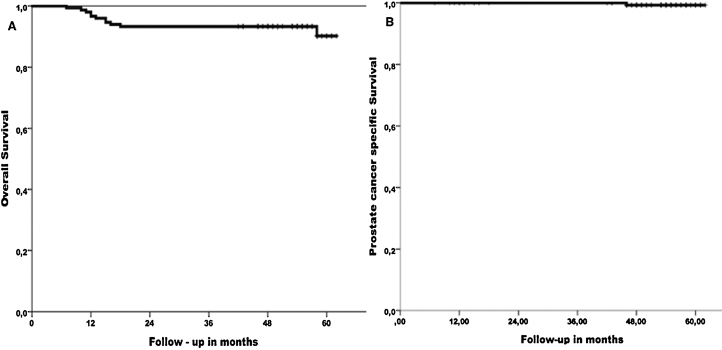
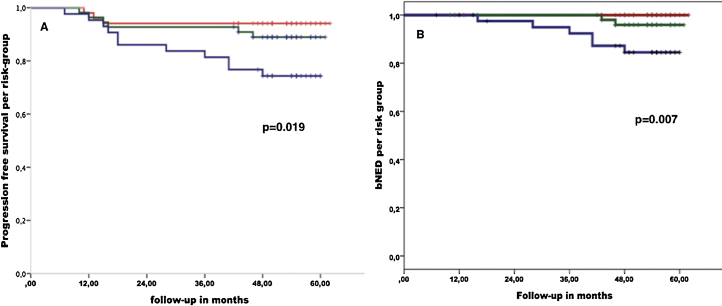
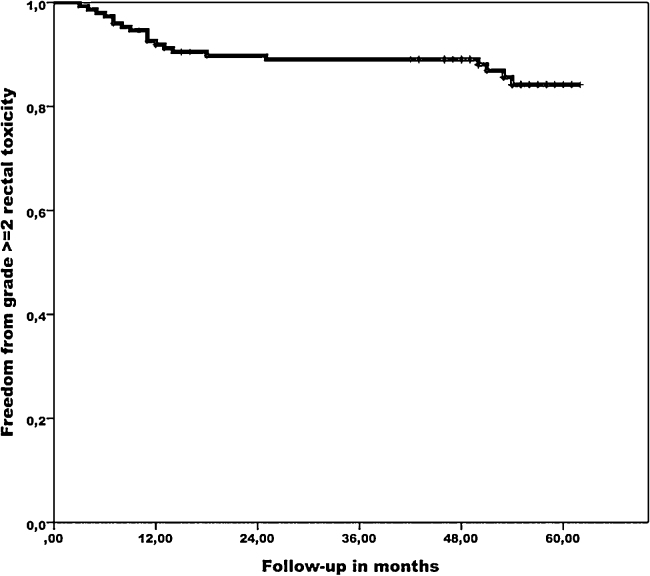
Results: The median follow-up was 53 months. For the entire cohort, the 5-year bNED rate was 94.6%, and for low-, intermediate- and high-risk patients the 5-year bNED was 100%, 96.4%, and 86% (p = 0.007), respectively. The 5-year overall survival rate was 92%. Only 1 patient died from the disease at 48 months after treatment, giving a 5-year cancer-specific survival of 98%. The worst grade ≥2 rate GI and GU toxicity was 13.4% and 14%, respectively. No grade >3 toxicity was observed. The presence of grade ≥2 GI and GU toxicity at the last follow-up was only 1.3% and 3%, respectively.
Conclusions: Hypo-RT (69 Gy/23 fractions) with a high equivalent BED produces excellent rates of biochemical control for low, intermediate and high-risk prostate cancer. The long term GU and GI toxicity rates were considered low and acceptable.
Keywords: 3D-CRT; Biochemical control; Late toxicity; Outcomes.
Figures
References
-
- Viani G.A., Stefano E.J., Afonso S.L. Higher-than-conventional radiation doses in localized prostate cancer treatment: a meta-analysis of randomized, controlled trials. Int J Radiat Oncol Biol Phys. 2009;74:1405–1418. - PubMed
-
- Kuban D.A., Tucker S.L., Dong L. Long-term results of the m. D. Anderson randomized dose-escalation trial for prostate cancer. Int J Radiat Oncol Biol Phys. 2008;70:67–74. - PubMed
-
- Zietman A.L., Bae K., Slater J.D. Randomized trial comparing conventional-dose with high-dose conformal radiation therapy in early-stage adenocarcinoma of the prostate: long-term results from proton radiation oncology group/american college of radiology 95-09. J Clin Oncol. 2010;28:1106–1111. - PMC - PubMed
-
- Miralbell R., Roberts S.A., Zubizarreta E. Dose-fractionation sensitivity of prostate cancer deduced from radiotherapy outcomes of 5,969 patients in seven international institutional datasets: alpha/beta = 1.4 (0.9–2.2) gy. Int J Radiat Oncol Biol Phys. 2012;82:e17–e24. - PubMed
-
- Leborgne F., Fowler J., Leborgne J.H. Later outcomes and alpha/beta estimate from hypofractionated conformal three-dimensional radiotherapy versus standard fractionation for localized prostate cancer. Int J Radiat Oncol Biol Phys. 2012;82:1200–1207. - PubMed
LinkOut - more resources
Full Text Sources
Other Literature Sources
Research Materials
