Review
. 2016 Sep 6;8(1):7.
doi: 10.1186/s13231-016-0021-2. eCollection 2016.

Pathophysiology and management of reperfusion injury and hyperperfusion syndrome after carotid endarterectomy and carotid artery stenting

Affiliations
Review

Pathophysiology and management of reperfusion injury and hyperperfusion syndrome after carotid endarterectomy and carotid artery stenting

Muhammad U Farooq et al. Exp Transl Stroke Med. .

Abstract

Cerebral hyperperfusion is a relatively rare syndrome with significant and potentially preventable clinical consequences. The pathophysiology of cerebral hyperperfusion syndrome (CHS) may involve dysregulation of the cerebral vascular system and hypertension, in the setting of increase in cerebral blood flow. The early recognition of CHS is important to prevent complications such as intracerebral hemorrhage. This review will focus on CHS following carotid endarterectomy and carotid artery stenting. We will discuss the typical clinical features of CHS, risk factors, pathophysiology, diagnostic modalities for detection, identification of patients at risk, and prevention and treatment. Although currently there are no specific guidelines for the management of CHS, identification of patients at risk for CHS and aggressive treatment of hypertension are recommended.

Keywords: Carotid artery stenting; Carotid endarterectomy; Cerebral blood flow; Cerebral hyperperfusion; Reperfusion injury; Risk factors and treatment of cerebral hyperperfusion syndrome.


Figures
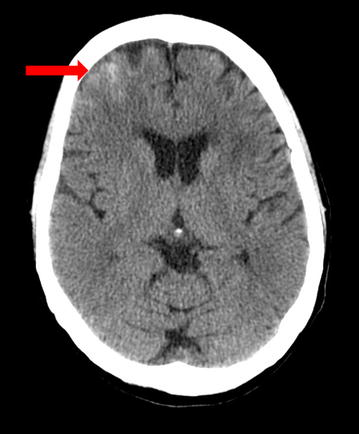
Fig. 1
Fig. 1
CT scan of the brain (axial sequence) shows an area of hyperdensity in the right frontal lobe suggestive of intracerebral hemorrhage (arrow) in a 67 year old woman who underwent right carotid endarterectomy (CEA) for the treatment of a 95 % right ICA stenosis. The patient post-operatively developed headache, photophobia and intermittent dizziness. This CT brain was done almost 24 h after the CEA. Systolic blood pressure was in the 170 s mm Hg and difficult to control as after CEA there was thought to be a clamp injury to the right carotid artery bulb. However, the patient did well clinically and at her 3 month follow up office visit, she had no residual neurological deficits
Fig. 2
Fig. 2
MRI of the brain (axial sequence) gradient recall echo (GRE) image shows hypointense foci in the right frontal region consistent with hemorrhage (arrows) in the same patient mentioned in Fig. 1

References

    1. Bouri S, Thapar A, Shalhoub J, Jayasooriya G, Fernando A, Franklin IJ, Davies AH. Hypertension and the post-carotid endarterectomy cerebral hyperperfusion syndrome. Eur J Vasc Endovasc Surg. 2011;41(2):229–237. doi: 10.1016/j.ejvs.2010.10.016. - DOI - PubMed
    1. van Mook WN, Rennenberg RJ, Schurink GW, van Oostenbrugge RJ, Mess WH, Hofman PA, de Leeuw PW. Cerebral hyperperfusion syndrome. Lancet Neurol. 2005;4(12):877–888. doi: 10.1016/S1474-4422(05)70251-9. - DOI - PubMed
    1. Moulakakis KG, Mylonas SN, Sfyroeras GS, Andrikopoulos V. Hyperperfusion syndrome after carotid revascularization. J Vasc Surg. 2009;49(4):1060–1068. doi: 10.1016/j.jvs.2008.11.026. - DOI - PubMed
    1. Meyers PM, Higashida RT, Phatouros CC, Malek AM, Lempert TE, Dowd CF, Halbach VV. Cerebral hyperperfusion syndrome after percutaneous transluminal stenting of the craniocervical arteries. Neurosurgery. 2000;47(2):335–343. doi: 10.1097/00006123-200008000-00013. - DOI - PubMed
    1. Piepgras DG, Morgan MK, Sundt TM, Jr, Yanagihara T, Mussman LM. Intracerebral hemorrhage after carotid endarterectomy. J Neurosurg. 1988;68(4):532–536. doi: 10.3171/jns.1988.68.4.0532. - DOI - PubMed

LinkOut - more resources
