


Computational identification of microRNAs associated to both epithelial to mesenchymal transition and NGAL/MMP-9 pathways in bladder cancer
- PMID: 27602581
- PMCID: PMC5341942
- DOI: 10.18632/oncotarget.11805
Computational identification of microRNAs associated to both epithelial to mesenchymal transition and NGAL/MMP-9 pathways in bladder cancer
Abstract
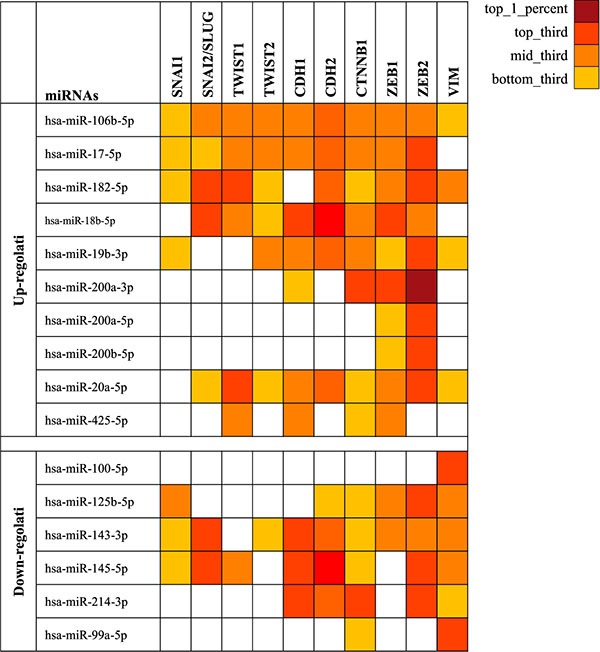
Bladder cancer is one of the leading cancer of the urinary tract. It is often diagnosed at advanced stage of the disease. To date, no specific and effective early detection biomarkers are available. Cancer development and progression are associated with the involvement of both epithelial-mesenchymal transition (EMT) and tumor microenvironment of which NGAL/MMP-9 complex represents the main player in bladder cancer. It is known that change in microRNAs (miRNAs) expression may result in gene modulation. Therefore, the identification of specific miRNAs associated with EMT pathway and NGAL/MMP-9 complex may be useful to detect the development of bladder cancer at early stages.On this ground, the expression levels of miRNAs in public available datasets of bladder cancer containing data of non-coding RNA profiling was evaluated. This analysis revealed a group of 16 miRNAs differentially expressed between bladder cancer patients and related healthy controls. By miRNA prediction tool (mirDIP), the relationship between the identified miRNAs and the EMT genes was established. Using the DIANA-mirPath (v.2) software, miRNAs, able to modulate the expression of NGAL and MMP-9 genes, were recognized.The results of this study provide evidence that the downregulated hsa-miR-145-5p and hsa-miR-214-3p may modulate the expression of both EMT and NGAL/MMP-9 pathways. Therefore, further validation analyses may confirm the usefulness of these selected miRNAs for predicting the development of bladder cancer at the early stage of the disease.
Keywords: NGAL/MMP-9; bioinformatics; bladder cancer; epithelial-mesenchymal transition; miRNAs.
Conflict of interest statement
The authors declare no potential conflicts of interest.
Figures
References
-
- Mahdavifar N, Ghoncheh M, Pakzad R, Momenimovahed Z, Salehiniya H. Epidemiology, Incidence and Mortality of Bladder Cancer and their Relationship with the Development Index in the World. Asian Pac J Cancer Prev. 2016;17:381–6. - PubMed
-
- Malats N, Real FX. Epidemiology of Bladder Cancer. Hematology/oncology clinics of North America. 2015;29:177–89. - PubMed
-
- Ferlay J, Soerjomataram I, Ervik M, Dikshit R, Eser S, Mathers C, Rebelo M, Parkin DM, Forman D, Bray F. Lyon, France: International Agency for Research on Cancer; 2013. GLOBOCAN 2012 v1.0, Cancer Incidence and Mortality Worldwide: IARC CancerBase No. 11 [Internet] Available from: http://globocan.iarc.fr, accessed on day/month/year.
-
- Lee HW, Wang HT, Weng MW, Hu Y, Chen WS, Chou D, Liu Y, Donin N, Huang WC, Lepor H, Wu XR, Wang H, Beland FA, et al. Acrolein- and 4-Aminobiphenyl-DNA adducts in human bladder mucosa and tumor tissue and their mutagenicity in human urothelial cells. Oncotarget. 2014;5:3526–40. doi: 10.18632/oncotarget.1954. - DOI - PMC - PubMed
-
- Brait M, Munari E, LeBron C, Noordhuis MG, Begum S, Michailidi C, Gonzalez-Roibon N, Maldonado L, Sen T, Guerrero-Preston R, Cope L, Parrella P, Fazio VM, et al. Genome-wide methylation profiling and the PI3K-AKT pathway analysis associated with smoking in urothelial cell carcinoma. Cell Cycle. 2013;12:1058–70. - PMC - PubMed
MeSH terms
Substances
LinkOut - more resources
Full Text Sources
Other Literature Sources
Medical
Miscellaneous
