. 2016 Sep 7;11(9):e0161476.
doi: 10.1371/journal.pone.0161476. eCollection 2016.

Evolution of the Exon-Intron Structure in Ciliate Genomes

Affiliations

Evolution of the Exon-Intron Structure in Ciliate Genomes

Vladyslav S Bondarenko et al. PLoS One. .

Abstract

A typical eukaryotic gene is comprised of alternating stretches of regions, exons and introns, retained in and spliced out a mature mRNA, respectively. Although the length of introns may vary substantially among organisms, a large fraction of genes contains short introns in many species. Notably, some Ciliates (Paramecium and Nyctotherus) possess only ultra-short introns, around 25 bp long. In Paramecium, ultra-short introns with length divisible by three (3n) are under strong evolutionary pressure and have a high frequency of in-frame stop codons, which, in the case of intron retention, cause premature termination of mRNA translation and consequent degradation of the mis-spliced mRNA by the nonsense-mediated decay mechanism. Here, we analyzed introns in five genera of Ciliates, Paramecium, Tetrahymena, Ichthyophthirius, Oxytricha, and Stylonychia. Introns can be classified into two length classes in Tetrahymena and Ichthyophthirius (with means 48 bp, 69 bp, and 55 bp, 64 bp, respectively), but, surprisingly, comprise three distinct length classes in Oxytricha and Stylonychia (with means 33-35 bp, 47-51 bp, and 78-80 bp). In most ranges of the intron lengths, 3n introns are underrepresented and have a high frequency of in-frame stop codons in all studied species. Introns of Paramecium, Tetrahymena, and Ichthyophthirius are preferentially located at the 5' and 3' ends of genes, whereas introns of Oxytricha and Stylonychia are strongly skewed towards the 5' end. Analysis of evolutionary conservation shows that, in each studied genome, a significant fraction of intron positions is conserved between the orthologs, but intron lengths are not correlated between the species. In summary, our study provides a detailed characterization of introns in several genera of Ciliates and highlights some of their distinctive properties, which, together, indicate that splicing spellchecking is a universal and evolutionarily conserved process in the biogenesis of short introns in various representatives of Ciliates.


Conflict of interest statement

The authors have declared that no competing interests exist.

Figures
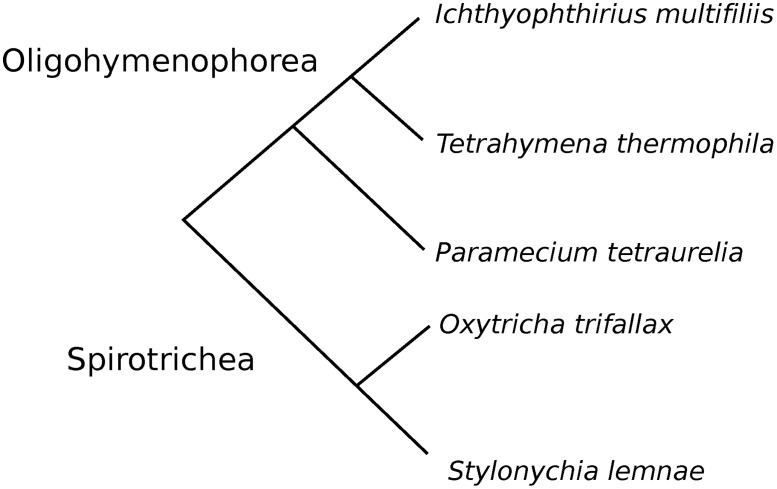
Fig 1
Fig 1. Phylogenetic relationships between the studied species.
Fig 2
Fig 2
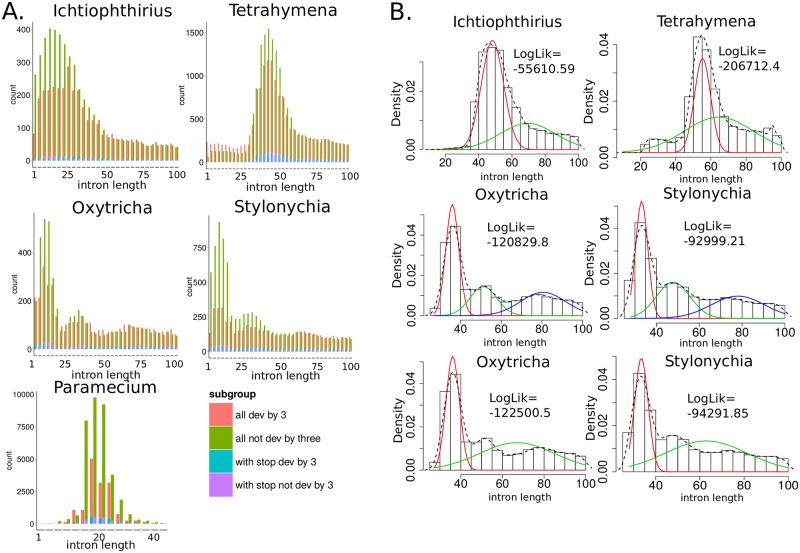
A. Intron length distributions of Paramecium [5], Tetrahymena [6], Ichthyophthirius, Oxytricha [8], and Stylonychia. Introns containing “n” or “N” nucleotides were excluded. Pink and green colors show the numbers of 3n±1 and 3n introns, respectively. Blue and purple colors show the numbers of 3n±1 and 3n introns with in-frame stop codons, respectively. B. Decomposition of the intron length distributions of Tetrahymena, Ichthyophthirius, Oxytricha, and Stylonychia in the length interval 1–100 bp into a sum of 2 or 3 weighted normal distributions. Histograms show the observed distributions without decomposition, whereas red, blue, and green curves denote the decomposed weighted normal distributions.
Fig 3
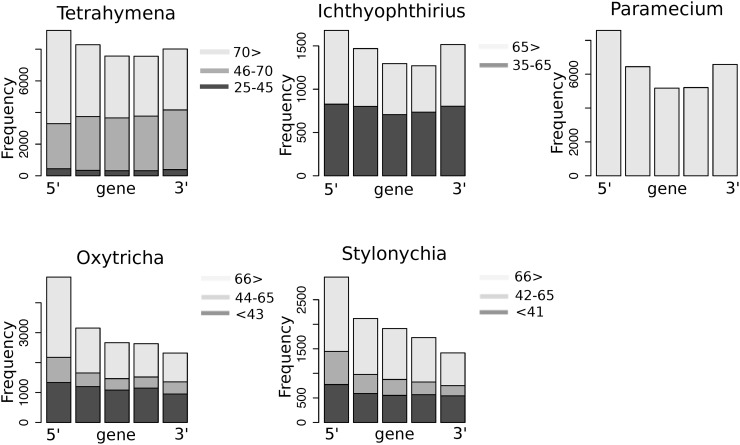
Fig 3. Densities of introns along the genes.
Genes containing at least five introns were selected and divided into five equal intervals; then numbers of introns in each interval were calculated. Different bar colors designate groups of introns (see the inserted legend). The same trend was observed for genes with ≥ 3 introns (S4 Fig).
Fig 4
Fig 4
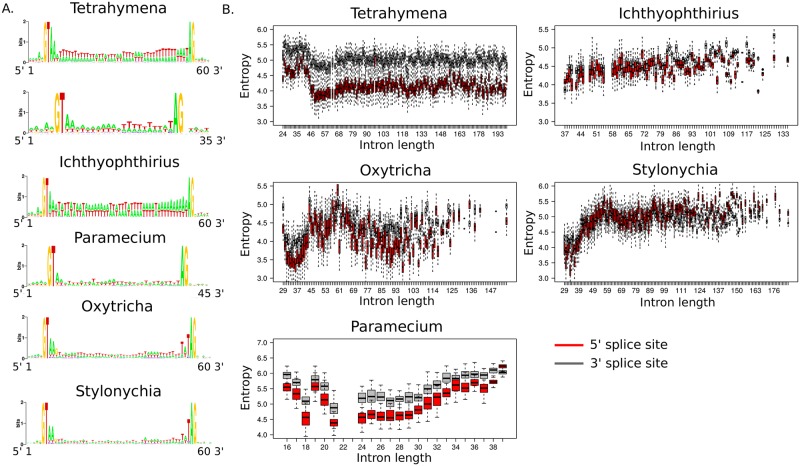
A. Conserved nucleotides at 5' and 3' ends of introns of Tetrahymena, Ichthyophthirius, Paramecium, Oxytricha, and Stylonychia [–10]. For each intron, a 5 bp long exon part was also considered. B. Strength of the 5' and 3' splice site motif as a function of the intron length. The strength of the splice site motif was calculated as the entropy of its frequency matrix, see the main text. Red and black boxplots designate the entropy measure of 5' and 3' splice sites, respectively. In order to account for uneven sample size, for each intron length up to 200 bp, we randomly sampled 50 introns 50 times and estimated their average splice sites entropy. Intron length intervals with less than 50 introns were excluded.
Fig 5
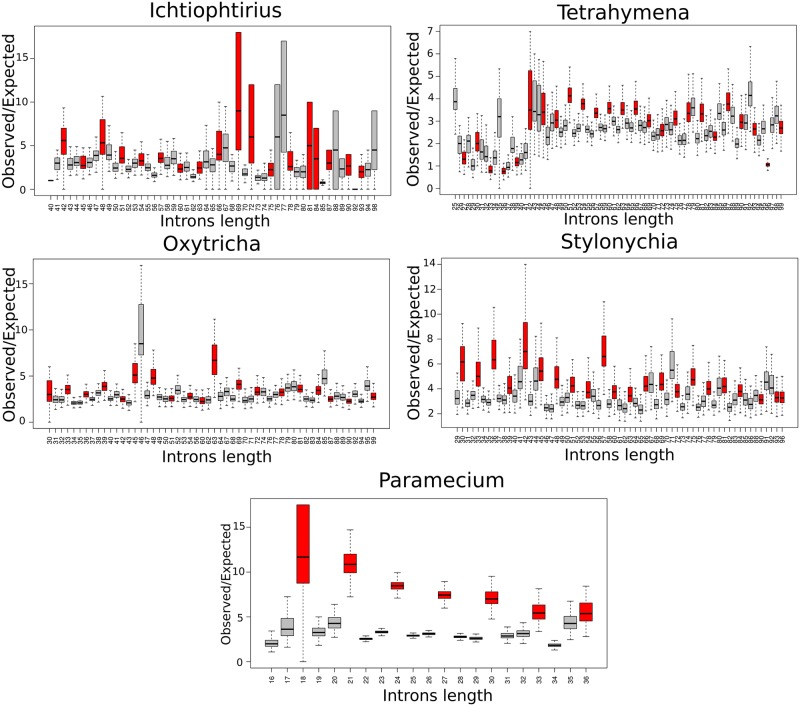
Fig 5. Enrichment of in-frame stop codons in introns of Paramecium, Tetrahymena, Ichthyophthirius, Oxytricha, and Stylonychia.
Red and gray boxplots designate O/E values for 3n and 3n±1 introns, respectively. Boxplots were obtained by combining O/E values from 1000 replicates. P-value of stop-codons enrichment was less than 10-4 (by Monte-Carlo 1000-fold simulations) for all introns of Paramecium, Oxytricha, Stylonychia, 41–100 bp long introns of Tetrahymena, and almost all introns of Ichthyophthirius.
Fig 6
Fig 6
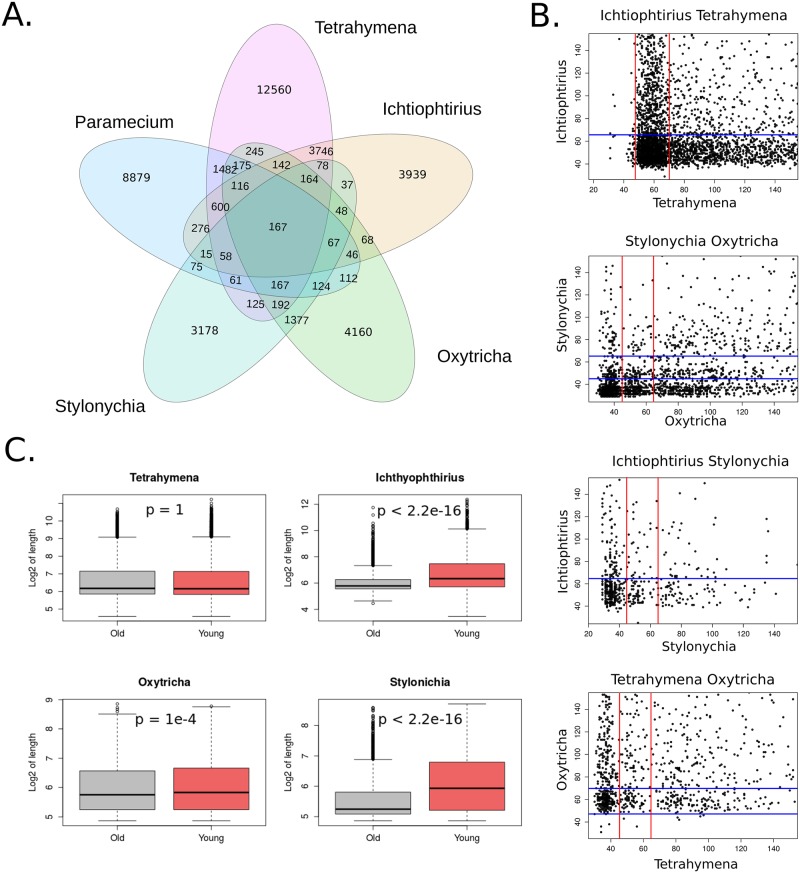
A. The numbers of introns conserved between the orthologs of Paramecium, Tetrahymena, Ichthyophthirius, Oxytricha, and Stylonychia. B. Scatter-plots of orthologous introns length of Tetrahymena, Ichthyophthirius, Oxytricha, and Stylonychia. The intron length range up to 150 bp is shown. Red and blue lines separate classes of the intron lengths. C. L distributions of the conserved and young introns in orthologous genes for Tetrahymena, Ichthyophthirius, Oxytricha, and Stylonychia (in the log2 scale). Conserved introns are significantly shorter than young introns in Ichthyophthirius, Oxytricha, and Stylonychia (by the Wilcoxon rank sum test, p-value < 2.2×10⁻¹⁶, < 10-4, and < 2.2×10⁻¹⁶, respectively).

References

    1. Prescott DM. The DNA of ciliated protozoa. Microbiol Rev. 1994; 58(2): 233–67. - PMC - PubMed
    1. Prescott DM. Genome gymnastics: unique modes of DNA evolution and processing in ciliates. Nat Rev Genet. 2000; 1(3): 191–8. - PubMed
    1. Prescott DM. Cutting, splicing, reordering, and elimination of DNA sequences in hypotrichous ciliates. Bioessays. 1992; 14(5): 317–24. - PubMed
    1. Prescott DM. Evolution of DNA organization in hypotrichous ciliates. Ann N Y Acad Sci. 1999; 870: 301–13. - PubMed
    1. Aury JM, Jaillon O, Duret L, Noel B, Jubin C, Porcel BM, et al. Global trends of whole-genome duplications revealed by the ciliate Paramecium tetraurelia. Nature. 2006; 444(7116): 171–8. - PubMed

LinkOut - more resources