


Is Hyperbaric Oxygen Therapy Effective for Traumatic Brain Injury? A Rapid Evidence Assessment of the Literature and Recommendations for the Field
- PMID: 27603765
- PMCID: PMC5426690
- DOI: 10.1097/HTR.0000000000000256
Is Hyperbaric Oxygen Therapy Effective for Traumatic Brain Injury? A Rapid Evidence Assessment of the Literature and Recommendations for the Field
Abstract
Objective: This systematic review examines the efficacy of hyperbaric oxygen (HBO2) for traumatic brain injury (TBI) to make evidence-based recommendations for its application and future research.
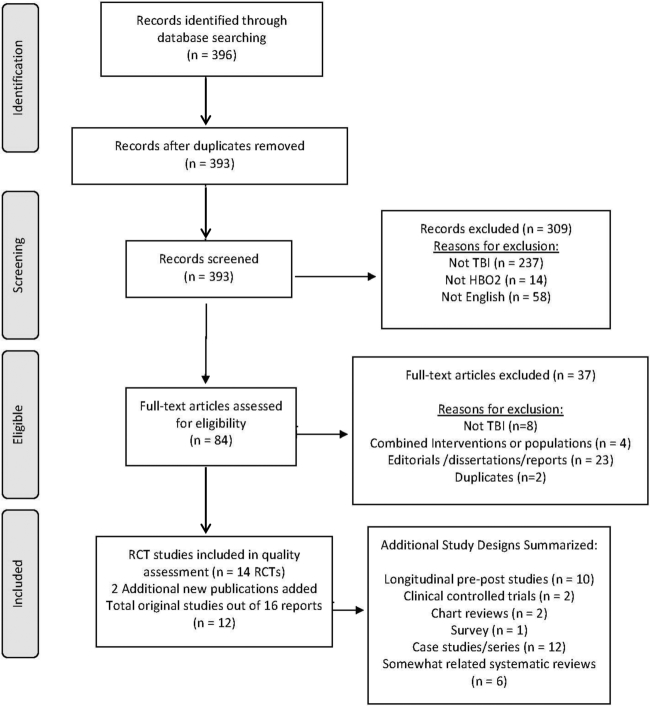
Methods: A comprehensive search was conducted to identify studies through 2014. Methodological quality was assessed and synthesis and interpretation of relevant data was performed.
Results: Twelve randomized trials were included. All mild TBI studies demonstrated minimal bias and no statistically significant differences between HBO2 and sham arms. Statistically significant improvement occurred over time within both groups. Moderate-to-severe TBI studies were of mixed quality, with majority of results favoring HBO2 compared with "standard care." The placebo analysis conducted was limited by lack of details.
Conclusions: For mild TBI, results indicate HBO2 is no better than sham treatment. Improvements within both HBO2 and sham groups cannot be ignored. For acute treatment of moderate-to-severe TBI, although methodology appears flawed across some studies, because of the complexity of brain injury, HBO2 may be beneficial as a relatively safe adjunctive therapy if feasible. Further research should be considered to resolve the controversy surrounding this field, but only if methodological flaws are avoided and bias minimized.
References
-
- McDonagh M, Helfand M, Carson S, Russman BS. Hyperbaric oxygen therapy for traumatic brain injury: a systematic review of the evidence. Arch Phys Med Rehabil. 2004;85(7):1198–1204. - PubMed
-
- Alternative Therapy Evaluation Committee for the Insurance Corporation of British Columbia. A review of the scientific evidence on the treatment of traumatic brain injuries and strokes with hyperbaric oxygen. Brain Inj. 2003;17(3):225–236. - PubMed
-
- Hyperbaric Oxygen Therapy: Don't Be Misled. Food and Drug Administration. Consumer Health Information. Secondary Hyperbaric Oxygen Therapy: Don't Be Misled. http://www.fda.gov/downloads/ForConsumers/ConsumerUpdates/UCM366015.pdf. Accessed February 15, 2015.
-
- Rockswold SB, Rockswold GL, Zaun DA, Liu J. A prospective, randomized Phase II clinical trial to evaluate the effect of combined hyperbaric and normobaric hyperoxia on cerebral metabolism, intracranial pressure, oxygen toxicity, and clinical outcome in severe traumatic brain injury. J Neurosurg. 2013;118(6):1317–1328. - PubMed
Publication types
MeSH terms
LinkOut - more resources
Full Text Sources
Other Literature Sources
Medical
