


Endoscopic gastric atrophy is strongly associated with gastric cancer development after Helicobacter pylori eradication
- PMID: 27604367
- PMCID: PMC5411409
- DOI: 10.1007/s00464-016-5211-4
Endoscopic gastric atrophy is strongly associated with gastric cancer development after Helicobacter pylori eradication
Abstract
Background: Risk factors for gastric cancer during continuous infection with Helicobacter pylori have been well documented; however, little has been reported on the risk factors for primary gastric cancer after H. pylori eradication. We conducted a retrospective, endoscopy-based, long-term, large-cohort study to clarify the risk factors for gastric cancer following H. pylori eradication.
Methods: Patients who achieved successful H. pylori eradication and periodically underwent esophagogastroduodenoscopy surveillance thereafter at Toyoshima Endoscopy Clinic were enrolled. The primary endpoint was the development of gastric cancer. Statistical analysis was performed using the Kaplan-Meier method and Cox's proportional hazards models.
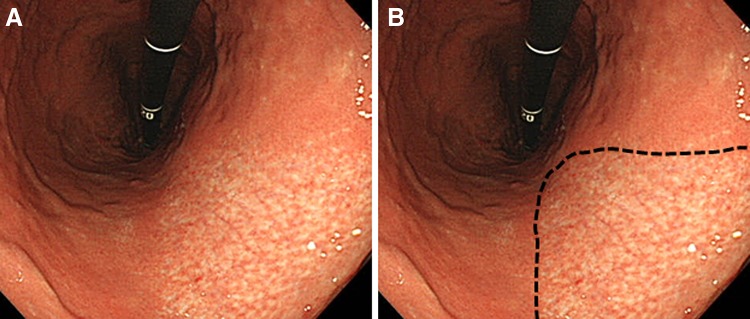
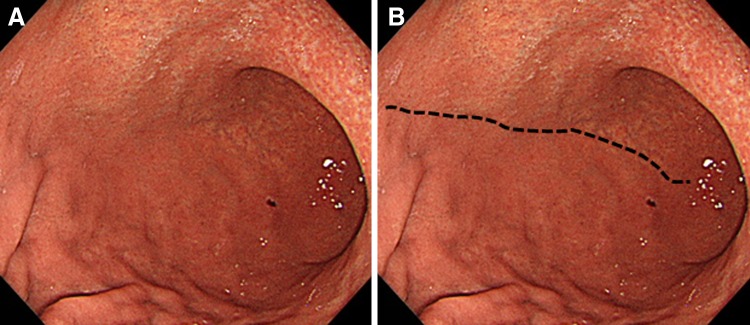
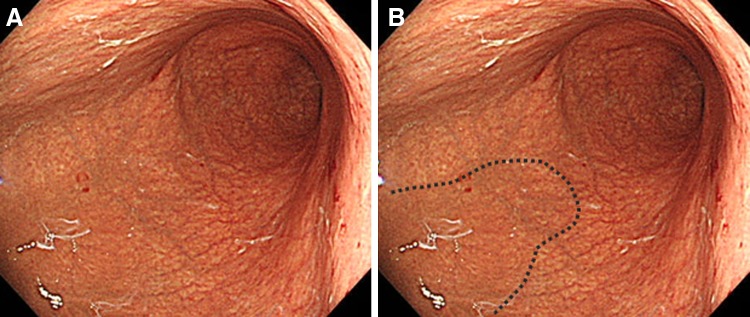
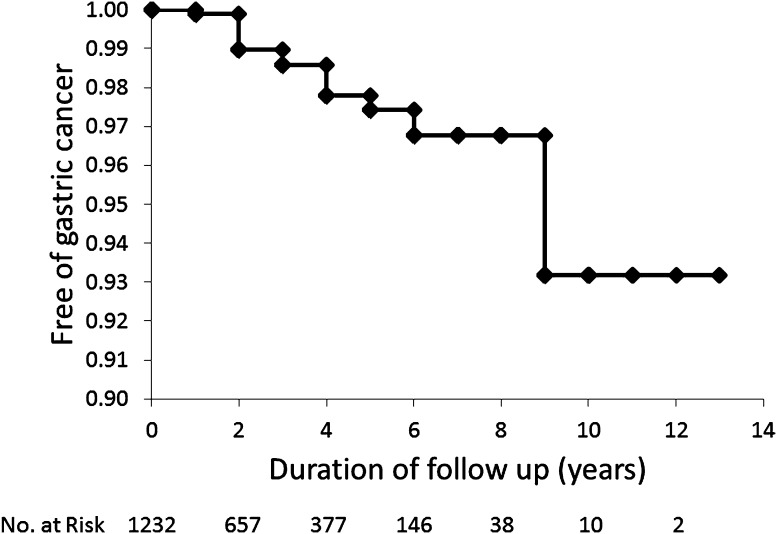
Results: Gastric cancer developed in 15 of 1232 patients. The cumulative incidence rates were 1.0 % at 2 years, 2.6 % at 5 years, and 6.8 % at 10 years. Histology showed that all gastric cancers (17 lesions) in the 15 patients were of the intestinal type, within the mucosal layer, and <20 mm in diameter. Based on univariate analysis, older age and higher endoscopic grade of gastric atrophy were significantly associated with gastric cancer development after eradication of H. pylori, and gastric ulcers were marginally associated. Multivariate analysis identified higher grade of gastric atrophy (hazard ratio 1.77; 95 % confidence interval 1.12-2.78; P = 0.01) as the only independently associated parameter.
Conclusions: Endoscopic gastric atrophy is a major risk factor for gastric cancer development after H. pylori eradication. Further long-term studies are required to determine whether H. pylori eradication leads to regression of H. pylori-related gastritis and reduces the risk of gastric cancer.
Keywords: Atrophic gastritis; Chemoprevention; Endoscopy; Helicobacter pylori; Risk factors; Stomach neoplasms.
Conflict of interest statement
Drs. Osamu Toyoshima, Yutaka Yamaji, Shuntaro Yoshida, Shuhei Matsumoto, Hiroharu Yamashita, Takamitsu Kanazawa, and Keisuke Hata have no conflicts of interest or financial ties to disclose.
Figures
References
-
- International Agency for Research on Cancer. Stomach cancer. Estimated incidence, mortality and prevalence worldwide in 2012. [Cited 2016 12/6]. http://globocan.iarc.fr/Pages/fact_sheets_cancer.aspx
-
- International Agency for Research on Cancer. Helicobacter pylori eradication as a strategy for preventing gastric cancer. IARC working group reports, vol 8. [Cited 2016 12/6]. http://www.iarc.fr/en/publications/pdfs-online/wrk/wrk8/Helicobacter_pyl...
-
- International Agency for Research on Cancer. Helicobacter pylori. Biological agents, volume 100 B. A review of human carcinogens, pp 385–435. [Cited 2016 12/6]. http://monographs.iarc.fr/ENG/Monographs/vol100B/mono100B.pdf
-
- Ma JL, Zhang L, Brown LM, Li JY, Shen L, Pan KF, Liu WD, Hu Y, Han ZX, Crystal-Mansour S, Pee D, Blot WJ, Fraumeni JF, Jr, You WC, Gail MH. Fifteen-year effects of Helicobacter pylori, garlic, and vitamin treatments on gastric cancer incidence and mortality. J Natl Cancer Inst. 2012;104:488–492. doi: 10.1093/jnci/djs003. - DOI - PMC - PubMed
MeSH terms
LinkOut - more resources
Full Text Sources
Other Literature Sources
Medical
