Review
. 2016 Oct 5;8(9):3006-3010.
doi: 10.1093/gbe/evw220.

The Genome as an Evolutionary Timepiece

Affiliations
Review

The Genome as an Evolutionary Timepiece

Simon Y W Ho et al. Genome Biol Evol. .

Abstract

The molecular clock is a valuable and widely used tool for estimating evolutionary rates and timescales in biological research. There has been considerable progress in the theory and practice of molecular clocks over the past five decades. Although the idea of a molecular clock was originally put forward in the context of protein evolution and advanced using various biochemical techniques, it is now primarily applied to analyses of DNA sequences. An interesting but very underappreciated aspect of molecular clocks is that they can be based on genetic data other than DNA or protein sequences. For example, evolutionary timescales can be estimated using microsatellites, protein folds, and even the extent of recombination. These genome features hold great potential for molecular dating, particularly in cases where nucleotide sequences might be uninformative or unreliable. Here we present an outline of the different genetic data types that have been used for molecular dating, and we describe the features that good molecular clocks should possess. We hope that our article inspires further work on the genome as an evolutionary timepiece.

Keywords: evolutionary rate; genomic data; molecular clock; molecular dating; phylogenetic analysis.


Figures

<sc>Fig</sc>. 1.—
Fig. 1.—
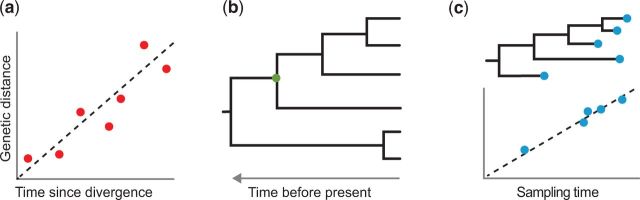
Methods used to estimate evolutionary timescales from genomic data. (a) Linear regression of pairwise genetic distances against time since divergence. Each data point in this plot represents a pair of taxa, with their divergence time inferred from the fossil record or from the age of a geological event that is presumed to be associated with the evolutionary divergence. Fitting a line through these points involves the assumption that genetic change accumulates at a constant rate through time, with the slope presenting an estimate of this rate. The line of best fit can be used to infer the timing of evolutionary divergence events, provided that a measure of genetic distance is available for the taxa in question. Molecular clocks based on linear regression have a number of weaknesses, including nonindependence of the data points and sensitivity to rate variation across lineages. (b) Phylogenetic analysis using a clock model. The tree is a chronogram with branch lengths measured in units of time. These methods usually involve models that explicitly describe the evolution of characters along the branches of the tree. Phylogenetic molecular clocks are calibrated by constraining the age of one or more nodes in the tree, such as the node indicated with a green circle, allowing the remaining node times to be inferred from the genetic data. (c) Root-to-tip distances computed from a phylogram, plotted against the ages of the sequences. A regression line is fitted through these data points, with the slope of the line giving an estimate of the evolutionary rate. This method is often used in analyses of time-structured sequence data, such as those from rapidly evolving viruses.
<sc>Fig</sc>. 2.—
Fig. 2.—
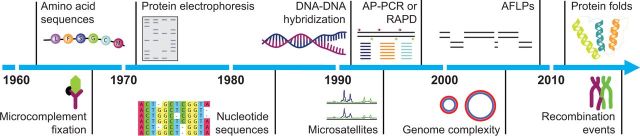
Timeline showing the use of different genetic data types for molecular-clock analyses. The development and analysis of different data types is illustrated by a range of studies over the past five decades: amino acid sequences (Zuckerkandl and Pauling 1962), microcomplement fixation (Sarich and Wilson 1967b), protein electrophoresis (Nei 1971), nucleotide sequences (Miyata and Yasunaga 1980; Cohn et al. 1984), DNA–DNA hybridization (Wayne et al. 1991), microsatellites (Goldstein et al. 1995), randomly amplified polymorphic DNA (Espinasa and Borowsky 1998), genome complexity (Sharov 2006), amplified fragment length polymorphisms (Kropf et al. 2009), protein folds (Wang et al. 2011), and recombination events (Moorjani et al. 2016).

References

    1. Bromham L. 2009. Why do species vary in their rate of molecular evolution? Biol Lett. 5:401–404. - PMC - PubMed
    1. Caetano-Anollés G, Wang M, Caetano-Anollés D, Mittenthal JE. 2009. The origin, evolution and structure of the protein world. Biochem J. 417:621–637. - PubMed
    1. Cohn VH, Thompson MA, Moore GP. 1984. Nucleotide sequence comparison of the Adh gene in three drosophilids. J Mol Evol. 20:31–37. - PubMed
    1. Davey JW, et al. 2011. Genome-wide genetic marker discovery and genotyping using next-generation sequencing. Nat Rev Genet. 12:499–510. - PubMed
    1. Donoghue PCJ, Yang Z. 2016. The evolution of methods for establishing evolutionary timescales. Phil Trans R Soc B. 371:20160020.. - PMC - PubMed

Publication types