


Impact of impaired fractional flow reserve after coronary interventions on outcomes: a systematic review and meta-analysis
- PMID: 27608682
- PMCID: PMC5017064
- DOI: 10.1186/s12872-016-0355-7
Impact of impaired fractional flow reserve after coronary interventions on outcomes: a systematic review and meta-analysis
Abstract
Background: FFR is routinely used to guide percutaneous coronary interventions (PCI). Visual assessment of the angiographic result after PCI has limited efficacy. Even when the angiographic result seems satisfactory FFR after a PCI might be useful for identifying patients with a suboptimal interventional result and higher risk for poor clinical outcome who might benefit from additional procedures. The aim of this meta-analysis was to investigate available data of studies that examined clinical outcomes of patients with impaired vs. satisfactory fractional flow reserve (FFR) after percutaneous coronary interventions (PCI).
Methods: This meta-analysis was carried out according to the Cochrane Handbook for Systematic Reviews. The Mantel-Haenszel method using the fixed-effect meta-analysis model was used for combining the results. Studies were identified by searching the literature through mid-January, 2016, using the following search terms: fractional flow reserve, coronary circulation, after, percutaneous coronary intervention, balloon angioplasty, stent implantation, and stenting. Primary endpoint was the rate of major adverse cardiac events (MACE). Secondary endpoints included rates of death, myocardial infarction (MI), repeated revascularisation.
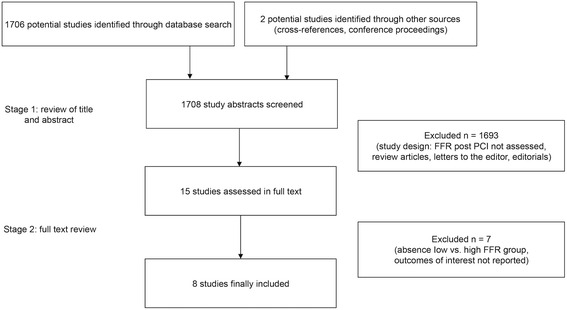
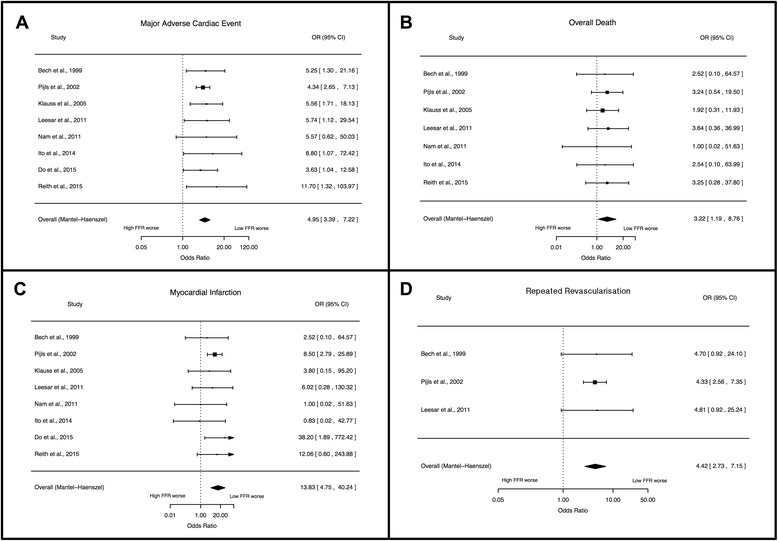
Results: Eight relevant studies were found including a total of 1337 patients. Of those, 492 (36.8 %) had an impaired FFR after PCI, and 853 (63.2 %) had a satisfactory FFR after PCI. Odds ratios indicated that a low FFR following PCI was associated with an impaired outcome: major adverse cardiac events (MACE, OR: 4.95, 95 % confidence interval [CI]: 3.39-7.22, p <0.001); death (OR: 3.23, 95 % CI: 1.19-8.76, p = 0.022); myocardial infarction (OR: 13.83, 95 % CI: 4.75-40.24, p <0.0001) and repeated revascularisation (OR: 4.42, 95 % CI: 2.73-7.15, p <0.0001).
Conclusions: Compared to a satisfactory FFR, a persistently low FFR following PCI is associated with a worse clinical outcome. Prospective studies are needed to identify underlying causes, determine an optimal threshold for post-PCI FFR, and clarify whether simple additional procedures can influence the post-PCI FFR and clinical outcome.
Keywords: Coronary artery disease; Fractional flow reserve; Intracoronary imaging; Meta-analysis; Outcome; Percutaneous coronary interventions.
Figures
References
-
- Fihn SD, Gardin JM, Abrams J, Berra K, Blankenship JC, Dallas AP, Douglas PS, Foody JM, Gerber TC, Hinderliter AL, King SB, III, Kligfield PD, Krumholz HM, Kwong RY, Lim MJ, Linderbaum JA, Mack MJ, Munger MA, Prager RL, Sabik JF, Shaw LJ, Sikkema JD, Smith CR, Jr, Smith SC, Jr, Spertus JA, Williams SV, Anderson JL. CCF/AHA/ACP/AATS/PCNA/SCAI/STS guideline for the diagnosis and management of patients with stable ischemic heart disease: a report of the American College of Cardiology Foundation/American Heart Association task force on practice guidelines, and the American College of Physicians, American Association for Thoracic Surgery, Preventive Cardiovascular Nurses Association, Society for Cardiovascular Angiography and Interventions, and Society of Thoracic Surgeons. Circulation. 2012;126(25):e354–471. doi: 10.1161/CIR.0b013e318277d6a0. - DOI - PubMed
-
- Fihn SD, Blankenship JC, Alexander KP, Bittl JA, Byrne JG, Fletcher BJ, Fonarow GC, Lange RA, Levine GN, Maddox TM, Naidu SS, Ohman EM, Smith PK. ACC/AHA/AATS/PCNA/SCAI/STS focused update of the guideline for the diagnosis and management of patients with stable ischemic heart disease: a report of the American College of Cardiology/American Heart Association Task Force on Practice Guidelines, and the American Association for Thoracic Surgery, Preventive Cardiovascular Nurses Association, Society for Cardiovascular Angiography and Interventions, and Society of Thoracic Surgeons. Circulation. 2014;130(19):1749–67 - PubMed
-
- Windecker S, Kolh P, Alfonso F, Collet JP, Cremer J, Falk V, Filippatos G, Hamm C, Head SJ, Juni P, Kappetein AP, Kastrati A, Knuuti J, Landmesser U, Laufer G, Neumann FJ, Richter DJ, Schauerte P, Sousa Uva M, Stefanini GG, Taggart DP, Torracca L, Valgimigli M, Wijns W, Witkowski A. 2014 ESC/EACTS Guidelines on myocardial revascularization: The Task Force on Myocardial Revascularization of the European Society of Cardiology (ESC) and the European Association for Cardio-Thoracic Surgery (EACTS)Developed with the special contribution of the European Association of Percutaneous Cardiovascular Interventions (EAPCI) Eur Heart J. 2014;35(37):2541–2619. doi: 10.1093/eurheartj/ehu278. - DOI - PubMed
Publication types
MeSH terms
LinkOut - more resources
Full Text Sources
Other Literature Sources
Medical
Miscellaneous
