


The effectiveness of the peer delivered Thinking Healthy Plus (THPP+) Programme for maternal depression and child socio-emotional development in Pakistan: study protocol for a three-year cluster randomized controlled trial
- PMID: 27608926
- PMCID: PMC5017048
- DOI: 10.1186/s13063-016-1530-y
The effectiveness of the peer delivered Thinking Healthy Plus (THPP+) Programme for maternal depression and child socio-emotional development in Pakistan: study protocol for a three-year cluster randomized controlled trial
Erratum in
-
Erratum to: The effectiveness of the peer delivered Thinking Healthy Plus (THPP+) Programme for maternal depression and child socio-emotional development in Pakistan: study protocol for A three-year cluster randomized controlled trial.Trials. 2017 Feb 16;18(1):74. doi: 10.1186/s13063-016-1665-x. Trials. 2017. PMID: 28209167 Free PMC article. No abstract available.
Abstract
Background: The negative effects of perinatal depression on the mother and child start early and persist throughout the lifecourse (Lancet 369(9556):145-57, 2007; Am J Psychiatry 159(1):43-7, 2002; Arch Dis Child 77(2):99-101, 1997; J Pak Med Assoc 60(4):329; J Psychosoma Res 49(3):207-16, 2000; Clin Child Fam Psychol Rev 14(1):1-27, 2011). Given that 10-35 % of children worldwide are exposed to perinatal depression in their first year of life (Int Rev Psychiatry 8(1):37-54, 1996), mitigating this intergenerational risk is a global public health priority (Perspect Public Health 129(5):221-7, 2009; Trop Med Int Health 13(4):579-83, 2008; Br Med Bull 101(1):57-79, 2012). However, it is not clear whether intervention with depressed women can have long-term benefits for the mother and/or her child. We describe a study of the effectiveness of a peer-delivered depression intervention delivered through 36 postnatal months, the Thinking Healthy Program Peer-delivered PLUS (THPP+) for women and their children in rural Pakistan.
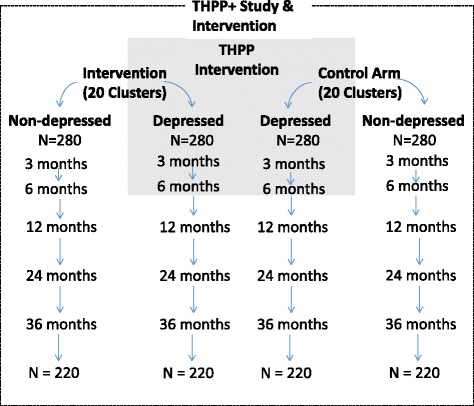
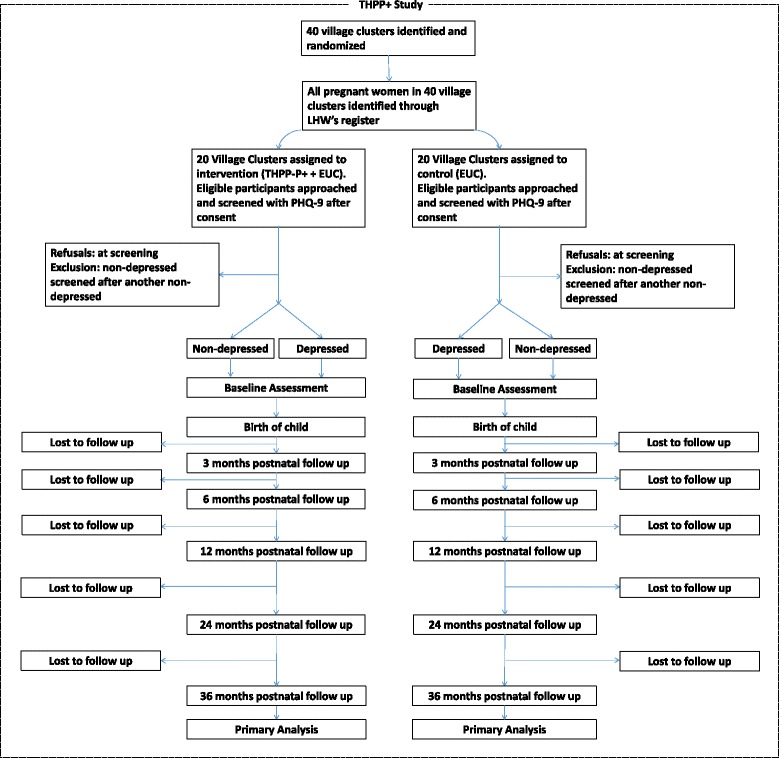
Methods/design: The THPP+ study aims are: (1) to evaluate the effects of an extended 36-month perinatal depression intervention on maternal and index child outcomes using a cluster randomized controlled trial (c-RCT) and (2) to determine whether outcomes among index children of perinatally depressed women in the intervention arm converge with those of index children born to perinatally nondepressed women. The trial is designed to recruit 560 pregnant women who screened positive for perinatal depression (PHQ-9 score ≥10) from 40 village clusters, of which 20 receive the THPP+ intervention. An additional reference group consists of 560 perinatally nondepressed women from the same 40 clusters as the THPP+ trial. The women in the nondepressed group are not targeted to receive the THPP+ intervention; but, by recruiting pregnant women from both intervention and control clusters, we are able to evaluate any carryover effects of the THPP+ intervention on the women and their children. Perinatally depressed women in the THPP+ intervention arm receive bimonthly group-based sessions. Primary outcomes are 3-year maternal depression and 3-year child development indicators. Analyses are intention-to-treat and account for the clustered design.
Discussion: This trial, together with the reference group, has the potential to further our understanding of the early developmental lifecourse of children of both perinatally depressed and perinatally nondepressed women in rural Pakistan and to determine whether intervening with women's depression in the perinatal period can mitigate the negative effects of maternal depression on 36-month child development.
Trial registration: THPP-P ClinicalTrials.gov Identifier: NCT02111915 (registered on 9 April 2014). THPP+ ClinicalTrials.gov Identifier: NCT02658994 (registered on 21 January 2016).
Sponsor: Human Development Research Foundation (HDRF).
Keywords: Child development; Low- and middle-income countries; Maternal depression; Nonmental health professionals; Peer volunteers; Perinatal depression; Psychological treatment; Randomized trials; Task-shifting; Thinking healthy program.
Figures
References
-
- Hussain MFA, Nauman F. Maternal mental distress: a risk factor for infant under nutrition in developing countries. J Pak Med Assoc. 2010;60(4):329. - PubMed
Publication types
MeSH terms
Associated data
Grants and funding
LinkOut - more resources
Full Text Sources
Other Literature Sources
Medical
Miscellaneous
