. 2016 Sep 9:6:32983.
doi: 10.1038/srep32983.

Impact of Degree Heterogeneity on Attack Vulnerability of Interdependent Networks

Affiliations

Impact of Degree Heterogeneity on Attack Vulnerability of Interdependent Networks

Shiwen Sun et al. Sci Rep. .

Abstract

The study of interdependent networks has become a new research focus in recent years. We focus on one fundamental property of interdependent networks: vulnerability. Previous studies mainly focused on the impact of topological properties upon interdependent networks under random attacks, the effect of degree heterogeneity on structural vulnerability of interdependent networks under intentional attacks, however, is still unexplored. In order to deeply understand the role of degree distribution and in particular degree heterogeneity, we construct an interdependent system model which consists of two networks whose extent of degree heterogeneity can be controlled simultaneously by a tuning parameter. Meanwhile, a new quantity, which can better measure the performance of interdependent networks after attack, is proposed. Numerical simulation results demonstrate that degree heterogeneity can significantly increase the vulnerability of both single and interdependent networks. Moreover, it is found that interdependent links between two networks make the entire system much more fragile to attacks. Enhancing coupling strength between networks can greatly increase the fragility of both networks against targeted attacks, which is most evident under the case of max-max assortative coupling. Current results can help to deepen the understanding of structural complexity of complex real-world systems.


Figures

Figure 1
Figure 1. Vulnerability of single eba networks with different p after a fraction f of nodes removed from the networks.
(a) The relative size S of the giant connected component; (b) Efficiency loss (el); (c) Number of isolated connected components (Ns); (d) Average size of isolated connected components (〈s〉). All the networks are with N = 10000 and 〈k〉 = 6. Each point is averaged over 10 independent realizations.
Figure 2
Figure 2. Vulnerability of interdependent eba networks with different p after a fraction f of nodes removed from the networks with coupling strength q = 1.0.
Different coupling types are considered separately: (a) random coupling; (b) assortative coupling; (c) disassortative coupling. All the networks are with N = 2000 and 〈k〉 = 6. Each point is averaged over 10 independent realizations. The legends in (b,c) are the same as those of (a).
Figure 3
Figure 3. The critical values fc as a function of the coupling strength q and model parameter p.
Different coupling types are considered separately: (a) random coupling; (b) max-max coupling; (c) min-min coupling; (d) max-min coupling; (e) min-max coupling. All the networks are with N = 2000 and 〈k〉 = 6. Each point is averaged over 10 independent realizations.
Figure 4
Figure 4. Cumulative degree distribution P(k) of eBA evolving networks with N = 10,000 and for different parameter p.
In panel (a) (log-log scale), P(k) follows a power-law form, which corresponds to one special case of eBA networks (p = 1.0). Panel (b) (in semi-log scale) presents the other special case of eBA networks (p = 0.0), whose degree distribution follows a exponential form. A higher value of p makes corresponding network more heterogeneous in connectivity.
Figure 5
Figure 5. The dependencies of and kmax on parameter p of eBA networks with N = 10,000 and .
Figure 6
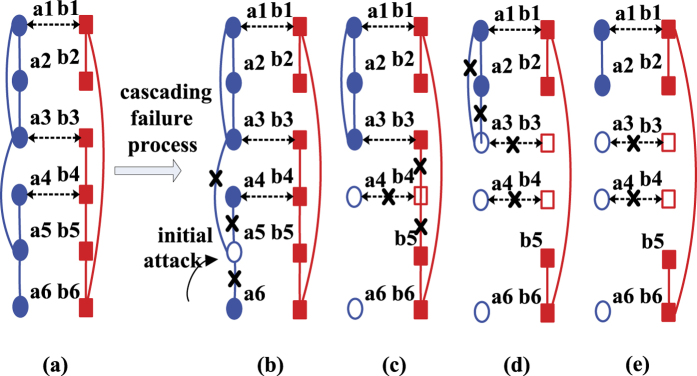
Figure 6. Illustration of an interdependent system composed of two networks and the cascading failure process caused by node removal from one network.
The initial system is shown in (a). Nodes in network A are represented by blue circles ({ai|1 ≤ i ≤ 6}) and nodes in network B are represented by red squares ({bj|1 ≤ j ≤ 6}). The intra-links in each network are represented as solid lines and the interdependent links between networks are represented as dashed lines. (be) Illustrate the iterative process of a cascade of failures induced by an initial attack on a single node a5 in network A.

References

    1. Albert R. & Barabási A. L. Statistical mechanics of complex networks. Rev. Mod. Phys. 74, 47–97 (2002).
    1. Newman M. E. J. The structure and function of complex networks. SIAM Rev. 45(2), 167–256 (2003).
    1. Boccalettia S., Latora V., Moreno Y., Chavez M. & Hwang D. U. Complex networks: structure and dynamics. Phys. Rep. 424, 175–308 (2006).
    1. Kivela M. et al. Multilayer Networks. J. of Comp. Net. 2(3), 203–271 (2014).
    1. Boccaletti S. et al. The structure and dynamics of multilayer networks. Phys. Rep. 544(1), 1–122 (2014). - PMC - PubMed

Publication types

LinkOut - more resources