. 2016 Aug 25:6:86.
doi: 10.3389/fcimb.2016.00086. eCollection 2016.

Economic Game Theory to Model the Attenuation of Virulence of an Obligate Intracellular Bacterium

Affiliations

Economic Game Theory to Model the Attenuation of Virulence of an Obligate Intracellular Bacterium

Damian Tago et al. Front Cell Infect Microbiol. .

Abstract

Diseases induced by obligate intracellular pathogens have a large burden on global human and animal health. Understanding the factors involved in the virulence and fitness of these pathogens contributes to the development of control strategies against these diseases. Based on biological observations, a theoretical model using game theory is proposed to explain how obligate intracellular bacteria interact with their host. The equilibrium in such a game shows that the virulence and fitness of the bacterium is host-triggered and by changing the host's defense system to which the bacterium is confronted, an evolutionary process leads to an attenuated strain. Although, the attenuation procedure has already been conducted in practice in order to develop an attenuated vaccine (e.g., with Ehrlichia ruminantium), there was a lack of understanding of the theoretical basis behind this process. Our work provides a model to better comprehend the existence of different phenotypes and some underlying evolutionary mechanisms for the virulence of obligate intracellular bacteria.

Keywords: Ehrlichia ruminantium; co-evolution; game theory; obligate intracellular bacteria; virulence attenuation.


Figures
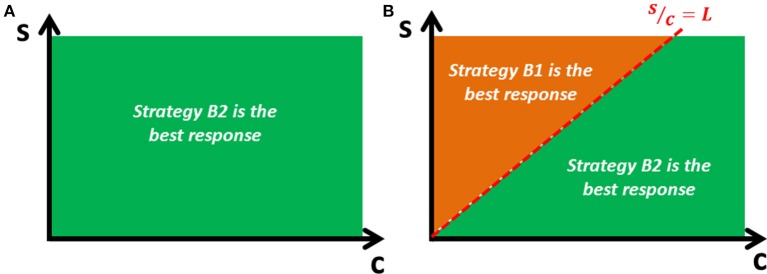
Figure 1
Figure 1
Bacterium's best response. The optimal strategy for the bacterial player depends on the cost-efficiency parameters (s and c). (A) If the bacterium faces the host's incomplete defense system (only intracellular), the best response is to replicate without evading (strategy B2). (B) If the bacterium faces the host's complete defense system (both, intra- and extracellular), the best response is to evade before replicating (strategy B1) if the efficiency parameter [s] is sufficiently high relative to the cost parameter [c].
Figure 2
Figure 2
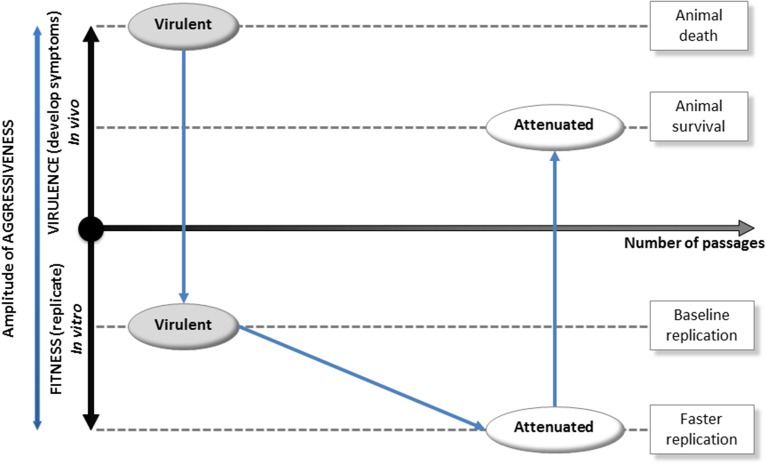
Evolution of host-triggered aggressiveness in an obligate intracellular pathogenic bacterium. In this scheme, the ultimate amplitude of aggressiveness is proportional to virulence (ability to induce symptoms and evading the host's immune system) and fitness (ability to replicate inside the cell in vitro). First, a virulent strain that sickens the animal delivers effector proteins (i) to counteract host immune response and (ii) to scavenge the host cell. Effector synthesis is an energy-consuming process that leads to a moderate fitness in vitro(development cycle of 5 days for virulent Gardel strain). Second, by the mean of iterative passages in vitro, the resulting attenuated strain gained skills to grow in cell culture but lost the ability to hijack host immunity and is eliminated when injected in the animal. Thus, this strain exhibits a greater fitness in vitro (development cycle of 4 days for attenuated Gardel strain) but a decreased virulence once inside the animal (host's success in eliminating the bacterium). This behavior highlights the co-evolutionary arms race between a bacterial pathogen and its host.
Figure 3
Figure 3
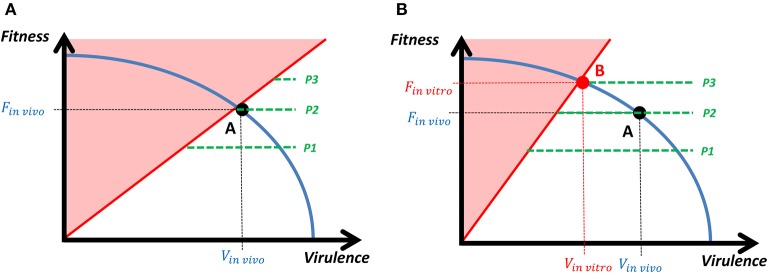
Transition from in vivo to in vitro equilibrium. The tradeoff between fitness and virulence is represented by the downward sloping efficient frontier (blue line), and the green dotted lines represent the indifference curves. Each indifference curve represents the combination of fitness and virulence that provide the same payoff to the bacteria and we assume that the payoff landscape is independent on the virulence and increasing on fitness, which determines the form of the indifference curves (P1 < P2 < P3). (A) When facing the in vivo conditions (intra- and extracellular defense systems are adopted by the host) the payoff of the bacterium in the red zones is equal to zero (if the bacteria are too virulent, they will kill the host along with the bacteria themselves; if the bacteria are not virulent enough relative to their fitness, they will be easily detected by the host's immune system and eliminated), and the optimal strategy for the bacterium is characterized by the tangency point between the highest indifference curve and the efficient frontier (point A). (B) When moving to the in vitro conditions (only intracellular defense system is adopted by the host), the zone for which the bacterium's payoff is reduced, so the equilibrium changes (point B) and the bacterium achieves a higher payoff (P3 > P2). However, when the bacterium faces back the in vivo conditions, the equilibrium point B gets into the red zone. This means that the bacteria are not virulent enough (relative to their fitness) to evade the host's immune system and they are eliminated.

References

    1. Atack J., Srikhanta Y., Djoko K., Welch J., Hasri N., Steichen C., et al. (2013). Characterization of an ntrX mutant of Neisseria gonorrhoeae reveals a response regulator that controls expression of respiratory enzymes in oxidase-positive proteobacteria. J. Bacteriol. 195, 2632–2641. 10.1128/JB.02062-12 - DOI - PMC - PubMed
    1. Barnewall R. E., Rikihisa Y., Lee E. H. (1997). Ehrlichia chaffeensis inclusions are early endosomes which selectively accumulate transferrin receptor. Infect. Immun. 65, 1455–1461. - PMC - PubMed
    1. Bechah Y., Karkouri K., Mediannikov O., Leroy Q., Pelletier N., Robert C., et al. (2010). Genomic, proteomic, and transcriptomic analysis of virulent and avirulent Rickettsia prowazekii reveals its adaptive mutation capabilities. Genome Res. 20, 655–663. 10.1101/gr.103564.109 - DOI - PMC - PubMed
    1. Best A., White A., Boots M. (2008). Maintenance of host variation in tolerance to pathogens and parasites. Proc. Natl. Acad. Sci. U.S.A. 105, 20786–20791. 10.1073/pnas.0809558105 - DOI - PMC - PubMed
    1. Bitsaktsis C., Huntington J., Winslow G. (2004). Production of IFN-gamma by CD4 T cells is essential for resolving Ehrlichia infection. J. Immunol. 172, 6894–6901. 10.4049/jimmunol.172.11.6894 - DOI - PubMed

Publication types

LinkOut - more resources