


Design and protocol for the Dialysis Optimal Health Program (DOHP) randomised controlled trial
- PMID: 27612446
- PMCID: PMC5018180
- DOI: 10.1186/s13063-016-1558-z
Design and protocol for the Dialysis Optimal Health Program (DOHP) randomised controlled trial
Abstract
Background: Chronic kidney disease (CKD) and end-stage kidney disease (ESKD) are serious and growing health problems with enormous impact on psychological and social functioning. Despite high rates of comorbid depression and anxiety in these patient populations, and the adverse impact these have upon treatment adherence, quality of life, social connectedness and healthcare costs there has been little attention focused on the prevention or management of these problems. Thus, our aim was to evaluate the Dialysis Optimal Health Program (DOHP) that adopts a person-centred approach and engages collaborative therapy to educate and support those diagnosed with ESKD who are commencing dialysis.
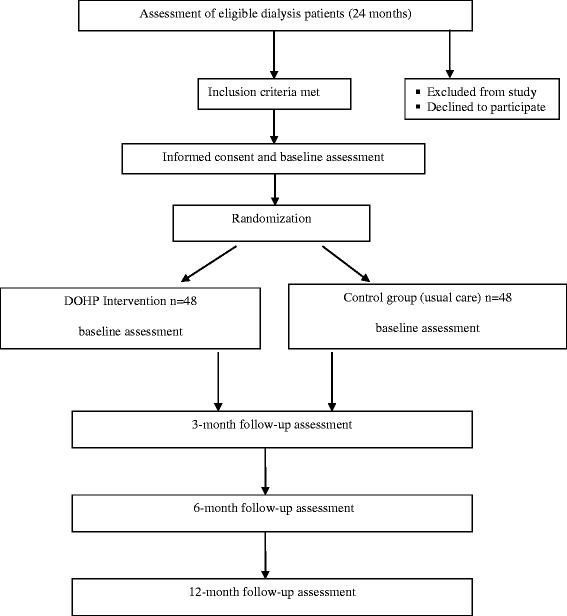
Methods: The study design is a randomised controlled trial. Ninety-six adult patients initiating haemodialysis or peritoneal dialysis will be randomly allocated to either the intervention (DOHP) or usual care group. Participants receiving the intervention will receive nine (8 + 1 booster session) sequential sessions based on a structured information/workbook, psychosocial and educational supports and skills building. The primary outcome measures are depression and anxiety (assessed by the Hospital Anxiety and Depression Scale; HADS). Secondary outcomes include health-related quality of life (assessed by the Kidney Disease Quality of Life instrument; KDQOL), self-efficacy (assessed by General Self-Efficacy Scale) and clinical indices (e.g. albumin and haemoglobin levels). Cost-effectiveness analysis and process evaluation will also be performed to assess the economic value and efficacy of the DOHP. Primary and secondary measures will be collected at baseline and at 3-, 6-, and 12-month follow-up time points.
Discussion: We believe that this innovative trial will enhance knowledge of interventions aimed at supporting patients in the process of starting dialysis, and will broaden the focus from physical symptoms to include psychosocial factors such as depression, anxiety, self-efficacy, wellbeing and community support. The outcomes associated with this study are significant in terms of enhancing an at-risk population's psychosocial health and reducing treatment-related costs and associated pressures on the healthcare system.
Trial registration: ANZCTR no. 12615000810516 . Registered on 5 August 2015.
Keywords: Chronic kidney disease; Collaborative therapy; Dialysis; End-stage kidney disease; Psychosocial health; Randomised controlled trial.
Figures
References
-
- Australian Institute of Health and Welfare . Cardiovascular disease, diabetes and chronic kidney disease— Australian facts: prevalence and incidence, cardiovascular, diabetes and chronic kidney disease series no. 2. Cat. no. CDK 2. Canberra: AIHW; 2014.
-
- ANZDATA Registry. 37th Report, Chapter 1: Incidence of End Stage Kidney Disease. Adelaide: Australia and New Zealand Dialysis and Transplant Registry; 2015. Available at: http://www.anzdata.org.au
-
- Kimmel PL, Weihs K, Peterson RA. Survival in hemodialysis patients: the role of depression. J Am Soc Nephrol. 1993;4(1):12–27. - PubMed
Publication types
MeSH terms
Associated data
LinkOut - more resources
Full Text Sources
Other Literature Sources
Medical
