


Multiplication of Legionella pneumophila Sequence Types 1, 47, and 62 in Buffered Yeast Extract Broth and Biofilms Exposed to Flowing Tap Water at Temperatures of 38°C to 42°C
- PMID: 27613680
- PMCID: PMC5086563
- DOI: 10.1128/AEM.01107-16
Multiplication of Legionella pneumophila Sequence Types 1, 47, and 62 in Buffered Yeast Extract Broth and Biofilms Exposed to Flowing Tap Water at Temperatures of 38°C to 42°C
Erratum in
-
Erratum for van der Kooij et al., Multiplication of Legionella pneumophila Sequence Types 1, 47, and 62 in Buffered Yeast Extract Broth and Biofilms Exposed to Flowing Tap Water at Temperatures of 38°C to 42°C.Appl Environ Microbiol. 2016 Dec 15;83(1):e03036-16. doi: 10.1128/AEM.03036-16. Print 2017 Jan 1. Appl Environ Microbiol. 2016. PMID: 27979854 Free PMC article. No abstract available.
Abstract
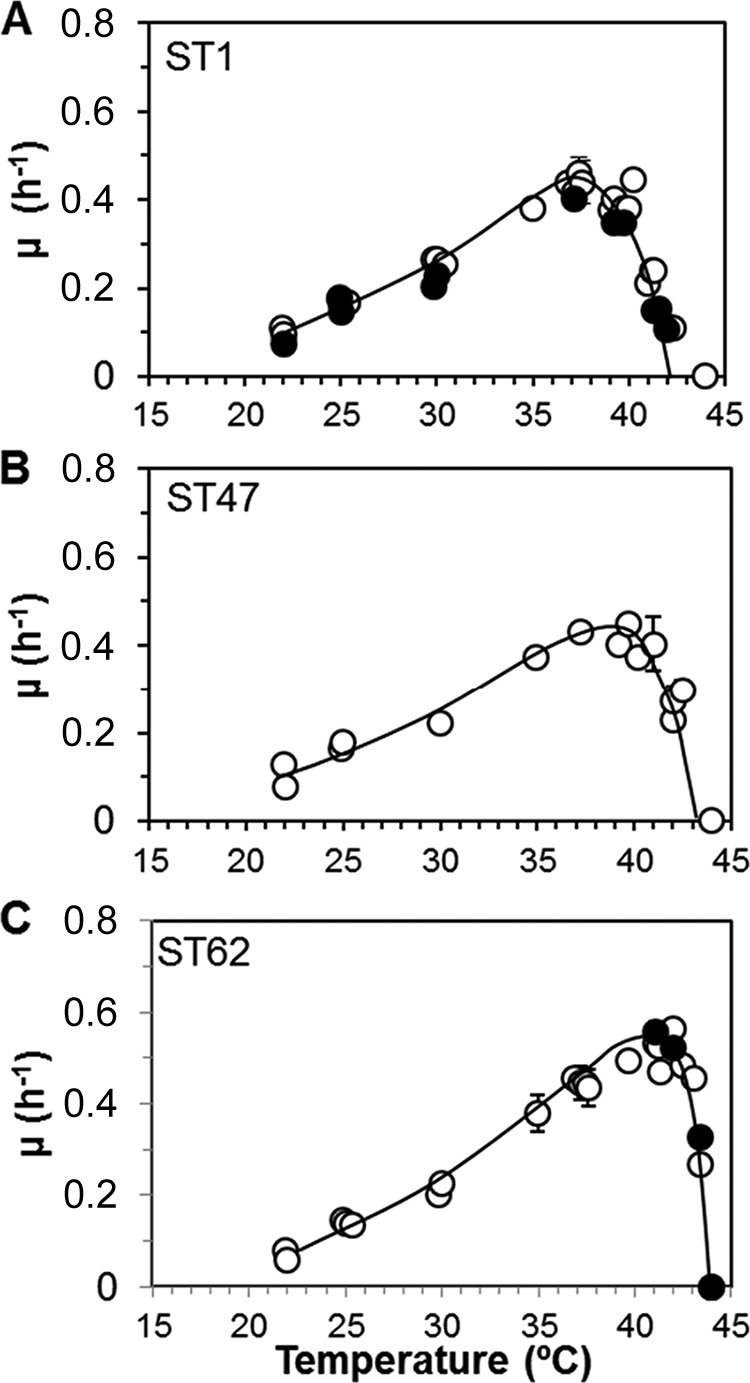
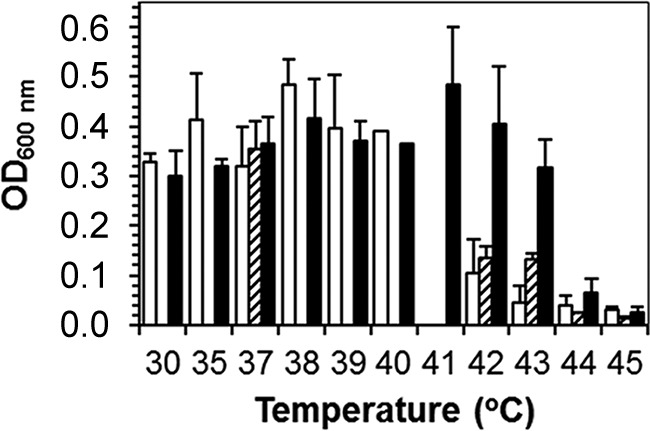
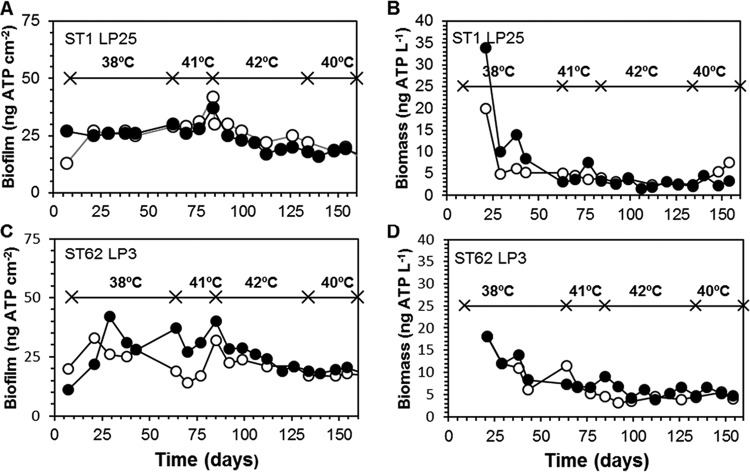
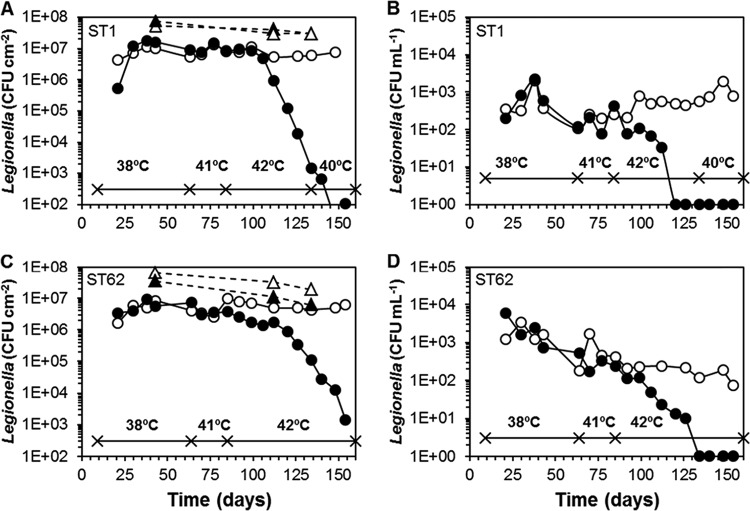
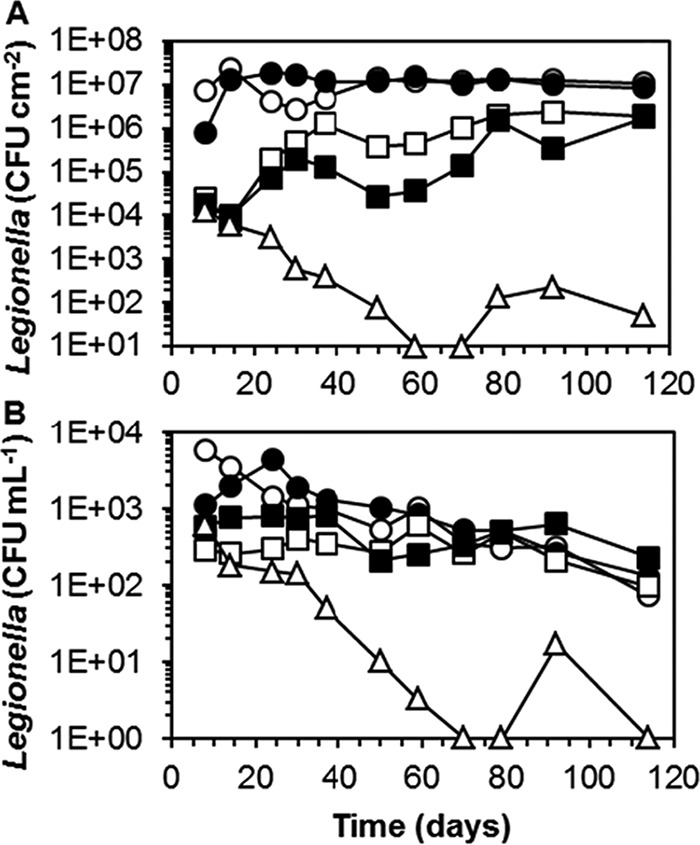
Legionella pneumophila proliferates in freshwater environments at temperatures ranging from 25 to 45°C. To investigate the preference of different sequence types (ST) for a specific temperature range, growth of L. pneumophila serogroup 1 (SG1) ST1 (environmental strains), ST47, and ST62 (disease-associated strains) was measured in buffered yeast extract broth (BYEB) and biofilms grown on plasticized polyvinyl chloride in flowing heated drinking water originating from a groundwater supply. The optimum growth temperatures in BYEB were approximately 37°C (ST1), 39°C (ST47), and 41°C (ST62), with maximum growth temperatures of 42°C (ST1) and 43°C (ST47 and ST62). In the biofilm at 38°C, the ST47 and ST62 strains multiplied equally well compared to growth of the environmental ST1 strain and an indigenous L. pneumophila non-SG1 strain, all attaining a concentration of approximately 107 CFU/cm-2 Raising the temperature to 41°C did not impact these levels within 4 weeks, but the colony counts of all strains tested declined (at a specific decline rate of 0.14 to 0.41 day-1) when the temperature was raised to 42°C. At this temperature, the concentration of Vermamoeba vermiformis in the biofilm, determined with quantitative PCR (qPCR), was about 2 log units lower than the concentration at 38°C. In columns operated at a constant temperature, ranging from 38 to 41°C, none of the tested strains multiplied in the biofilm at 41°C, in which also V. vermiformis was not detected. These observations suggest that strains of ST47 and ST62 did not multiply in the biofilm at a temperature of ≥41°C because of the absence of a thermotolerant host.
Importance: Growth of Legionella pneumophila in tap water installations is a serious public health concern. The organism includes more than 2,100 varieties (sequence types). More than 50% of the reported cases of Legionnaires' disease are caused by a few sequence types which are very rarely detected in the environment. Strains of selected virulent sequence types proliferated in biofilms on surfaces exposed to warm (38°C) tap water to the same level as environmental varieties and multiplied well as pure culture in a nutrient-rich medium at temperatures of 42 and 43°C. However, these organisms did not grow in the biofilms at temperatures of ≥41°C. Typical host amoebae also did not multiply at these temperatures. Apparently, proliferation of thermotolerant host amoebae is needed to enable multiplication of the virulent L. pneumophila strains in the environment at elevated temperatures. The detection of these amoebae in water installations therefore is a scientific challenge with practical implications.
Copyright © 2016, American Society for Microbiology. All Rights Reserved.
Figures
References
-
- European Centre for Disease Prevention and Control. 2014. Legionnaires' disease in Europe 2012. Surveillance report. European Centre for Disease Prevention and Control, Stockholm, Sweden: http://ecdc.europa.eu/en/publications/publications/legionnaires-disease-....
-
- Yu VL, Plouffe JF, Pistoris MC, Stout JE, Schousboe M, Widmer A, Summersgill J, File T, Heath CM, Paterson DL, Cheresky A. 2002. Distribution of Legionella species and serogroups isolated by culture in patients with sporadic community-acquired legionellosis: an international collaborative survey. J Infect Dis 186:127–128. doi: 10.1086/341087. - DOI - PubMed
-
- Amemura-Maekawa J, Kura F, Helbig JH, Chang B, Kaneko A, Watanabe Y, Isobe J, Nukina M, Nakajima H, Kawano K, Tada Y, Watanabe H, Working Group for Legionella in Japan . 2010. Characterization of Legionella pneumophila isolates from patients in Japan according to serogroups, monoclonal antibody subgroups and sequence types. J Med Microbiol 59:653–659. doi: 10.1099/jmm.0.017509-0. - DOI - PubMed
Publication types
MeSH terms
Substances
LinkOut - more resources
Full Text Sources
Other Literature Sources
Medical
Miscellaneous
