


Does Quitting Smoking Make a Difference Among Newly Diagnosed Head and Neck Cancer Patients?
- PMID: 27613928
- PMCID: PMC5103939
- DOI: 10.1093/ntr/ntw189
Does Quitting Smoking Make a Difference Among Newly Diagnosed Head and Neck Cancer Patients?
Abstract
Introduction: To determine if smoking after a cancer diagnosis makes a difference in mortality among newly diagnosed head and neck cancer patients.
Methods: Longitudinal data were collected from newly diagnosed head and neck cancer patients with a median follow-up time of 1627 days (N = 590). Mortality was censored at 8 years or September 1, 2011, whichever came first. Based on smoking status, all patients were categorized into four groups: continuing smokers, quitters, former smokers, or never-smokers. A broad range of covariates were included in the analyses. Kaplan-Meier curves, bivariate and multivariate Cox proportional hazards models were constructed.
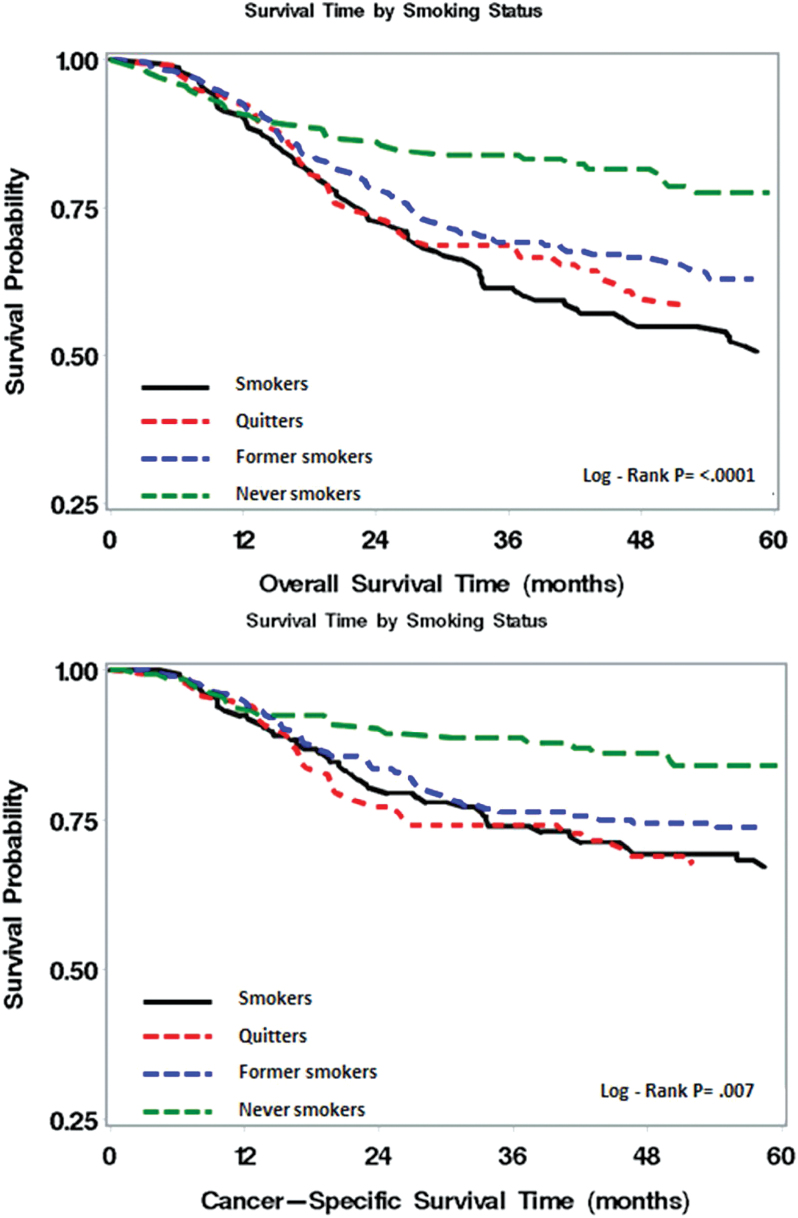
Results: Eight-year overall mortality and cancer-specific mortality were 40.5% (239/590) and 25.4% (150/590), respectively. Smoking status after a cancer diagnosis predicted overall mortality and cancer-specific mortality. Compared to never-smokers, continuing smokers had the highest hazard ratio (HR) of dying from all causes (HR = 2.71, 95% confidence interval [CI] = 1.48-4.98). Those who smoked at diagnosis, but quit and did not relapse-quitters-had an improved hazard ratio of dying (HR = 2.38, 95% CI = 1.29-4.36) and former smokers at diagnosis with no relapse after diagnosis-former smokers-had the lowest hazard ratio of dying from all causes (HR = 1.68, 95% CI = 1.12-2.56). Similarly, quitters had a slightly higher hazard ratio of dying from cancer-specific reasons (HR = 2.38, 95% CI = 1.13-5.01) than never-smokers, which was similar to current smokers (HR = 2.07, 95% CI = 0.96-4.47), followed by former smokers (HR = 1.70, 95% CI = 1.00-2.89).
Conclusions: Compared to never-smokers, continuing smokers have the highest HR of overall mortality followed by quitters and former smokers, which indicates that smoking cessation, even after a cancer diagnosis, may improve overall mortality among newly diagnosed head and neck cancer patients. Health care providers should consider incorporating smoking cessation interventions into standard cancer treatment to improve survival among this population.
Implications: Using prospective observational longitudinal data from 590 head and neck cancer patients, this study showed that continuing smokers have the highest overall mortality relative to never-smokers, which indicates that smoking cessation, even after a cancer diagnosis, may have beneficial effects on long-term overall mortality. Health care providers should consider incorporating smoking cessation interventions into standard cancer treatment to improve survival among this population.
© The Author 2016. Published by Oxford University Press on behalf of the Society for Research on Nicotine and Tobacco. All rights reserved. For permissions, please e-mail: journals.permissions@oup.com.
Figures
References
-
- American Cancer Society. Cancer Facts and Figures 2010. Atlanta, GA: American Cancer Society; 2010.
-
- McBride CM, Ostroff JS. Teachable moments for promoting smoking cessation: the context of cancer care and survivorship. Cancer Control. 2003;10(4):325–333. - PubMed
-
- Duffy SA, Khan MJ, Ronis DL, et al. Health behaviors of head and neck cancer patients the first year after diagnosis. Head Neck. 2008;30(1):93–102. - PubMed
-
- Sardari Nia P, Weyler J, Colpaert C, Vermeulen P, Van Marck E, Van Schil P. Prognostic value of smoking status in operated non-small cell lung cancer. Lung Cancer. 2005;47(3):351–359. - PubMed
Publication types
MeSH terms
Grants and funding
LinkOut - more resources
Full Text Sources
Other Literature Sources
Medical
