. 2016 Nov;37(11):14585-14594.
doi: 10.1007/s13277-016-5332-3. Epub 2016 Sep 10.

Overexpression of LARP1 predicts poor prognosis of colorectal cancer and is expected to be a potential therapeutic target

Affiliations

Overexpression of LARP1 predicts poor prognosis of colorectal cancer and is expected to be a potential therapeutic target

Ling Ye et al. Tumour Biol. 2016 Nov.

Abstract

This study investigated the significance of La-related protein 1 (LARP1) in the development and progression of colorectal cancer (CRC). Quantitative real-time polymerase chain reaction and Western blot analyses were carried out to determine the mRNA and protein expression of LARP1 in CRC tumor tissues and paired adjacent normal mucosa. The expression of LARP1 was upregulated in CRC. Immunohistochemical analysis using tissue microarray was performed. A positive correlation between LARP1 and proliferating cell nuclear antigen (PCNA) in the area of proliferation was observed using the Spearman's correlation coefficient test (r = 0.332, P < 0.01). The elevated expression of LARP1 significantly correlated with T stage (P = 0.02), N stage (P = 0.006), M stage (P < 0.001), American Joint Committee on Cancer (AJCC) stage (P = 0.04), differentiation rank (P < 0.001), and PCNA level (P < 0.001). In addition, the inhibitory effect of LARP1 knockdown on CRC cell proliferation was demonstrated using Cell Counting Kit-8 (CCK8) and colony-forming cell (CFC) assays. Multivariate analysis showed that LARP1 was an independent prognostic factor for overall survival (OS; hazard rate (HR) = 0.244; 95 % confidence interval (CI), 0.078-0.769; P = 0.016) and disease-free survival (DFS; HR = 0.281; 95 % CI, 0.086-0.917; P = 0.035) in CRC patients. LARP1 plays an important role in the proliferation of colorectal cancer and represents a new prognostic indicator.

Keywords: Colorectal cancer; LARP1; Prognosis; Proliferation.


Conflict of interest statement

Compliance with ethical standards Ethical approval All procedures performed in studies involving human participants were in accordance with the ethical standards of the institutional and/or national research committee and with the 1964 Helsinki Declaration and its later amendments or comparable ethical standards. Conflicts of interest None.

Figures
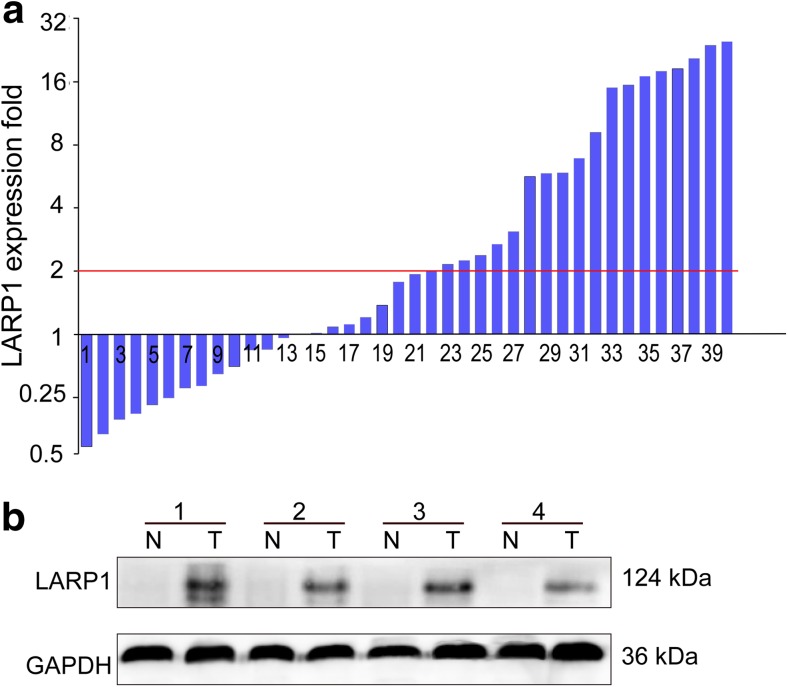
Fig. 1
Fig. 1
LARP1 expression in colorectal cancer tissues and adjacent normal mucosa. a Relative expression of LARP1 gene in 40 matched colorectal cancer tissue specimens compared with normal mucosa samples. The fold change of quantitative real-time polymerase chain reaction (RT-PCR) was calculated using the logarithmic scale of 2−ΔΔCt. b Western blot of LARP1 protein expression in representative four paired colorectal tumor tissues
Fig. 2
Fig. 2
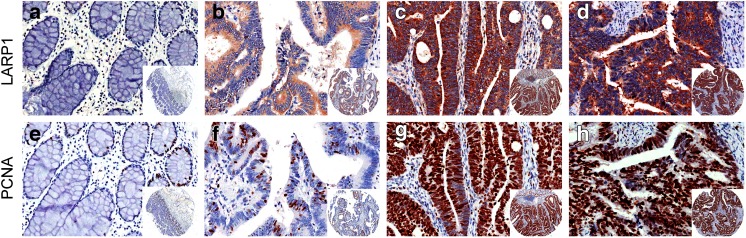
Immunohistochemical staining of LARP1 and PCNA expression in normal and colorectal cancer tissues. Representative images of LARP1 and PCNA expression in normal colonic epithelium (a, e), highly differentiated tumor tissues (b, f), moderately differentiated tumor tissues (c, g), and poorly differentiated cancer (d, h). The expression of LARP1 was higher in specimens with intensely positive PCNA staining. Original magnification ×200 (×40 for inset images)
Fig. 3
Fig. 3
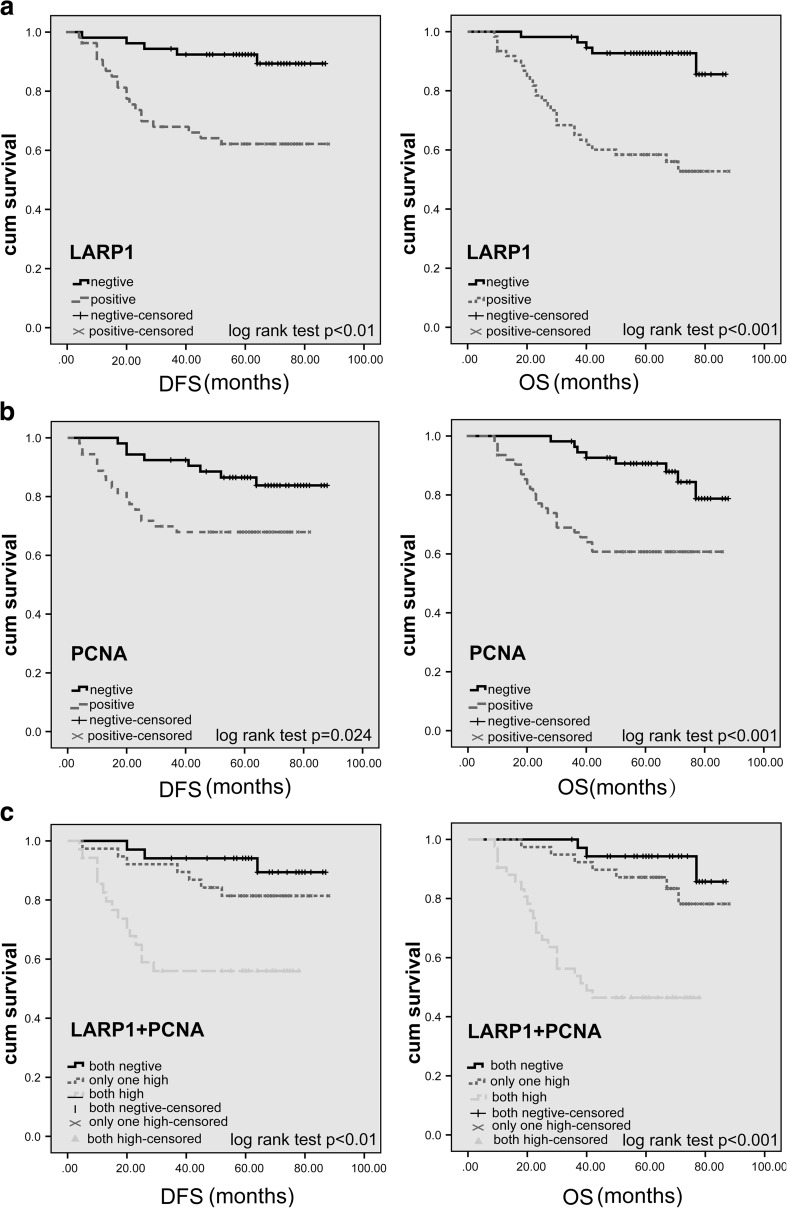
Kaplan–Meier survival analyses and log-rank test. a Disease-free survival (DFS) and overall survival (OS) of 117 patients correlated with LARP1 expression were determined by immunohistochemical staining of tissue microarrays. b DFS and OS were significantly higher in patients with PCNA-negative than in PCNA-positive tumors (P < 0.05). c DFS and OS were significantly lower in patients with tumors expressing high rather than low levels of both LARP1 and PCNA (P < 0.01)
Fig. 4
Fig. 4
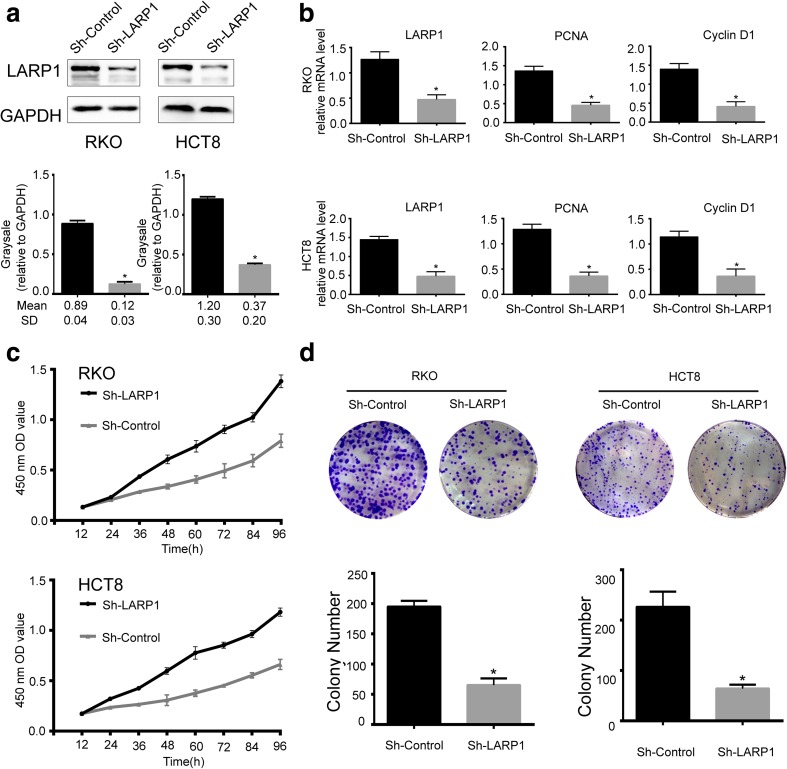
LARP1 knockdown inhibits colorectal cancer cell proliferation. a LARP1 level in stable knockdown HCT8 and RKO cell lines was assessed by Western blot. Grayscale values were analyzed using Quantity One software (n = 3, P < 0.05). b expression of proliferation-related genes was inhibited in LARP1 knockdown cells according to real-time PCR (n = 3; P < 0.05). c, d Effects of LARP1 knockdown on cell growth were evaluated by Cell Counting Kit-8 assays (c) and plate colony formation assays (d) (n = 3; P < 0.05)

References

    1. Siegel R, Naishadham D, Jemal A. Cancer statistics, 2012. CA Cancer J Clin. 2012;62(1):10–29. doi: 10.3322/caac.20138. - DOI - PubMed
    1. Liu S, et al. Incidence and mortality of colorectal cancer in China, 2011. Chin J Cancer Res. 2015;27(1):22–28. doi: 10.1186/s40880-015-0023-9. - DOI - PMC - PubMed
    1. Julie Bogaert HP. Molecular genetics of colorectal cancer. Ann Gastroenterol. 2014;27(1):9–14. - PMC - PubMed
    1. Prenen H, Vecchione L, Van Cutsem E. Role of targeted agents in metastatic colorectal cancer. Target Oncol. 2013;8(2):83–96. doi: 10.1007/s11523-013-0281-x. - DOI - PubMed
    1. Fleshman JW, Smallwood N. Current concepts in rectal cancer. Clin Colon Rectal Surg. 2015;28(1):5–11. doi: 10.1055/s-0035-1545064. - DOI - PMC - PubMed

MeSH terms