. 2016 Nov 1;24(21):5183-5196.
doi: 10.1016/j.bmc.2016.08.040. Epub 2016 Aug 24.

Synthesis and biological evaluation of santacruzamate A analogues for anti-proliferative and immunomodulatory activity

Affiliations

Synthesis and biological evaluation of santacruzamate A analogues for anti-proliferative and immunomodulatory activity

Samantha M Gromek et al. Bioorg Med Chem. .

Abstract

Santacruzamate A (SCA) is a natural product isolated from a Panamanian marine cyanobacterium, previously reported to have potent and selective histone deacetylase (HDAC) activity. To optimize the enzymatic and cellular activity, 40 SCA analogues were synthesized in a systematic exploration of the zinc-binding group (ZBG), cap terminus, and linker region. Two cap group analogues inhibited proliferation of MCF-7 breast cancer cells, with analogous increased degranulation of cytotoxic T cells (CTLs), while one cap group analogue reduced CTL degranulation, indicative of suppression of the immune response. Additional testing of these analogues resulted in reevaluation of the previously reported SCA mechanism of action. These analogues and the resulting structure-activity relationships will be of interest for future studies on cell proliferation and immune modulation.

Keywords: Anti-proliferative activity; Enzyme assays; Immune modulation; Natural product analogues; Santacruzamate A.


Figures

Figure 1
Figure 1
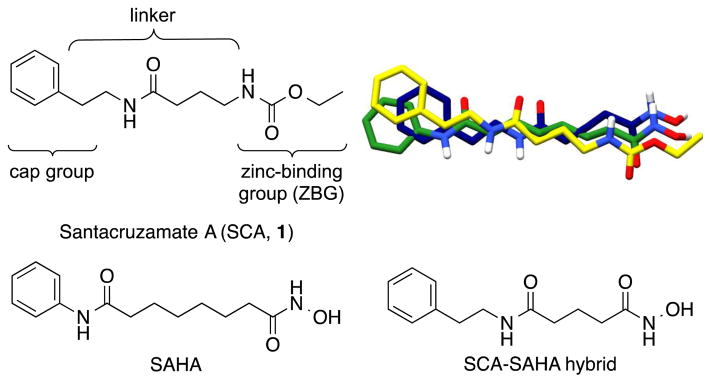
Santacruzamate A (SCA, 1), SAHA, and the SCA-SAHA hybrid compound reported previously, and their overlaid 3D structures (SCA in yellow, SAHA in green, and SCA-SAHA hybrid in blue).
Figure 2
Figure 2
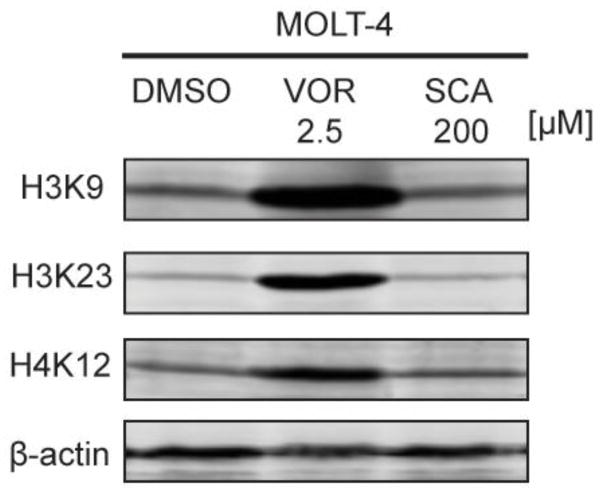
Effect of santacruzamate A and SAHA on the levels of acetylated histones H3K9, H3K23, and H4K12 in Molt-4 cells.
Figure 3
Figure 3
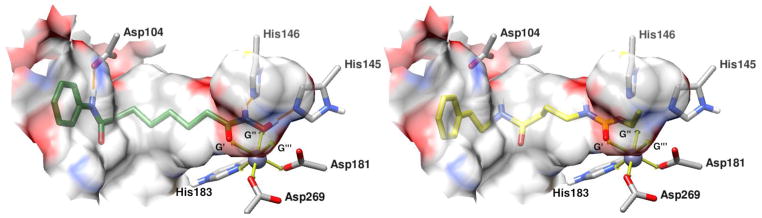
X-ray crystal structure of SAHA (green, left) bound to HDAC2 (gray, PDB: 4LXZ), with santacruzamate A (1) (yellow, right) overlaid over the binding conformation of SAHA with HDAC2. The zinc ion (dark gray) within the HDAC2 active site is shown with an idealized octahedral metal geometry (idealized metal geometries of the zinc ion are shown as yellow arrows and geometries not filled by HDAC2 are labeled G′, G″, G″′ and proceed clockwise starting from left) using the Chimera program. SAHA binds to the zinc ion via chelation with G′ and G″, while santacruzamate A likely binds only to G′. Hydrogen bonds are depicted as orange lines. The surface of the HDAC2 active site, within 4.1Å of the ligands, was generated via Chimera and colored according to the corresponding heteroatom on enzyme surface.
Scheme 1
Scheme 1
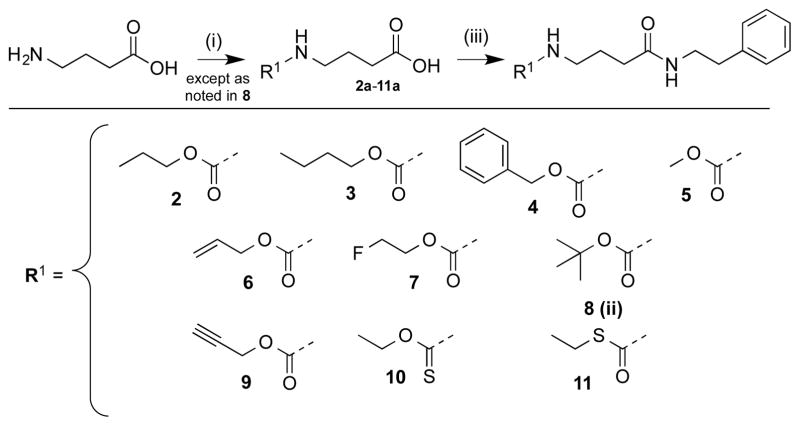
Synthesis of santacruzamate A N-carbamate analogues. Reagent and conditions: (i) ClCO2-R1, K2CO3 or NaOH, THF, 0 °C to rt, 70–90%; (ii) Boc2O, NaOH, THF, 97%; (iii) phenethylamine, EDC-HCl, TEA, cat. DMAP, CH2Cl2, 43–93%.
Scheme 2
Scheme 2
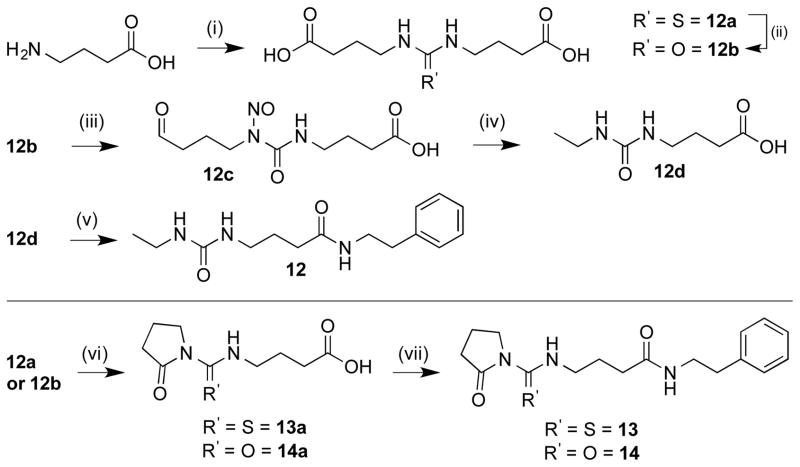
Synthesis of santacruzamate A urea analogues. Reagents and conditions: (i) CS2, NaOH, H2O; (ii) 30% H2O2, KOH, H2O; (iii) KNO2, diluted H2SO4, 0 °C to rt; (iv) 68% ethylamine/H2O, 100 °C; (v) phenethylamine, EDC-HCl, TEA, cat. DMAP, CH2Cl2, 0 °C to rt; (vi) 12a or 12b, cat. p-TsOH, NEAT 180 °C, 30 torr; (vii) 13a or 13b, phenethylamine, EDC-HCl, TEA, cat. DMAP, CH2Cl2, 0 °C to rt.
Scheme 3
Scheme 3
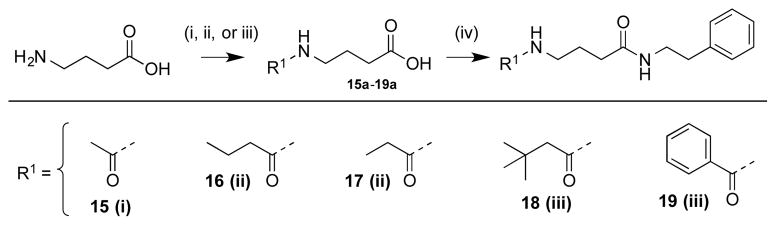
Synthesis of santacruzamate A N-amide analogues. Reagents and conditions: (i) Ac2O, AcOH, Et2O; (ii) propionic anhydride or butyric anhydride, cat H2SO4, 100 °C; (iii) R2-COCl, NaOH, THF/H2O, 0 °C to rt; (iv) phenethylamine, EDC-HCl, TEA, cat. DMAP, CH2Cl2.
Scheme 4
Scheme 4
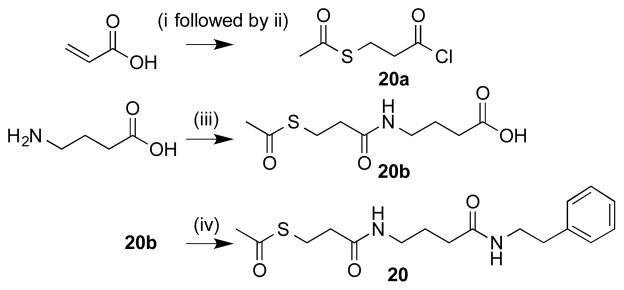
Synthesis of santacruzamate A thiol analogue. Reagents and conditions: (i) thioacetic acid, 0 °C to rt; (ii) thionyl chloride, DCM, refluxed for 2 h at 40 °C; (iii) 20a, H2O, Na2CO3, 0 °C to rt; (iv) phenethylamine, EDC-HCl, TEA, cat. DMAP, CH2Cl2.
Scheme 5
Scheme 5
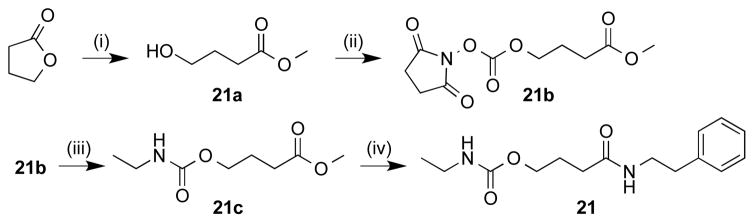
Synthesis of santacruzamate A inverted ethyl carbamate analogue. Reagents and Conditions: (i) TEA, MeOH, reflux, 92%; (ii) methyl-4-hydroxybutanoate, N,N′-disuccinimdyl carbonate, TEA 79%; (iii) NHS-methyl-4-hydroxybutanoate, 68% ethylamine, TEA, THF; (iv) phenethylamine, EDC-HCl, TEA, DMAP, CH2Cl2 56%.
Scheme 6
Scheme 6
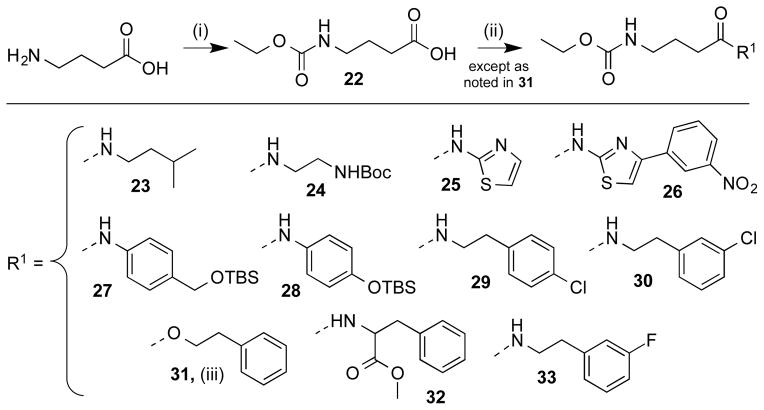
Synthesis of santacruzamate Acap group analogues. Reagent and conditions: (i) ethyl chloroformate, K2CO3, H2O, 0 °C to rt; (ii) cap-group R1, EDC-HCl, TEA, cat. DMAP, CH2Cl2; (iii) EDC-HCl, HOBt, TEA, phenethyl-OH, DCM, 0 °C to rt.
Scheme 7
Scheme 7
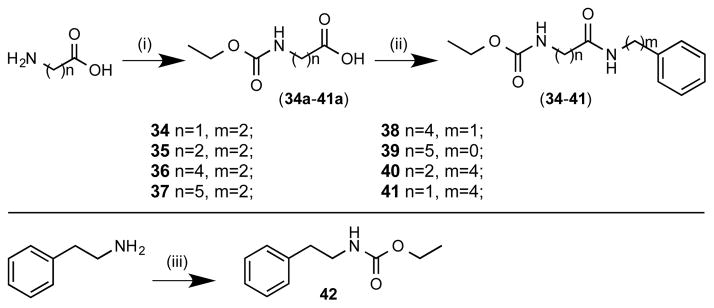
Synthesis of santacruzamate A linker analogues. Reagents and conditions: (i) ethyl chloroformate, K2CO3, H2O, 0 °C to rt; (ii) phenethylamine, aniline, benzenemethanamine, or benzenebutanamine, EDC-HCl, TEA, cat. DMAP, CH2Cl2, 0 °C to rt; (iii) ethylchloroformate, TEA, CH2Cl2.

References

    1. Minucci S, Pelicci PG. Nat Rev Cancer. 2006;6:38–51. - PubMed
    1. Bachireddy P, Burkhardt UE, Rajasagi M, Wu CJ. Nat Rev Cancer. 2015;15:201–215. - PMC - PubMed
    1. Gnyszka A, Jastrzebski Z, Flis S. Anticancer Res. 2013;33:2989–2996. - PubMed
    1. Yuan Y, Tang AJ, Castoreno AB, Kuo SY, Wang Q, Kuballa P, Xavier R, Shamji AF, Schreiber SL, Wagner BK. Cell Death Dis. 2013;4:e690. - PMC - PubMed
    1. Gandhi AK, Shi T, Li M, Jungnelius U, Romano A, Tabernero J, Siena S, Schafer PH, Chopra R. PLoS One. 2013;8:e80437. - PMC - PubMed

Publication types

MeSH terms