Review
. 2016 Jul 18;5(9):795-803.
doi: 10.1016/j.molmet.2016.07.004. eCollection 2016 Sep.

Interactions between host genetics and gut microbiome in diabetes and metabolic syndrome

Affiliations
Review

Interactions between host genetics and gut microbiome in diabetes and metabolic syndrome

Siegfried Ussar et al. Mol Metab. .

Abstract

Background: Diabetes, obesity, and the metabolic syndrome are multifactorial diseases dependent on a complex interaction of host genetics, diet, and other environmental factors. Increasing evidence places gut microbiota as important modulators of the crosstalk between diet and development of obesity and metabolic dysfunction. In addition, host genetics can have important impact on the composition and function of gut microbiota. Indeed, depending on the genetic background of the host, diet and other environmental factors may produce different changes in gut microbiota, have different impacts on host metabolism, and create different interactions between the microbiome and the host.

Scope of review: In this review, we highlight how appropriate animal models can help dissect the complex interaction of host genetics with the gut microbiome and how diet can lead to different degrees of weight gain, levels of insulin resistance, and metabolic outcomes, such as diabetes, in different individuals. We also discuss the challenges of identifying specific disease-associated microbiota and the limitations of simple metrics, such as phylogenetic diversity or the ratio of Firmicutes to Bacteroidetes.

Major conclusions: Understanding these complex interactions will help in the development of novel treatments for microbiome-related metabolic diseases. This article is part of a special issue on microbiota.

Keywords: Environment; Host genetics; Metabolic syndrome; Microbial diversity; Microbiome; Microbiota; Obesity.


Figures
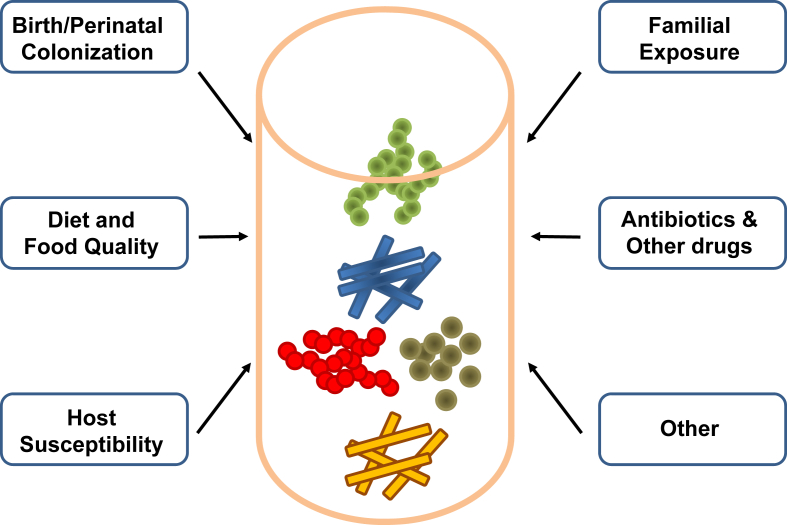
Figure 1
Figure 1
Factors contributing to the development of the microbiome. The development and composition of the gut microbiome is highly dependent on a multitude of environmental and host factors, especially those present in early life. Although core components of the gut microbiome tend to remain stable in adults, they continue to rapidly respond to alterations in the envrionment such as diet, medication and other factors.
Figure 2
Figure 2
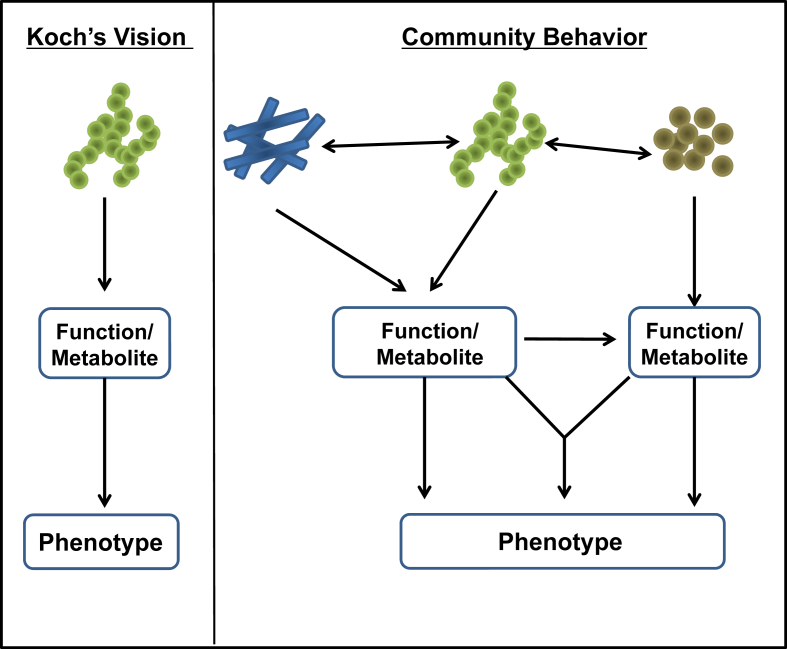
Co-dependency of gut microbiota to modulate host metabolism. To identify individual bacterial taxa causally linked to specific host phenotype, one might anticipate a model which fulfills Koch's postulates, much like traditional views from genetics with one gene yielding one mRNA and then one protein with a defined and unique function. However, like modern cell biology the association of microbial taxa with host phenotypes is likely complex and impacted by the interaction of the microbiota themselves supporting their growth. Moreover, individual functions and metabolic pathways are either shared or split among different microbiota, and in most cases several microbiota and their functions may be required to impact specific host phenotypes.
Figure 3
Figure 3
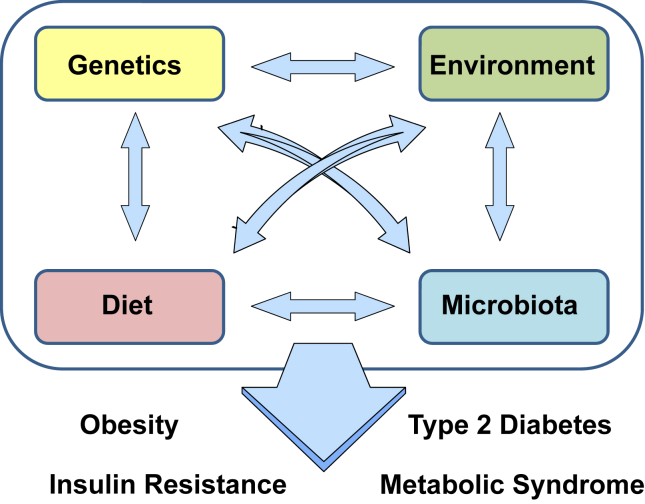
Obesity and its associated co-morbidities are the result of a complex interaction of host genetics, environment and gut micrbiota. The development of obesity, insulin resistance, type 2 diabetes and the metabolic syndrome in general are the consequence of a complex multidirectional interaction between host genetics, environment, diet and the gut microbiota.
Figure 4
Figure 4
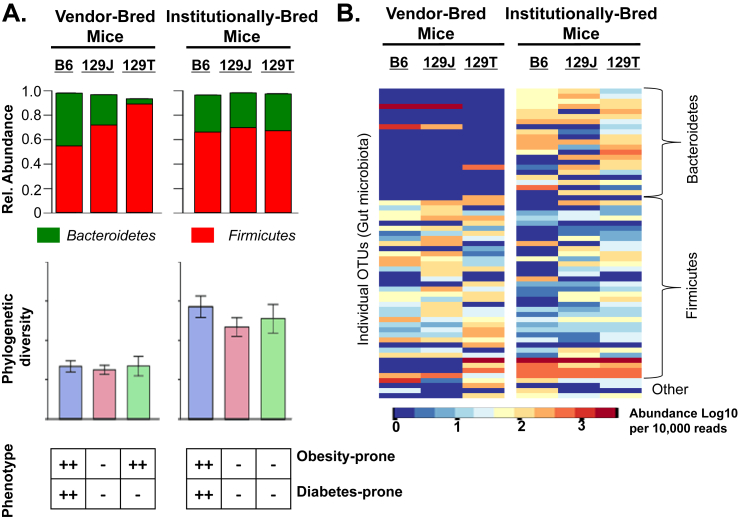
Host genetics and environment shape personalized microbiota. The impact of gut microbiota on host physiology depends on a complex interaction of host genetics, environment, diet. A) Scores such as phylogenetic diversity or ratio of Firmicutes to Bacteroidetes (F/B) may appear as robust metrics predicting metabolic fitness in a genetically homogenous population. However, in different genetic backgrounds similar diversity scores or F/B ratios can reflect very different microbial communities, with distinct impact on host metabolism. B) Assessment of individual taxa or operational taxonomic units (OTUs) can provide more insight into the true nature and diversity of gut microbiota.
Figure 5
Figure 5
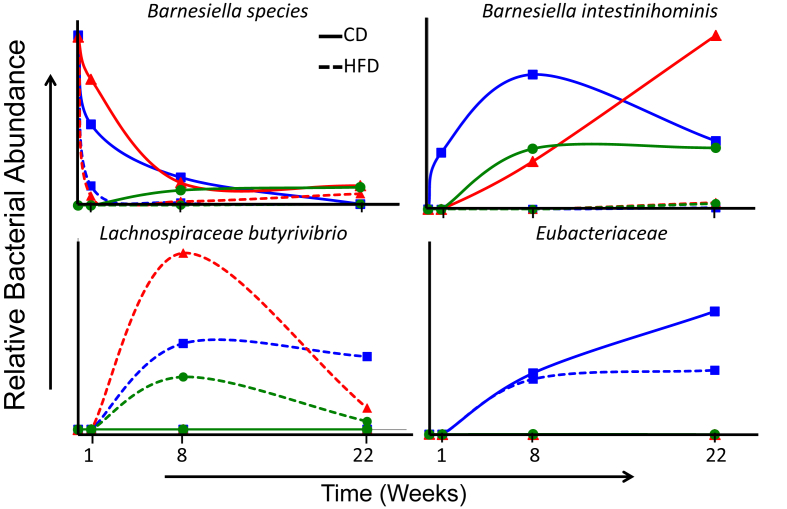
Dynamic nature of diet, host and microbiota interactions. Gut microbiota rapidly reconfigure with highly individual kinetics among taxa upon environmental changes such as different housing conditions or changes in diet. Some bacterial taxa such as the Barnesiella species illustrated in the upper left panel are present in the microbiota of one specific vendor versus another [compare B6J (blue line) and 129J (red line) from Jackson to 129T (green line) from Taconic Farms]. In this example, this microbial species in the two Jackson-bred strains is rapidly lost in the new environment, but the rate of loss depends on the diet with faster kinetics upon high fat diet feeding versus chow diet (dashed versus solid lines). Other bacterial taxa such as Barnesiella intestinihominis or Lachnospiraceae Butyrivibrio are absent from all the vendor bred mice, but rapidly colonize the gut upon introduction into a common new environment. In the case of B. intestinihominis (upper right panel) the microbe only colonizes in the chow diet fed group, whereas with Lachnospiraceae Butyrivibrio (lower left panel) colonization occurs only in the HFD fed group. Some taxa, such as a specific OTU of the Eubacteriaceae (lower right panel) colonize the gut upon introduction into a new environment independent of type of the diet, but specific to a single genetic background, in this case B6J. Thus, the association of certain groups of microbiota with specific host phenotypes is the result of a complex interaction of host genetics and various environmental factors at a specific time.

References

    1. Kelly C.R., Kahn S., Kashyap P., Laine L., Rubin D., Atreja A. Update on fecal microbiota transplantation 2015: indications, methodologies, mechanisms, and outlook. Gastroenterology. 2015;149:223–237. - PMC - PubMed
    1. Qin J., Li R., Raes J., Arumugam M., Burgdorf K.S., Manichanh C. A human gut microbial gene catalogue established by metagenomic sequencing. Nature. 2010;464:59–65. - PMC - PubMed
    1. Tremaroli V., Backhed F. Functional interactions between the gut microbiota and host metabolism. Nature. 2012;489:242–249. - PubMed
    1. Kelly C.J., Zheng L., Campbell E.L., Saeedi B., Scholz C.C., Bayless A.J. Crosstalk between microbiota-derived short-chain fatty acids and intestinal epithelial HIF augments tissue barrier function. Cell Host Microbe. 2015;17:662–671. - PMC - PubMed
    1. Perry R.J., Peng L., Barry N.A., Cline G.W., Zhang D., Cardone R.L. Acetate mediates a microbiome–brain–beta-cell axis to promote metabolic syndrome. Nature. 2016;534:213–217. - PMC - PubMed

LinkOut - more resources