. 2016 Nov;26(11):1826-1835.
doi: 10.1016/j.euroneuro.2016.08.014. Epub 2016 Sep 9.

Inactivation of the melanin concentrating hormone system impairs maternal behavior

Affiliations

Inactivation of the melanin concentrating hormone system impairs maternal behavior

Amal Alachkar et al. Eur Neuropsychopharmacol. 2016 Nov.

Abstract

In order to prepare the mother for the demands of pregnancy and lactation, the maternal brain is subjected to a number of adaptations. Maternal behaviors are regulated by complex neuronal interactions. Here, we show that the melanin concentrating hormone (MCH) system is an important regulator of maternal behaviors. First, we report that melanin concentrating hormone receptor 1 knockout (MCHR1 KO) mice display a disruption of maternal behavior. Early postpartum MCHR1 KO females exhibit poor nesting, deficits in pup retrieval and maternal aggression. In addition, ablation of MCH receptors results in decreased milk production and prolactin mRNA levels. Then we show that these results are in line with those obtained in wild type mice (WT) treated with the specific MCHR1 antagonist GW803430. Furthermore, following pups retrieval, MCHR1 KO mice display a lower level of Fos expression than WT mice in the ventral tegmental area, and nucleus accumbens. With the progression of the lactation period, however, the MCHR1 KO mice improve maternal care towards their pups. This is manifested by an increase in the pups׳ survival rate and the decrease in pups׳ retrieval time beyond the second day after parturition. In conclusion, we show that the MCH system plays a significant role in the initiation of maternal behavior. In this context, MCH may play a role in integrating information from multiple sources, and connecting brain reward, homeostatic and regulatory systems.

Keywords: Antagonist; Knockout; Maternal behavior; Melanin concentrating hormone; Mice.


Conflict of interest statement

Conflict of interest

None.

Figures

Figure 1
Figure 1
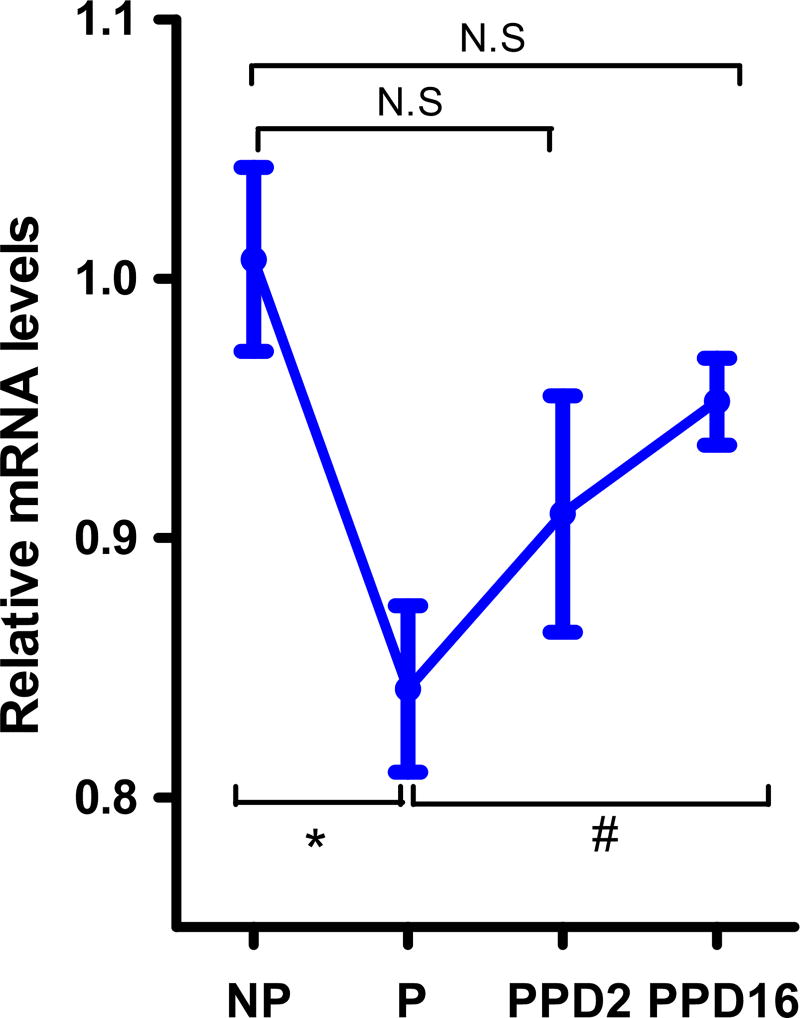
Hypothalamic mRNA levels of MCH by qt-PCR in non-pregnant (NP), pregnant (P), and postpartum (PPD2 and PPD16) female WT mice (n = 3–4). One way ANOVA followed by Tukey posthoc test, F3,14 = 15.69, P vs. NP, *P < 0.05; P vs. PPD16, # P < 0.05.
Figure 2
Figure 2
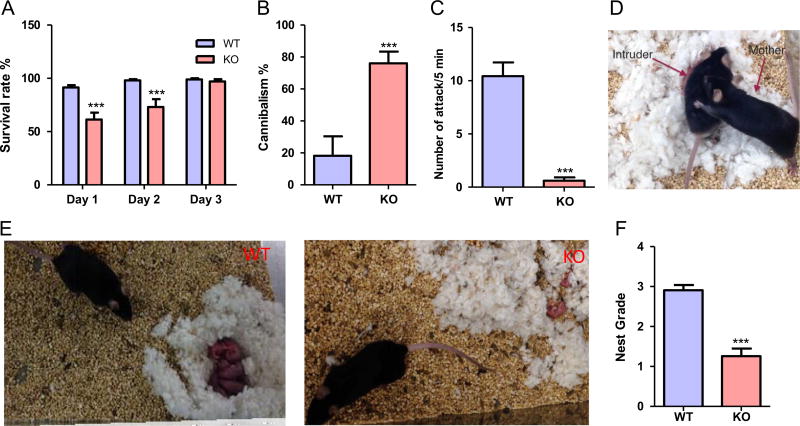
MCHR1 ablation affects several aspects of maternal behaviors. (A) Survival rates in the progeny of WT and MCHR1 KO mice (n = 19–22). Two way ANOVA followed by Bonferroni post-hoc test (F1,111 = 27.83, P < 0.001): WT vs. KO, PPD1: ***P < 0.001, PPD2: ***P < 0.001, PPD3: P > 0.05. (B) Cannibalism rates in the progeny of WT and MCHR1 KO mice as a percentage of the mortalities (n = 19–22). Unpaired t-test (t = 4.3): WT vs. KO, ***P < 0.001. (C) Number of attacks by WT and MCHR1 KO females of male intruder mice (n = 23). Unpaired t-test (t = 7.4): WT vs. KO, ***P < 0.001. (D) Representative graph of maternal aggression in the WT female mice on PPD7. (E) Representative graph of the nest build by WT (left panel) and MCHR1 KO (right panel) mice. (F) The score of the nesting quality of WT and MCHR1 KO mice (n = 22–24). Unpaired t-test (t = 6.8): WT vs. KO, ***P < 0.001.
Figure 3
Figure 3
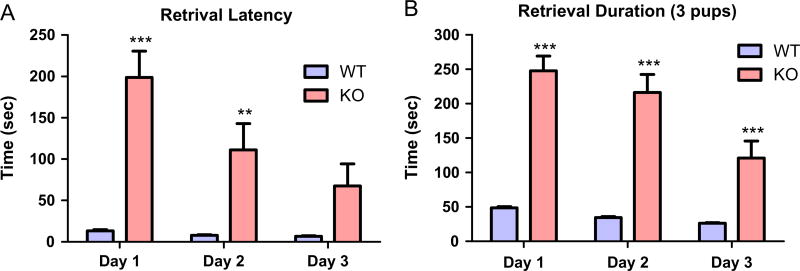
Effect of MCHR1 genetic ablation on pups’ retrieval in postpartum female mice. (A) The retrieval latency of WT and MCHR1 KO female mice (n = 19–20). Two way ANOVA followed by followed by Bonferroni post-hoc test (F1,111 = 42.6, P < 0.001): WT vs. KO, PPD1: ***P < 0.001, PPD2: **P < 0.01, PPD3: P > 0.05. (B) The retrieval duration of WT and MCHR1 KO female mice (n = 19–20). Two way ANOVA followed by Bonferroni post-hoc test (F1,111 = 129, P < 0.001): WT vs. KO, PPD1: ***P < 0.001, PPD2: ***P < 0.001, PPD3: ***P < 0.001.
Figure 4
Figure 4
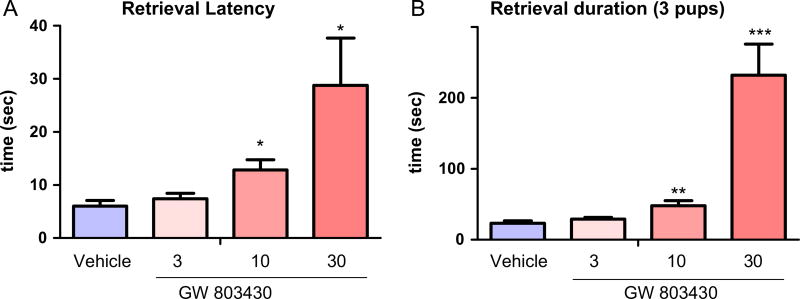
Effect of MCHR1 antagonist GW803430 on pups’ retrieval in postpartum female mice. (A) The dose response of MCHR1 antagonist GW803430 in the retrieval latency (n = 5–6). One way ANOVA followed by Dunnett's test, (F3,19 = 5.14): vehicle vs. drug, **P < 0.01, ***P < 0.001. (B) The dose response of MCHR1 antagonist GW803430 in the retrieval duration (n = 5–6). One way ANOVA followed by Dunnett's test (F3,19 = 16.1): vehicle vs. drug, *P < 0.05.
Figure 5
Figure 5
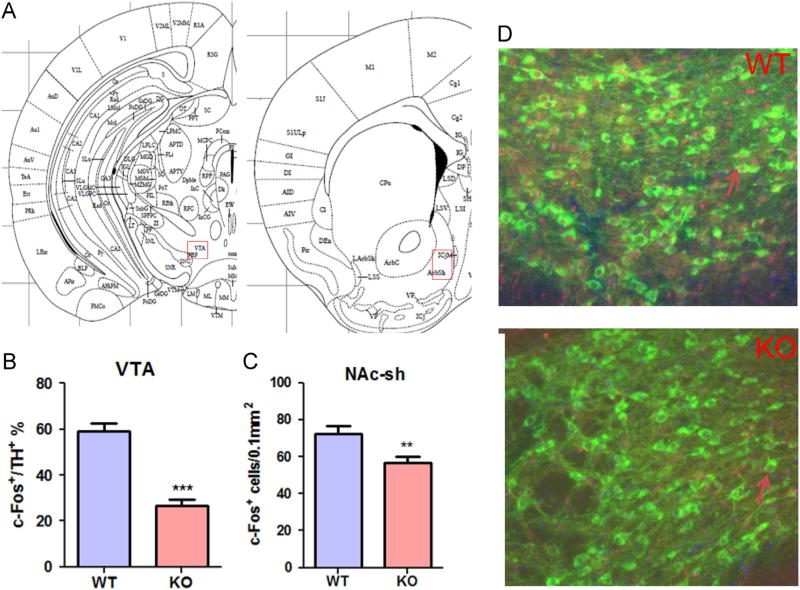
Fos-ir- neurons following pups retrieval test on PPD2. (A) Histological locations of the mice brain analyzed for Fos-like immunoreactivity. VTA: Ventral Tegmental Area, NAc-sh: Nucleus accumbens shell. (B) The ratio of the Fos positive cell numbers to the TH-positive cell numbers in the VTA in PPD2 WT and MCHR1 KO mice (n = 3). Unpaired t-test (t = 5.1): WT vs. KO, ***P < 0.001. (C) Numbers of Fos positive cells in the NAc-sh (C) following pups’ retrieval test on PPD2 in WT and MCHR1 KO mice (n = 3). Unpaired t-test (NAc-sh: t = 2.8): WT vs. KO, **P < 0.01. (D) Representative micrograph of the immunoreactivity for both Fos (red) and TH (green) in the VTA in PPD2 WT and MCHR1 KO mice. Arrows indicate representative cells immunoreactive for both Fos and TH. (For interpretation of the references to color in this figure legend, the reader is referred to the web version of this article.)
Figure 6
Figure 6
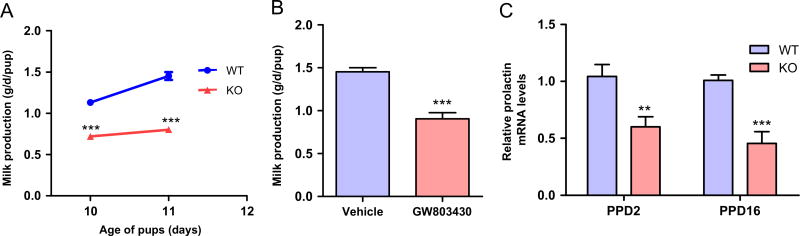
Effect of inactivation of MCHR1 on Milk production and pituitary prolactin mRNA in postpartum female WT and MCHR1 KO mice. (A) The milk production of WT and MCHR1 KO mice (n = 5–6) on PPD10 and PPD12. Two way ANOVA followed by Bonferroni post-hoc test (F1,18 = 285.4, P < 0.001): WT vs. KO, PPD10: ***P < 0.001, PPD11: ***P < 0.001. (B) The effect of GW803430 (30 mg/kg) on the milk production of WT mice on PPD11 (n = 5). Unpaired t-test (t = 6.3): vehicle vs. GW803430, ***P < 0.001. (C) The relative prolactin mRNA levels in the pituitary of WT and MCHR1 KO mice on PPD2 and PPD16 measured by qtPCR (n = 3). Unpaired t-test (PPD2: t = 3.2; PPD16: t = 5.1): WT vs. KO, **P < 0.01, ***P < 0.001.

References

    1. Adams AC, Domouzoglou EM, Chee MJ, Segal-Lieberman G, Pissios P, Maratos-Flier E. Ablation of the hypothalamic neuropeptide melanin concentrating hormone is associated with behavioral abnormalities that reflect impaired olfactory integration. Behav. Brain Res. 2011;224(1):195–200. - PMC - PubMed
    1. Alachkar A, Jiang D, Harrison M, Zhou Y, Chen G, Mao Y. An EJC factor RBM8a regulates anxiety behaviors. Curr. Mol. Med. 2013;13(6):887–899. - PubMed
    1. Benedetto L, Pereira M, Ferreira A, Torterolo P. Melanin-concentrating hormone in the medial preoptic area reduces active components of maternal behavior in rats. Peptides. 2014;58:20–25. - PubMed
    1. Bittencourt JC, Presse F, Arias C, Peto C, Vaughan J, Nahon JL, et al. The melanin-concentrating hormone system of the rat brain: an immuno- and hybridization histochemical characterization. J. Comp. Neurol. 1992;319(2):218–245. - PubMed
    1. Blouin AM, Siegel JM. Relation of melanin concentrating hormone levels to sleep, emotion and hypocretin levels. Sleep. 2013;36(12):1777. - PMC - PubMed

Substances