


Respiratory toxicity and immunotoxicity evaluations of microparticle and nanoparticle C60 fullerene aggregates in mice and rats following nose-only inhalation for 13 weeks
- PMID: 27618498
- PMCID: PMC5215911
- DOI: 10.1080/17435390.2016.1235737
Respiratory toxicity and immunotoxicity evaluations of microparticle and nanoparticle C60 fullerene aggregates in mice and rats following nose-only inhalation for 13 weeks
Abstract
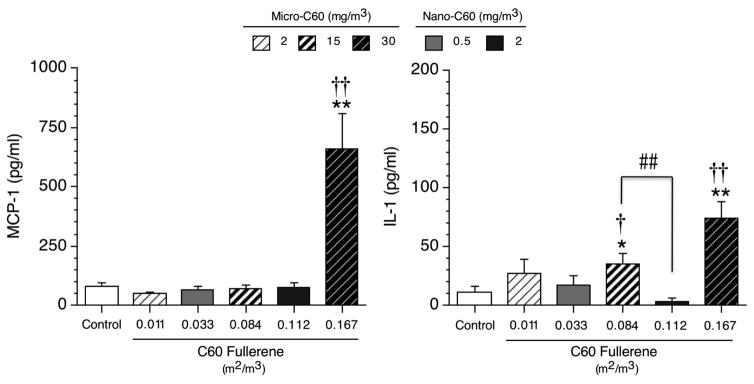
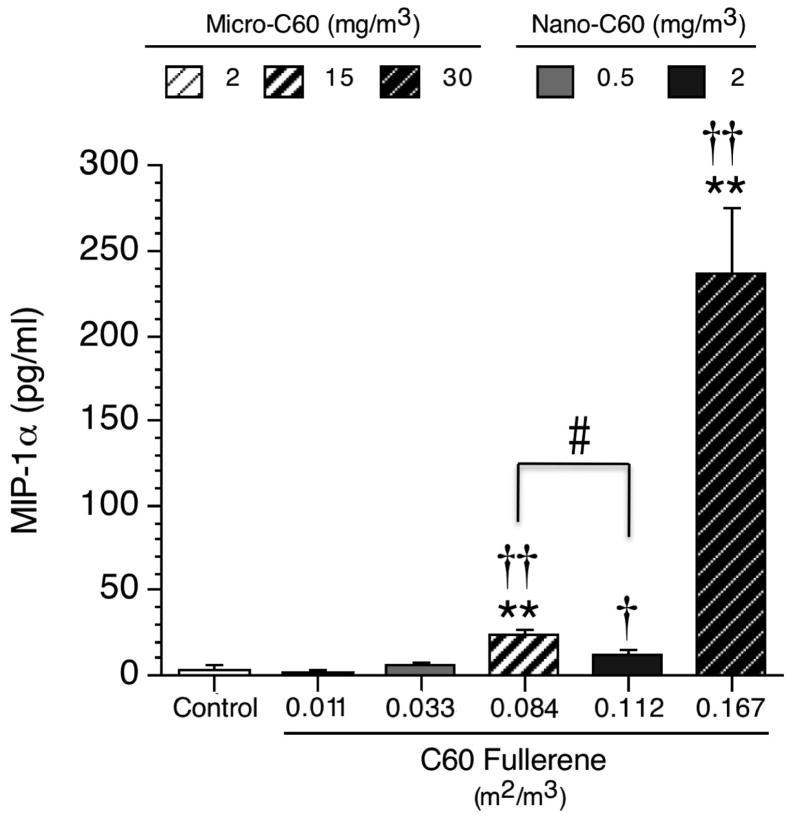
C60 fullerene (C60), or buckminsterfullerene, is a spherical arrangement of 60 carbon atoms, having a diameter of approximately 1 nm, and is produced naturally as a by-product of combustion. Due to its small size, C60 has attracted much attention for use in a variety of applications; however, insufficient information is available regarding its toxicological effects. The effects on respiratory toxicity and immunotoxicity of C60 aggregates (50 nm [nano-C60] and 1 μm [micro-C60] diameter) were examined in B6C3F1/N mice and Wistar Han rats after nose-only inhalation for 13 weeks. Exposure concentrations were selected to allow for data evaluations using both mass-based and particle surface area-based exposure metrics. Nano-C60 exposure levels selected were 0.5 and 2 mg/m3 (0.033 and 0.112 m2/m3), while micro-C60 exposures were 2, 15 and 30 mg/m3 (0.011, 0.084 and 0.167 m2/m3). There were no systemic effects on innate, cell-mediated, or humoral immune function. Pulmonary inflammatory responses (histiocytic infiltration, macrophage pigmentation, chronic inflammation) were concentration-dependent and corresponded to increases in monocyte chemoattractant protein (MCP)-1 (rats) and macrophage inflammatory protein (MIP)-1α (mice) in bronchoalveolar lavage (BAL) fluid. Lung overload may have contributed to the pulmonary inflammatory responses observed following nano-C60 exposure at 2 mg/m3 and micro-C60 exposure at 30 mg/m3. Phenotype shifts in cells recovered from the BAL were also observed in all C60-exposed rats, regardless of the level of exposure. Overall, more severe pulmonary effects were observed for nano-C60 than for micro-C60 for mass-based exposure comparisons. However, for surface-area-based exposures, more severe pulmonary effects were observed for micro-C60 than for nano-C60, highlighting the importance of dosimetry when evaluating toxicity between nano- and microparticles.
Keywords: Buckminsterfullerene; immunotoxicity; inhalation; nanoparticles; pulmonary inflammation.
Conflict of interest statement
Declaration of Interest This work was supported [in part] by the Intramural Research Program of the National Institutes of Health (NIH), National Institute of Environmental Health Sciences (NIEHS) and by NTP Contracts N01-ES-55538 and N01-ES-5553.
Figures
References
-
- Akila P, Prashant V, Suma MN, Prashant SN, Chaitra TR. CD163 and its expanding functional repertoire. Clin Chim Acta. 2012;413:669–674. - PubMed
-
- Auttachoat W, Germolec DR, Collins BJ, Luebke RW, White KL, Jr, Guo TL. Immunotoxicological profile of chloroform in female B6C3F1 mice when administered in drinking water. Drug Chem Toxicol. 2009;32:77–87. - PubMed
-
- Baker GL, Gupta A, Clark ML, Valenzuela BR, Staska LM, Harbo SJ, Pierce JT, Dill JA. Inhalation toxicity and lung toxicokinetics of C60 fullerene nanoparticles and microparticles. Toxicol Sci. 2008;101:122–131. - PubMed
-
- Balbus JM, Maynard AD, Colvin VL, Castranova V, Daston GP, Denison RA, Dreher KL, Goering PL, Goldberg AM, Kulinowski KM, Monteiro-Riviere NA, Oberdorster G, Omenn GS, Pinkerton KE, Ramos KS, Rest KM, Sass JB, Silbergeld EK, Wong BA. Meeting report: hazard assessment for nanoparticles--report from an interdisciplinary workshop. Environ Health Perspect. 2007;115:1654–1659. - PMC - PubMed
-
- Baran CP, Opalek JM, McMaken S, Newland CA, O’Brien JM, Hunter MG, Bringardner BD, Monick MM, Brigstock DR, Stromberg PC, Hunninghake GW, Marsh CB. Important roles for macrophage colony-stimulating factor, CC chemokine ligand 2, and mononuclear phagocytes in the pathogenesis of pulmonary fibrosis. Am J Respir Crit Care Med. 2007;176:78–89. - PMC - PubMed
MeSH terms
Substances
Grants and funding
LinkOut - more resources
Full Text Sources
Other Literature Sources
Medical
Miscellaneous
