. 2017 Feb;16(1):73-81.
doi: 10.1111/acel.12527. Epub 2016 Sep 13.

Caloric restriction increases brain mitochondrial calcium retention capacity and protects against excitotoxicity

Affiliations

Caloric restriction increases brain mitochondrial calcium retention capacity and protects against excitotoxicity

Ignacio Amigo et al. Aging Cell. 2017 Feb.

Abstract

Caloric restriction (CR) protects against many cerebral pathological conditions that are associated with excitotoxic damage and calcium overload, although the mechanisms are still poorly understood. Here we show that CR strongly protects against excitotoxic insults in vitro and in vivo in a manner associated with significant changes in mitochondrial function. CR increases electron transport chain activity, enhances antioxidant defenses, and favors mitochondrial calcium retention capacity in the brain. These changes are accompanied by a decrease in cyclophilin D activity and acetylation and an increase in Sirt3 expression. This suggests that Sirt3-mediated deacetylation and inhibition of cyclophilin D in CR promote the inhibition of mitochondrial permeability transition, resulting in enhanced mitochondrial calcium retention. Altogether, our results indicate that enhanced mitochondrial calcium retention capacity underlies the beneficial effects of CR against excitotoxic conditions. This protection may explain the many beneficial effects of CR in the aging brain.

Keywords: aging; brain; calcium; caloric restriction; mitochondria.


Figures

Figure 1
Figure 1
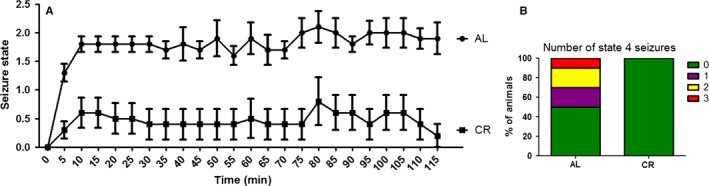
Caloric restriction protects against in vivo excitotoxicity. (A) Time course of seizure appearance in AL and CR animals after 25 mg kg−1 kainic acid i.p. injection. (B) Number of state 4 seizures measured using Racine's scale. Results are shown as mean ± SEM.
Figure 2
Figure 2
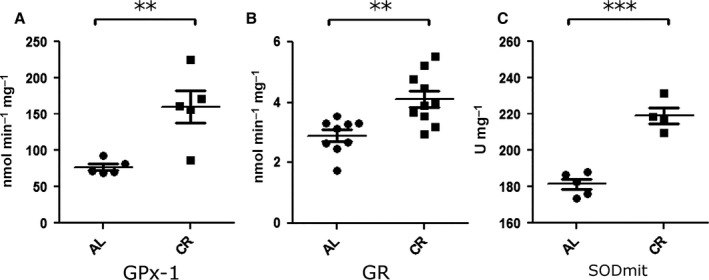
Antioxidant activity is higher in brains from CR animals. The activity of antioxidant enzymes was assayed in whole‐brain homogenates (A, B) or mitochondrial fractions (C). (A) Enzymatic activity of glutathione peroxidase (Gpx‐1). (B) Enzymatic activity of glutathione reductase (GR). (C) Enzymatic activity of superoxide dismutase in mitochondrial fractions (SOD mit). Results are shown as mean ± SEM. **P < 0.01; ***P < 0.001 two‐tailed, unpaired Student's t‐test.
Figure 3
Figure 3
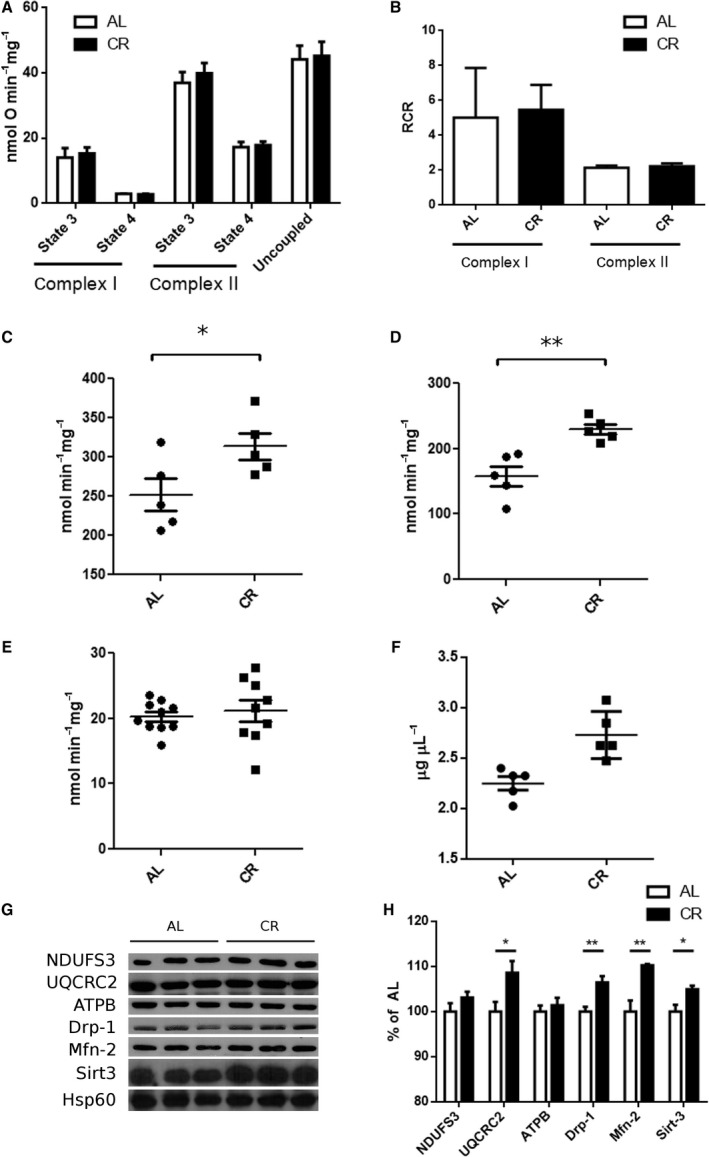
CR induces mitochondrial changes in the brain. (A) Oxygen consumption in isolated brain mitochondria. Rates are shown in the presence (state 3) and absence (state 4) of ADP, both with substrates of complex I and complex II. Uncoupled rates were determined after addition of CCCP. (B) Respiratory control rates determined as the ratio state 3/state 4. (C) Enzymatic activity of complex I + III in mitochondrial samples. (D) Enzymatic activity of complex IV in mitochondrial samples. (E) Citrate synthase activity in whole‐brain homogenates. (F) Cardiolipin determination in whole‐brain homogenates. (G) Western blot of mitochondrial samples using antibodies against different mitochondrial proteins: NDUFS3 (complex I), UQCRC2 (complex III), ATPB (complex V), Drp‐1, Mfn‐2, Sirt3, and Hsp60. (H) Quantification of bands from G using Hsp60 as loading control. Results of CR samples are shown as percentage of AL samples. Results are shown as mean ± SEM. *P < 0.05 two‐tailed, **P < 0.01, two‐tailed unpaired Student's t‐test.
Figure 4
Figure 4
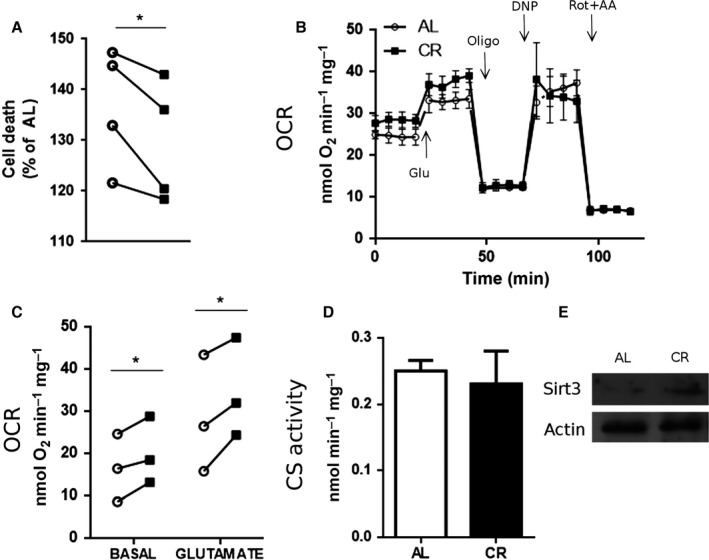
Serum from CR animals protects against excitotoxicity and increases mitochondrial respiration in vitro. Cerebellar granule neurons were treated for 24 h with either AL (white bars/symbols) or CR serum (black bars/symbols) and their bioenergetic properties studied. Metabolic parameters were determined as indicated in the Experimental procedures section. (A) Cell death after glutamate challenge. (B) Typical experiment measuring oxygen consumption rates (OCR) using the Seahorse XF Analyzer. Drugs were injected at indicated time points. (C) OCR quantification under basal conditions and after glutamate stimulation. (D) Citrate synthase activity. (E) Western blot for Sirt3 using actin as loading control. Results are shown as mean ± SEM. *P < 0.05 two‐tailed, paired Student's t‐test.
Figure 5
Figure 5
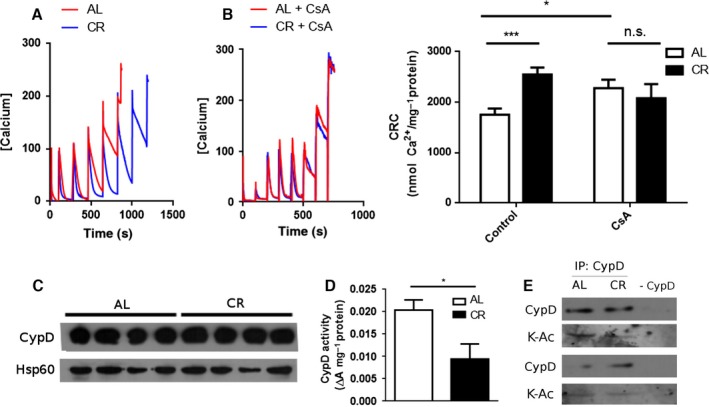
Calcium retention capacity is increased in brains from CR animals. Calcium uptake in brain mitochondria from AL or CR animals was monitored using Calcium Green‐5N as described in Experimental procedures. (A) Representative traces. Each peak corresponds to a 100 μm calcium addition. (B) Representative traces in the presence of 5 μm cyclosporin A (CsA). (C) Quantification of calcium retention capacity (CRC). (D) Western blot against cyclophilin D (CypD) using Hsp60 as loading control. (E) Peptidyl prolyl isomerase activity from brain AL or CR mitochondrial fractions. (F) Immunoprecipitation of mitochondrial samples from AL and CR brains with anti‐CypD antibody and blotting using anti‐CypD and anti‐acetylated lysine antibodies. The negative control (‐ CypD) was performed without anti‐CypD. Results are shown as mean ± SEM. *P < 0.05; ***P < 0.001 two‐tailed, unpaired Student's t‐test.

References

    1. Amigo I, Kowaltowski AJ (2014) Dietary restriction in cerebral bioenergetics and redox state. Redox. Biol. 2, 293–304. - PMC - PubMed
    1. Basso E, Fante L, Fowlkes J, Petronilli V, Forte MA, Bernardi P (2005) Properties of the permeability transition pore in mitochondria devoid of cyclophilin D. J. Biol. Chem. 280, 18558–18561. - PubMed
    1. Bochaton T, Crola‐Da‐Silva C, Pillot B, Villedieu C, Ferreras L, Alam MR, Thibault H, Strina M, Gharib A, Ovize M, Baetz D (2015) Inhibition of myocardial reperfusion injury by ischemic postconditioning requires sirtuin 3‐mediated deacetylation of cyclophilin D. J. Mol. Cell. Cardiol. 84, 61–69. - PubMed
    1. Brand MD, Nicholls DG (2011) Assessing mitochondrial dysfunction in cells. Biochem J. 435, 297–312. - PMC - PubMed
    1. Bruce‐Keller AJ, Umberger G, McFall R, Mattson MP (1999) Food restriction reduces brain damage and improves behavioral outcome following excitotoxic and metabolic insults. Ann. Neurol. 45, 8–15. - PubMed

LinkOut - more resources